

Blog

8 First Day of Class Activities to Start Building Classroom Rapport Right Away

Although many kiddos are already back in school, most colleges are gearing up for a spring semester start next week. In honor of a brand new year of academics, and for many, a nerve-wracking first day, I wanted to share some strategies for building classroom rapport right away. After all, the first day - notoriously “syllabus day” - is all about building community!
I have collected these strategies and have used them personally in one form or another. Some I thought of myself, and as with most things in teaching, some were borrowed from my generous (and awesome) teacher friends who have shared with me.

Index Card for Questions
(function(m,a,i,l,e,r){ m['MailerLiteObject']=e;function f(){var c= ;var r=this.push(c);return "number"!=typeof r?r:f.bind(c.q);}f.q=f.q||[];m[e]=m[e]||f.bind(f.q);m[e].q=m[e].q||f.q;r=a.createElement(i);var _=a.getElementsByTagName(i)[0];r.async=1;r.src=l+'?v'+(~~(new Date().getTime()/1000000));_.parentNode.insertBefore(r,_);})(window, document, 'script', 'https://static.mailerlite.com/js/universal.js', 'ml');var ml_account = ml('accounts', '1604460', 'h2k3s9j4m7', 'load');
Materials
3” x 5” white or colored index cards (1 per student)
Preparation
Nothing (except don’t forget to bring them to class!)
Even extroverted students can be unsure or shy in front of a new group of people.
How to Use
Before class begins, hand out an index card to each student. Explain that everyone is new to each other and may not yet be comfortable asking questions in class, so they are free to write down any question(s) with their name or anonymously. All questions will be answered at the beginning of the next class.
Reasoning
It’s the first day, and sometimes even extroverted students can be unsure or shy in front of a new group of people. Having an index card and the option for anonymity gives them a way to ask questions without having to speak in front of the class.

First Day Surveys
Materials
Printed surveys (1 per student)
Preparation
Create the surveys with whatever focuses you want to learn about from your students’ perspective. I focus on their feelings and experiences with writing, as well as their confidence levels with those things, but if you’re more interested in other aspects, change it up! It’s all about interacting on a personal level.
Print the surveys.
How to Use
I typically take attendance with an interesting ice breaker first, and then hand out the surveys. The surveys are 6 questions, with space at the top for their preferred name and major. I ask them:
How they feel about writing
How confident they are
What their process is
Something they struggle with
Something they want to learn about in our class
If there is anything else I should know about as their instructor
This leaves room for things like learning disabilities, shy learners, and learners who are coming back to school after 20 years in the workforce.
It helps me gauge where they are at and how they’re feeling without a “quiz” or some sort of initial ungraded writing assignment.
I encourage them to be as thoughtful and detailed as they can, because the more I learn the more I can help and gear our class towards where they are starting. If your questions are different, that’s perfectly fine!
I would highly recommend keeping them to one side of a piece of paper, though. Anything longer will feel like an assessment, which is what I am avoiding with this survey. I’ve even done a half sheet version with about 3 questions.
Reasoning
I’ve done first day surveys every semester since I started teaching, and I love them! I don’t know the students yet, and they don’t know me, so I like to find out a little more about them on their terms.
My questions are really open to whatever students want to tell me. It helps me gauge where they are at and how they’re feeling without a “quiz” or some sort of initial ungraded writing assignment. It also helps me learn a little more about their personalities by how they answer the questions.
Get the Survey!

Meet Your Neighbors
Materials
Nothing
Preparation
Be prepared for grimaces and sighs (this is usually the activity that gets the most resistance)! Otherwise, no materials necessary.
How to Use
Once we have done attendance and completed our surveys, I have students introduce themselves to at least 2 people near where they are sitting.
They must get each other’s name and a reliable form of contact information, then write it down or record it digitally.
I walk around and monitor students while they are exchanging information to make sure that they are reaching out to each other. Sometimes this requires prompting.
We do group work almost every day in my classes, and meeting two other students the first day begins the conversation.
Reasoning
We do group work almost every day in my classes, and meeting two other students the first day begins the conversation. Then when we work on things, at least those two people will be familiar.
They can generally work with these same neighbors throughout the semester, which gives them a chance to get more comfortable with sharing their writing and opinions with each other. It’s also important they have someone to reach out to if they miss class and need notes.

Commonalities With Your Neighbors
Materials
Blank paper (1 sheet per group)
Preparation
Nothing really; it’s a good idea to keep a creative mindset so when you visit the student groups you can help them figure out some categories or ideas if they’re stuck
How to Use
Once the students have met 2 neighbors, I task them with finding 3 things that all of them have in common. These things cannot be related to my class.
These kinds of interactions can build comfort because it’s easier to talk to someone you know you have things in common with.
I usually give an example, but not more than two because then the students will only ask each other about the examples I used. Ideas I pose are: pets, siblings, hobbies, and hometowns. Nothing polarizing or opinionated. Just the basics.
I collect the sheets (with all student names at the top) at the end of the activity.
Reasoning
We are all people first, with families and friends and pets. Getting to know someone a little bit makes them less of a stranger. These kinds of interactions can build comfort because it’s easier to talk to someone you know you have things in common with. It’s also a way to get them having a conversation, even if they are shyly offering very brief answers.

Identify Important Aspects of the Syllabus With Your Neighbors
Materials
Printed copy of the syllabus (1 hard copy per 2-3 students); Students can also pull up the syllabus digitally
Expo markers or Chalk (Depending on what kind of board you have in the classroom)
Preparation
Print out the syllabi
How to Use
By the time students have met and found a few things in common with their neighbors, they are ready to dig into some class material. Within the groups, I hand out one printed version of the syllabus and encourage them to log onto the class Canvas to view a digital copy, too.
Their goal is to identify the 5-7 pieces of information they think are most important for succeeding in this class.
Once they have identified the information, they delegate one person to go write it on the board.
Having students work with their neighbors to identify important items forces them to communicate with others and helps them to see what’s there.
When everyone has written their answers on the board, we go over the information they’ve chosen, the patterns that have appeared, and anything I feel is important that they did not list.
Note:I do my course calendars separate from the syllabus, so when I hand out the syllabus, this does not include the course calendar. If the course calendar is included in the same document, I would recommend telling the students they can’t use due dates as important information.
While it is important, I want them to look at things more holistically about what we are learning and doing in class, not when they have to have it done by. We go over the calendar separately in my classes.
Reasoning
Syllabus day can be dead boring. I’m sure we’ve all had the class where the teacher reads the whole thing to us. Heck, I’ve done that class before - it was boring as the teacher, too!
Having students work with their neighbors to identify important items forces them to communicate with others and helps them to see what’s there. They also have to figure out how to prioritize what’s important instead of me just telling them.

Syllabus Scavenger Hunt With Your Neighbors
Materials
Printed out worksheets (1 per student)
Printed copy of the syllabus & course calendar (1 hard copy per 2-3 students); Students can also pull up the syllabus digitally
Preparation
Decide what information you want the students to find & create the scavenger hunt. Print the scavenger hunt worksheets. syllabi, and course calendars.
How to Use
If you want to see each student’s thinking about the syllabus while still having them work in groups, this exercise is a good alternative to having them find the important aspects. This activity also allows you to be in control of what they are focusing on.
I have students work in groups to identify answers to the questions on the scavenger hunt, that way they are still getting conversation; however, if they prefer working individually, they can focus on their own work, too. The questions usually cover the front and back of one piece of paper.
It can also pretty easily be turned into a “game” with prizes, if you want to want to get some friendly competition going in the classroom.
I use a combination of closed and open-ended questions. They do things like fill in the blanks, find dates, and name objectives. I don’t include multiple choice or longer answer questions. I want them to be writing, but it is an in-class group activity, so nothing too extensive. The questions are not in the order of the syllabus, so students are looking through the documents more than once.
When I assign the scavenger hunt, I do include my course calendar, with a question or two about the first project so they are aware of what’s coming.
Note: I do my course calendars separate from the syllabus, so when I pass out documents for the activity, they have one printed copy of the syllabus and one copy of the course calendar per group. Both documents are accessible on our class Canvas, though, and I encourage them to find it and become familiar with it. We also follow this activity with a discussion of both the syllabus & course calendar.
Reasoning
I really enjoy the scavenger hunt activity because it gets the students working together and looking at the syllabus in a more creative and open ended way instead of just reading it through like an essay.
They also are interacting with the material, as well as each other, so it’s usually a win-win scenario. It can also pretty easily be turned into a “game” with prizes, if you want to want to get some friendly competition going in the classroom.

The Skittles Icebreaker Game
Materials
One fun sized packet or handful of Skittles or M & Ms per student
Napkins/Paper Towels/Something to hold the candy
Preparation
Decide a category for each color; Example: Blue Skittles are pets, Red Skittles are siblings
How to Use
This activity might be in lieu of an icebreaker question for attendance, or the Meet Your Neighbors activity.
Before students arrive, write the color categories on the board.
When you are ready to begin the activity, explain that you will be passing out candy, but before they can eat the candy, they will be sharing some information about themselves with the class. Alternatively, you could have them share in smaller groups, too, if it’s a large class.
It also gives students a chance to choose what they want to share rather than the teacher telling them.
Hand out the handful or fun-sized packet of candy after you have explained the instructions, and then ask for volunteers (I find this is usually a nicer way to begin than the top of the roster). If there aren’t any volunteers, you can begin calling on students.
If they are sharing in small groups, you can have them share a piece of information for each piece of candy.
If they are sharing with the class, I would instruct them to look at the categories and pick one candy of 3 colors to share information about - whatever colors they feel comfortable with.
That way, they don’t get overwhelmed by how much they have to share, and it also doesn’t take the whole class period to get through all the students.
Reasoning
Sometimes classes respond really well to icebreakers and have fun during attendance and sometimes they hate it and it’s like pulling teeth. Since most students love candy in class, this activity is a win.
Having predetermined categories also lessens the pressure of figuring out what to say when it’s their turn to speak in front of class, or even in small groups. It also gives students a chance to choose what they want to share rather than the teacher telling them.

Elevator Pitch Game
Materials
3” x 5” white or colored index cards (1 per student)
Preparation
Prepare your own 15 second elevator pitch (more personal than your “I’m your teacher” spiel)
How to Use
Explain that an elevator pitch is something students will be doing all their lives - at work and in school. It's a great skill to develop no matter where they are right now.
Give them about 5-7 minutes to identify 3 important things about themselves that they would tell a stranger when meeting for the first time. This doesn’t have to be school related, but can be if that’s what they feel is important.
They then need to turn those items into sentences they will use to introduce themselves. They must write the sentences down.
Having students create a very brief pitch allows them to think about what’s important about themselves that they want others to know right away.
Once everyone has their sentences, they have to give their pitch to at least 2 other students.
I remind them that it’s okay to be nervous, and since they wrote down their sentences, they can read them to the other person if they are afraid. But, they still have to talk to 2 other people in some fashion.
I collect the pitches at the end of the activity.
Note: I usually use this activity with small classes of about 12 people or less; however, it could easily be used in a bigger class! I like this for my linked courses, which run concurrently with the standard English 111 course.
So when I do the activity, the students will have already done community-building activities with each other. They have to give their pitch to 2 students who they did not meet in English 111.
Reasoning
Being able to present yourself to others is important. Having students create a very brief pitch allows them to think about what’s important about themselves that they want others to know right away. It also helps me and their peers get to know them a little bit.
What do you do on the first day of class? Have you tried anything that’s worked really well? I’d love to hear about it! Drop a comment below or email me at rachel@capturingyourconfidence.com!

How to Set & Reach Achievable Goals

Happy New Year!
I always love the feeling of the first few days of January because it seems like a fresh start. No matter what last year held, good or bad, this is a new year to do with what you want.
With the excitement can come pressure, though. It is a brand new year, so if we’ve been waiting to make changes, now is the time! We want to get on them quickly before they become last year’s news.
We talk a lot about New Year’s “Resolutions” - you know the ones: those often unrealistic goals we set for ourselves, like going to the gym 5 days a week and drinking nothing but water so we can get down to our goal weight by bikini season.
No matter what last year held, good or bad, this is a new year to do with what you want.
I have set these types of resolutions, and began with fervor and good intentions, only to be sadly disappointed and rife with burnout by the middle of February. Eventually the burnout takes over, and I once again succumb to old habits.
It feels awful. Like it’s only the second month of the year and already I’ve failed myself.
Has this happened to you before?
There are a few problems with “Resolutions”:
We only set them once per year In the spirit of beginning a whole new year, we set these resolutions for ourselves; but, after the newness has worn off, the reality is that time still passes the same way. There are still 12 months, 28-31 days per month, etc. Once we get back into a familiar pattern, we don’t seem to revisit our resolutions, though. It’s like the shirt you needed at the store... that you’ve never worn and is now forgotten at the back of the closet.

We tend to go too hard too fast Because we’re excited, we jump right into our resolutions! Weight loss and health goals are very popular, as is reading more. In the first few weeks of the year, maybe even the entire month of January, we diligently pursue our resolutions. Maybe we see progress, maybe not. Since we were so ready, we set a pace we can’t maintain for the rest of the year. We sometimes forget we will eventually need to slow down, or at least rest once in awhile.
We think of road bumps as failures Probably one of the biggest problems is that when we jumped in and worked our butts off on on our resolutions for weeks, we didn’t see as many results as we thought or wanted. We might think since we didn’t lose 5 pounds after extreme dieting and exercise that our New Year’s resolution to get “bikini ready” will never succeed - might as well give up. But it takes awhile to build new habits and see results, whether the resolution is physical or not. We shouldn’t give up, but we probably do need to take a day of rest and recuperation.
So How Do I Make Progress if I Don’t Do New Years’ Resolutions?
If you’re like me, you’re probably wondering what the heck to do with this information. Perhaps you never thought of forgotten New Years’ resolutions as a problem. Perhaps, in your experience, they haven’t been.
The main issue I have with resolutions is the word itself, and the idea that they are set in stone without flexibility.
The main issue I have with resolutions is the word itself, and the idea that they are set in stone without flexibility. I might think I know what the year will hold, but then June hits and something completely off the wall happens that I never could have expected. Resolution, by the nature of the definition, seems too stern to me, and doesn’t allow room to change when that crazy event happens.

So, rather than setting resolutions, I set yearly goals. Because I get a renewed energy in January, it’s the perfect time to plan how to best get to my dreams. And I have big dreams! So I need big goals.
Goals don’t have those connotations, though. Goals imply I am making an effort to achieve a purpose. If that event happens and I need to shift my resources or adjust the end plan, goals allow for that growth. If I am adjusting my goals, it also means that I am monitoring and working toward them rather than letting them sit in the back of my mind with no thought or progress.
I’ve been setting annual goals for several years now, and I find it a very effective tool. They started small-ish and very specific: things like “Lose 10 pounds by my birthday” (My birthday is in mid-April). I found these types of goals to be limiting, though, because what would I do after the 10 pounds? Probably set another goal - but then should I have just set a bigger goal to begin with?
I also found myself focusing too much on numbers and achievements (one of my strengths is Achiever, so this makes a lot of sense for me) rather than growth. This mindset came mostly from my time in school where “x” number of achievements makes up a diploma with a good GPA. Achievement or statistic based goals leave out the concept of well-rounded growth, though. You can’t measure being a better wife or dog-mom with numbers and statistics, you know?
We are not our grades, just like we are not our job titles or pay grades.
So I started thinking more big picture. I teach the growth mindset in my classes, and I wish I had implemented it in my life sooner. The basic idea is that with effort and hard work, we can grow our skills, even if we don’t have “natural talent” for something. We are not our grades, just like we are not our job titles or pay grades. This concept makes it possible to work on goals like being a more supportive friend because we can then think about listening and empathy skills.
I set my goals to encompass the important aspects of my life. Not just health and wellness, but my interests, dreams, and relationships, too. I want them to be diverse and inclusive because that will make more of a long-term impact than losing 10 pounds by my birthday.
You should try annual goals! They are a great way to make progress.

What Do Good Goals Look Like?
When you do set annual goals, there are a couple of details to consider. They are open to however you want and/or need to grow, but being vague or setting goals that you don’t really know what they mean aren’t going to help you much because you’re not going to remember what you were thinking. On top of that, how will you measure if you are making progress on that vague idea?
Start: Be a better person.
For example: Be a better person.
That’s an admirable goal! But it needs some work to be good and achievable.
Focused Good goals have a focus that you can actively take steps toward. In the example above, how would I know if I’m becoming a better person if that’s the only thing I wrote down? I wouldn’t, because it’s not focused.
Before I start working on this goal, I need to figure out what “better” means. Do I need to work on listening? Do I need to work on being more empathetic? Once I’ve figured that out, I can focus more on what I can do to be better.
Focus: I want to listen more to be a better friend.
Something like: I want to listen more to be a better friend.
Achievable Once my idea is focused, I need to make sure I can actually do something concrete and take action towards it. Listening is something I can practice, but how do I do that? How do I start taking those steps? Adding more specificity to our goals helps us make them more achievable.
Make Achievable: I want to practice active listening with my friends more so that I can better support them and be a good friend.
One way to make this example more achievable might be: I want to practice active listening with my friends more so that I can better support them and be a good friend.
Have Set Parameters When we have focused and achievable goals, we are almost ready to start working on them! After all, we know we can achieve them with some hard work and determination, right? The last step to setting a good goal is to make sure you have a way to measure it. How will you know if you’re making progress if you don’t know what progress actually is? You won’t. So build that in to your goal.
Set Parameters: I want to practice active listening with my friends more so that I can better support them and be a good friend. To do this, I will be accountable to them by asking how I am doing once per month and practicing the same skills with my family.
My goal is: I want to practice active listening with my friends more so that I can better support them and be a good friend. To do this, I will be accountable to them by asking how I am doing once per month and practicing the same skills with my family.
The parameters here are to involve the friends, which means that there will be accountability and dialog (hopefully) about progress, and to practice with family, too. Practicing more and getting additional feedback will create more opportunities to improve.
Challenges You A big part of setting goals is to make sure to challenge yourself. This is not to say make the goals impossible, because that will be disheartening! But if you know you will meet all of your goals by the middle of March, you might consider setting your sights a little higher or wider so that you can see longer-term progress over the course of the year.
If this all sounds daunting, don’t feel anxious - it is! Especially if we feel like our goals are high-stakes. In our example, the goal was to be a better friend by actively listening to others. If we don’t work on that, it could cost us friends.
No matter what your goals are, it’s important to remember that we are all works in progress. Goals help up take steps toward being better versions of ourselves, but there’s not a “perfect” end goal for being a human.
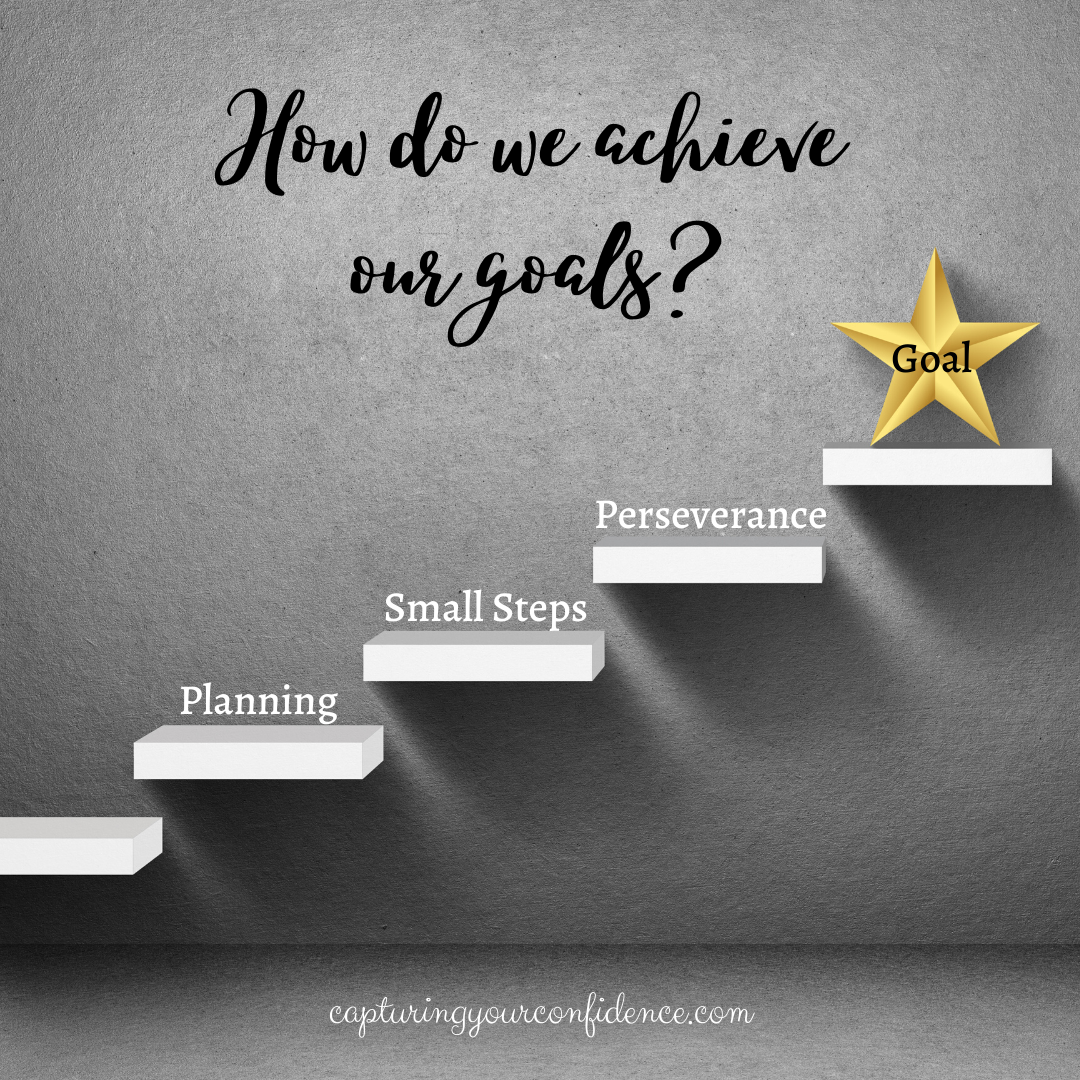
How Do We Achieve Our Goals?
Hooray, we have goals! Isn’t it an exciting feeling to think how much improvement we will see in ourselves once we have worked toward them? I love a good goals-setting session. However, we aren’t quite done yet. After all, we haven’t achieved those goals, have we? We need to take action to be able to get there.
Planning Before we jump headlong into these new goals, we need to take a little time and plan how we are going to achieve them.
Personally, I like to look at the year as a whole first because I am a visual person. When I can see all of the months on the page at one time, I can more easily envision steps for each month. I can also plan less on the months with a lot of holidays or vacation time, if that will affect my progress.
The important thing is that we are making progress, no matter how small it feels.
Once I have planned the month, I use a weekly planner and set 2-3 priorities for each week. Since I do multiple goals for different aspects of my life, I need to be able to balance them. Priorities aren’t always date specific, but I always write them down. For instance, I prioritize writing one section of my book each week. It doesn’t matter which day, or which section (although that will be more specific when my first draft is done), but I always prioritize writing something.
Some people do really well planning each day of the week. When I tried that, it felt overwhelming; however, if seeing all of your time blocked out helps you stay on track, by all means, go for it!

Small Steps When we have a whole year plan, it’s easier to see what steps we can take each week and day. The important thing is that we are making progress, no matter how small it feels. We want to be moving forward in some way every week.
Sometimes my small step for the day is to organize (or reorganize) because I have loose papers hanging out of my planner or because I wrote 5,000 words of content without any subheads. Sometimes my small step is preparing to put a lot of content on my blog at one time, which requires a lot of back-end work that’s much less exciting than the writing.
Your small steps should help you prepare to achieve your goals in whatever way possible, but should not get in the way of progress.
Your small steps should help you prepare to achieve your goals in whatever way possible, but should not get in the way of progress. For instance, I couldn’t make progress on my blog if the only thing I did was back-end work. Or on my writing if I only put in a bunch of subheads without any content underneath. We need to try to balance our steps so that we can actually see progress from our hard work.
Perseverance Sometimes it feels like we will never reach our goals. On days where we didn’t sleep enough, were over-committed at work and just need downtime in the evening instead of more “work” on ourselves, or even just that we’ve been feeling a little off the entire day, it’s hard to say: I’m going to take this step today.
Be kind to yourself on these days.
But don’t let these kind of days become a regular occurrence.
The reality is that if you’re working hard and you’re actively taking steps to make your goals happen, you will get there. But you have to keep trying, and you have to believe in yourself. Keep yourself in a positive, can do attitude, and you will be an unstoppable dream-getter. Who doesn’t want that?!
What has your experience been with goal-setting? How have goals helped you move toward your dreams? Have you ever missed your goal? How did you stay motivated? I’d love to hear about it! Drop a comment below or email me at rachel@capturingyourconfidence.com!

2019 in Review
I feel like I always say that every year has been a huge learning experience for me. While 2019 was not different in this respect, I would be remiss not to consider the incredible personal growth I’ve encountered this year.
This year started out like any other - challenging and with much stress about money and jobs. Though it was better than 2018, money and career stayed on the forefront of our minds for a lot of the year. I worked two jobs to compensate, and although I love teaching, it became a burden. I was tired.
There were several key turning points for me this year, the biggest being starting my novel. If you haven’t read about my journey with writing, this might not seem like it should be what I am most proud of or what made the most difference for me; however, it was.
The fact that I now have 18 sections of a book I still get excited to write is beyond joyous for me.
Writing has always been my biggest passion, and it was neglected for many years because of my own insecurity, so the fact that I now have 18 sections of a book I still get excited to write is beyond joyous for me. Beginning my novel also sparked my interest and now business of blogging.
I have big plans for the next year, and after seeing how well my blog has gone, and how good it makes me feel to produce writing consistently, I know I am on the right course at last.
Another key turning point for me was when I accepted a promotion at my company in the fall. For the first time, we didn’t have to worry about money. The biggest deal about this position is that it uses the skills I’ve developed throughout my education in a new and innovative way. It’s probably the best blend of teaching and non-teaching I could have asked for in a job. What I didn’t count on was liking it so much.

Of course these are only two times this year has surprised me, but they have both been (without exaggeration) game-changers in my life. I continue to be blessed with an amazingly supportive husband who has been with me through both the good and bad times. The best boy in the whole world, Charlie. A supportive family and friends.
While I know a lot of people had a tough 2019, I find that I have been extraordinarily blessed. I can only hope that this year’s hard work will seep into next year.
In case you’re interested, here are some quick facts from this year:
Writing
Novel
Quick Stats:
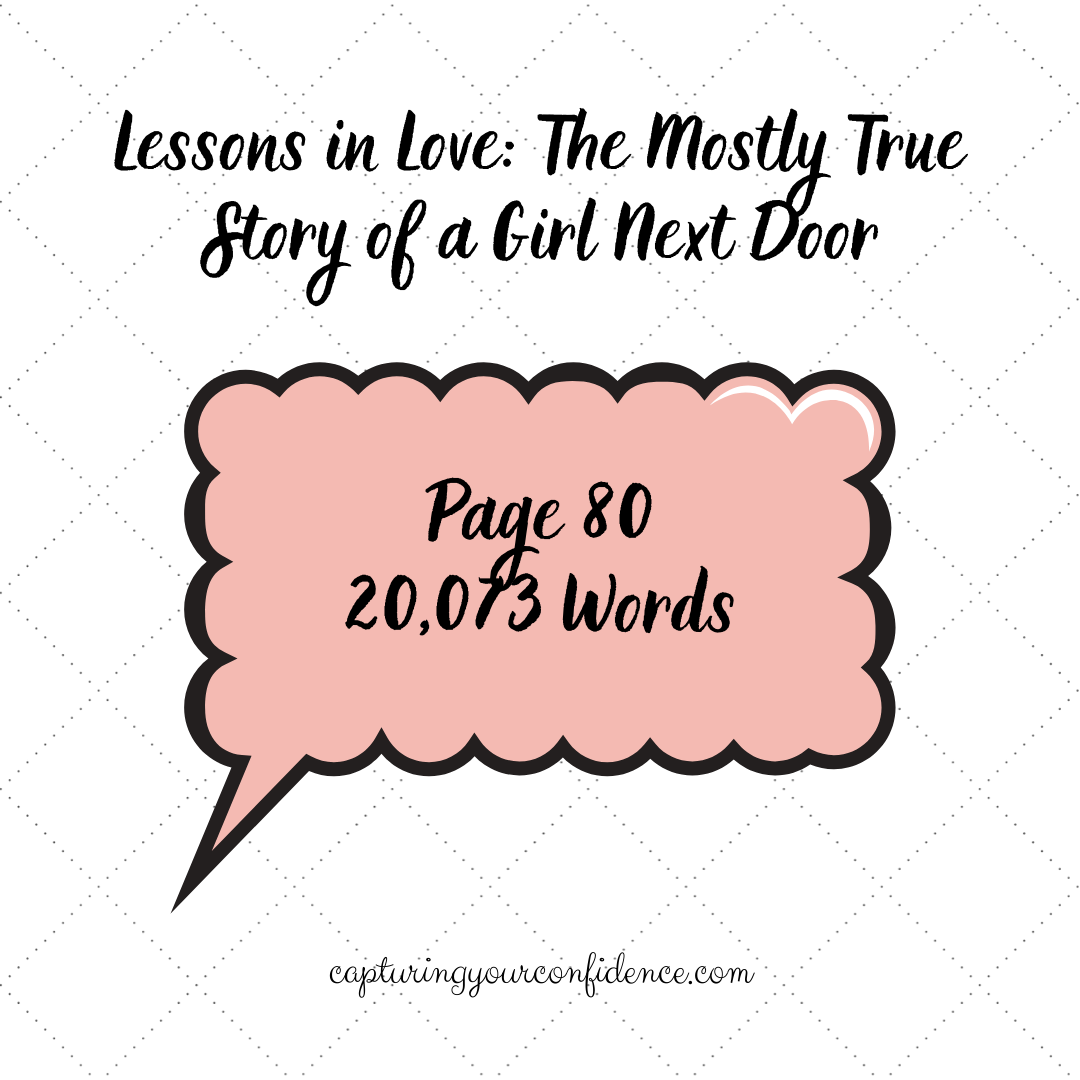
Approx. 20,000 words
80 pages
18 sections
Method:
Google Docs
Mostly typed on computer, but one or two sections typed on phone
Biggest Accomplishments:
Starting a novel after thinking I wasn’t good enough for many years
Figuring out how to put in a searchable table of contents
Continuing to work week after week and build on something that started as a wacky dream on a night I didn’t sleep well
Blog
Quick Stats:

38 blogs
Approx. 59,397 words, not including static website pages
Method:
Self-hosted Wordpress
Google docs for typing & blog safe-keeping
Typed on computer
Biggest Accomplishments:
Committing to my blog not just with time, but also financially
Being able to more or less keep up with one blog post per week, even with 2 ½ jobs this fall
A stranger (and acquaintance) approaching me to ask advice about blog writing!
Working with my first freelance client
Reading
Quick Stats:
17 books from Summer, Fall, and beginning of Winter 19/20

Last book completed in 2019:
Anne of Green Gables: A Graphic Novel
I was not counting before about April/May, but if my pattern was the same, about 22-23 books for the entire year
Method:
Physical book
Audio book
Biggest Accomplishments:
Making time for reading even when I was way past capacity for any non-work-related activity I might have wanted to do
Branching out to read more types of books than my “usual”
Teaching
Quick Stats:

3 classes; English 075, 111, & 112
2 semesters
Approx. 50 students
Method:
In the classroom
75 minute & 2 hour 50 minute sections
Biggest Accomplishments:
Teaching an advanced class when I had never done it before
Continuing to have students tell me they are more confident in writing after my class ended
Personal
Quick Stats:
One new car purchased

August 2019
One surgery for my husband
One house sold
Two small(er) student loans paid off
Credit card debt paid off
Started writing my novel and got 20,000 words in (so far)
Started a new day job that I actually enjoy
Began my blog!
Began freelance writing
Finished a semester of teaching when I was working 2 jobs (and a half)
Got interviews & rejections from numerous jobs
Losing 10 lbs and gaining it back
Biggest Accomplishments:
Continuously learning & striving to be my best
Being faithful to my blog
Acknowledging myself as a writer and actively making my dreams happen
Consciously working to have a more positive mindset in all situations
Being financially stable
Have your own accomplishments or stats to share? Drop a comment below or email me at rachel@capturingyourconfidence.com! I'd love to hear about it.

The Value of Taking a Break
Every year about this time, especially when I’m teaching, I feel the immense need for a break. I don’t mean an evening to unwind, either. I’m talking a full stop, unplugged, no emails break from work…In a world where a majority of our messaging tells us “hustling” all the time will get us where we want to go, a break is invaluable.

UPDATED OCTOBER 2020
Every year about this time, especially when I’m teaching, I feel the immense need for a break. I don’t mean an evening to unwind, either.
I’m talking a full stop, unplugged, no emails break from work.
Days where I can do whatever I want, whether that’s napping, watching movies with my dogs, or working on my novel without feeling an ounce of guilt.

In a world where a majority of our messaging tells us “hustling” all the time will get us where we want to go, a break is invaluable. Here’s why:
We are stressed.
Sometimes we are stressed because of work: maybe we don’t like our job or we are feeling a lot of pressure to complete projects on short timelines.
Sometimes there are unexpected family commitments that last longer than anticipated. Or someone we care about needs help and no one else is there, so we “find a way” to help them.
We often feel like jugglers with way too many balls in the air.
Sometimes we have health issues that have escalated or changed our lives. Issues we can’t afford to pay for because we don’t work at a job that makes a living wage.
We often feel like jugglers with way too many balls in the air.
We are overwhelmed.
Because of all our commitments, we can get overwhelmed. Our brains know we have to somehow prioritize our laundry list of “to do” items, even when that list seems to grow on its own.
But knowing that we have to do something is not the same as being able to effectively do it. Let alone be efficient.
So we shut down and don’t do anything (no one has to know about that 5 episode binge session of your favorite show on Netflix, right?).
We are emotionally overwrought.
Since we are stressed and overwhelmed, our emotions can be out of whack. We might be perfectly lovely individuals on a regular day, but on a stressful and overwhelming day? You’d better watch out!
Think of all the things we are trying to balance in our lives. Chances are, we have a stake in every single one. Work? Pays the bills (hopefully) and feeds the family. Family commitments? Builds and maintains relationships with the ones we love. Health? We have to take care of those or we might not be around as long as we would like.
If we think about all of these things on an average day, that makes for a pretty emotional package, doesn’t it?
We are tired.
I don’t know about you, but I rarely hear anyone saying “I slept really well last night. I even went to bed early!” We all wish we could, but the reality is that most of us struggle on an average day.
Sometimes tired feels like an understatement.
We get up for work in the morning, and have whatever caffeine will sustain us. We make the morning commute, arriving at work hoping that coffee/tea/energy drink has kicked in. If not, we immediately look for more.
And then we work. Some of us leave work and go to another job. If we don’t, we get home and can barely function as a human being sometimes because all of our brain power is spent. But, wait! We still have to eat dinner and possibly do dishes or spend time with family or friends.
Sometimes tired feels like an understatement.
We are human beings, not robots.
Probably the biggest reason taking a break is important is because we are humans! We are creative, wonderful, diverse creatures who have learned to do amazing things.
We are not robots that stand in an assembly line programmed to efficiently do one task over and over again. We are living, breathing beings who have a wide range of needs and emotions to contend with on a daily basis.

How often should we take a break?
We are stressed, overwhelmed, emotional tired humans who just need a break! Sometimes we don’t even realize how much we need it until it’s been far too long. The question remains, though, how often we should try to schedule this coveted relaxation.
In an ideal world, we could take a break once a week. We get so excited when we arrive at Friday because we think the weekend will be a break.
There’s a reason for that - we crave down time. If not down time, at least time to do what we like instead of what pays the bills.
In an ideal world, we could take a break once a week.
Do you ever catch yourself saying “Thank Goodness it’s Friday” or “TGIF”? I know I do!
As you probably know, taking a complete day to yourself every week is not always doable. We might have other commitments and chores to take care of. Even if they’re fun, they’re still a scheduled obligation.
Even when we are very busy, it’s really important to take a break at least once per month. We need that time to decompress and relax. Even if it’s a lazy Sunday afternoon laying around the house, we all need to take a break.
I’ve found taking a day off of work to create downtime can be extra relaxing since I am less likely to be roped into extra tasks during the week - because everyone else is busy working!

What do we do when we can’t take a break?
Sometimes life gets extra crazy, though, and we actually don’t have time for a full stop break from everything. We’ve all been there (some of us more recently than others) and it’s awful. So what can we do when this happens?
We schedule down time.
If you are a planner, this will probably be a piece of cake. If seeing obligations on your calendar stresses you out, though, this might be difficult the first few times you do it.
Scheduling time for a break should be no different than any other commitment you make. It’s a commitment that you need to make to and for yourself.
When we can’t take a whole day to ourselves, or maybe even half of a day, we need to schedule some time. Maybe that’s an hour or two in the afternoon after work. Or maybe, if you’re an early bird or a night owl, you can get some quiet at the beginning or end of the day.
We say yes to doing things all the time, and then we block that time on our calendars. Scheduling time for a break should be no different than any other commitment you make. It’s a commitment that you need to make to and for yourself.
We say no to new commitments.
We can sometimes feel guilty for not saying “yes” to positive opportunities. In fact, the word “no” tends to have a pretty negative connotation.
But that doesn’t have to be the case.
When we’re up to our eyeballs in stress and prior commitments, saying “no” to something is the best response for everyone. It’s good for you, because you don’t then feel the pain of having to try to fit yet another responsibility into your already packed life.
It’s also a plus for the person or group being told no because what are they actually getting when you say yes? They’re getting an overwhelmed overcommitted helper who doesn’t have the time and dedication they need to do a good job. So even though you show up, you can’t give it your best and therefore both parties are unhappy.
We find a way to relieve stress without a full stop break.
There have been days where I have gone from one place to the next without even having time to stop for a snack. If this has happened to you, you know the pain.
The stress is high, but there’s no outlet so it stays pent up.
If we can’t schedule downtime or say “no” to a new responsibility for whatever reason, we have to be able to handle the situation on the fly. As someone who likes to plan, I hate this. I hate it when I’m trapped in back-to-back responsibilities without reprieve.
"No" doesn't have to have negative connotations.
Some of the best outlets I’ve found in these circumstances are journaling, listening to calming music, or meditating. These options should be tailored to what suits you best because not all of them are appealing to everyone.

4 Benefits of Taking a Break
I love fall, and the holiday season, but I also think we all need a reminder to take a break where we are able. And if we “don’t have time,” schedule some in.
There are 4 major benefits of taking breaks:
We Feel Better
We feel better physically, mentally, and emotionally when we take a break. Our bodies can release the stress we’ve been holding onto and our mind will feel less burdened.
Because we’re less stressed, we will be able to deal with our human emotions better and more effectively prioritize when the stress starts to creep back.
Our Relationships Improve
When we get in a whirlwind of prioritizing and trying to get everything done, something inevitably has to take the backseat. Many times these are relationships with our family and friends.
We tend to feel bad about it, but nevertheless proceed because we assume (sometimes rightfully, sometimes not) that they will be waiting for us when our life gets less hectic. So, when we take a break we can finally make the much needed time to build and maintain these relationships. They thrive with the attention they need.
We’re More Productive
Do you know that feeling you get when you’ve been looking at something for so long that even small noticeable errors fly under the radar? The pre-break glazed over look and attitude that screams “I can’t do this anymore”?
Breaks have this incredible power of giving us clarity of the daily grind.
Taking a break fixes that! When we take a break, we create a critical distance from our work. That critical distance can really help spice things up when you go back to it because your brain had time to remember what the heck it was supposed to be doing in the first place. It also has room for new ideas that got pushed out due to stress.
We Gain a New or Refreshed Perspective
Taking a break allows you to remember why you love what you do, or shows you something you once loved is now lackluster.
If you remember why you loved what you were taking a break from, you’ll be excited to get back to it! If you discovered you no longer like what you do, or knew that but were gritting your teeth to “get it done,” it might be time for change. Breaks have this incredible power of giving us clarity of the daily grind.
The best thing we can do for ourselves is be kind! Not that we want to hold ourselves to lower standards - on the contrary. Allowing (or forcing) ourselves to make time for breaks is beneficial in all the best ways, including more efficient productivity.
My challenge to you is to figure out how you can take a break this week, even if it’s just a small one.
Need help figuring out how to manage your time and make time for breaks? I can help! If you’re a business person who could use a writer to free up some of your valuable time, learn more about how I can help here. If you’re a professional and/or creative who just needs someone to help them figure things, out, click here to read about how I work with individuals just like you. Let’s make time for you to take the break you want and need.
What do you think about breaks? How does that play out in your life? I’d love to hear about it! Drop a comment below or email me at rachel@capturingyourconfidence.com!

Interview with an Author: Kelly MacLellan

Our first guest author at Capturing Your Confidence is writer Kelly MacLellan. Kelly has a coaching business, Embrace Your Life Coaching, where she is a personal life and career coach.
Her book, Follow Your Heart to Discover Your Life Purpose, is a powerful tool to help readers struggling to find their life purpose. It builds a unique and achievable framework for following your heart to do what you are passionate about.

Kelly MacLellan
We connected with Kelly about her writing experiences and what advice she would give to aspiring writers and authors.
Tell us a little bit about your writing journey. Have you always wanted to be a writer? Or did the passion come to you later in your life?
For me, I would describe my writing journey to be natural. When I was young, I often wrote stories with illustrations and I took great pride in writing and delivering talks for an annual speech contest in our school. While I never won major contests, only regional ones, I remember the true joy was seeing how my writing impacted people.
Writing helps me process my experiences and it helps to fulfill my need to serve others. I am gifted (and sometimes cursed) with this constant need to improve and help others see their potential. It is extraordinary how writing can help plant the seed in someone who is ready for that idea to be planted.
Where did the idea for your book, Follow Your Heart to Discover Your Life Purpose, develop from?
The idea for my book came from my actual life experience. I was grieving the loss of a pregnancy and a period of infertility, and then a divorce. I had made some pretty radical, transformative decisions that lead me to the Dominican Republic.
I saw this moment in my life as a time that I was blessed with the time and freedom to heal and share all I had learned professionally and personally.
I was initially staying for a 12 week volunteer experience but then I fell in love with life again and wanted to stay and continue the experience. To stay, I promised myself that I would write a book. I saw this moment in my life as a time that I was blessed with the time and freedom to heal and share all I had learned professionally and personally.
What was your process for writing your book?
I approached the process of writing my book by committing to daily structured writing time. Because I saw this period of my life as a divine blessing, I consulted often with my spiritual guides. I would do a practice of yoga, meditation and then prayer. I would then sit down in front of the computer and write from 9 am - 2 pm usually.
To celebrate each day, I made sure to get out and see friends, go to the pool, or beach, café and simply enjoyed my life! This worked so well that I had most of the book finished in 6 months; but, I didn't release it for another 2 years.
Describe your biggest obstacle and how you overcame it.
My biggest obstacle was that when I was expecting my daughter and about to become a mother, I hesitated on publishing my book. It was my story. I wanted to protect my daughter and did not want the details of my story to ever impact her story. I overcame this fear when I resolved my complicated beliefs about mothers and daughters and perfection.
Each day, I started writing with the intention that the message in the writing would inspire and empower people to embrace their lives and follow their hearts.
I chose instead that I want my daughter to know my story and how much love I have for her. How I waited to be a mother for so long, and how I believe that God had a hand in our family story.
What is the part of the book (or process) you are most proud of?
The part of my book that I am most proud is that overall, I feel like I shared truly from my heart and wrote authentically using my voice. Each day, I started writing with the intention that the message in the writing would inspire and empower people to embrace their lives and follow their hearts.
Would you consider doing another book or other published writing in the future?
Yes, I have a few projects that are hanging on and still calling out for attention. I have set an intention that 2020 will be the year I give these projects some love and see what happens!
What do you want the world to know about you as an author?
That is a hard question.
First, I find it hard to connect with the word “Author”. Authors have always been people I have admired and respected. People who have accomplished great things in their fields. They wrote my textbooks or are Literary Geniuses!
Whatever your message is, craft it in a way that is intentional, believe in yourself, and don’t share it before it is really reflective of what you think and feel.
I think for me, I appreciate the title of writer or coach – because these titles imply that I know some things, have learned some lessons and am on a lifelong path to keep figuring things out! These titles imply that I love what I do, accept who I am and am passionate about sharing what I learn with others.
What is the biggest piece of advice you would give to aspiring writers?
My biggest piece of advice to an aspiring author and writer is to realize that your writing has an impact, whether your audience is far-reaching or even if it is read by one person – likely a family member.
Your voice matters, so don’t minimize your value! You really do not know what your message can inspire in the reader, in their life, and those that they know.
Whatever your message is, craft it in a way that is intentional, believe in yourself, and don’t share it before it is really reflective of what you think and feel.
Your voice matters, so don’t minimize your value!
And, if writing in your life is similar to my experience of writing and the role it plays in my life, make time for it. Dedicate time to play, learn, connect with new people and teachers, and explore new ways of writing and sharing it. It really is a life long endeavor, so take your time and trust the process.
If you would like to purchase Kelly's incredibly helpful book you can find a copy here.
If you would like to work with Kelly to receive one-on-one coaching, visit her website here.
If you know an author, or of an author, you would love to read an interview with, email me at rachel@capturingyourconfidence.com!
Book Review: The Wake by Paul Kingsnorth

Overview
Paul Kingsnorth’s first novel, The Wake, is a masterpiece of language in epic proportions. Writing about a time long ago - 1000 A.D. - he captures the essence of life as a free English man before the catastrophic events of the Norman invasion that would ultimately change England forever.
He basically updates Old English for the modern reader.
The most unique part of this almost 400-page novel is the use of what Kingsnorth calls, “a pseudo-language intended to convey the feeling of the old language by combining some of its vocabulary and syntax with the English we speak today,” (353). Basically, he updates Old English for the modern reader.
Content & Message
From the very beginning, the beauty of this carefully crafted language entranced me. Using lines such as, “aefry ember of hope gan lic the embers of a fyr brocen in the daegs beginning brocen by men other than us. hope falls harder when the end is cwic hope falls harder when in the daegs before the storm the stillness of the age was writen in the songs of men,” (2) Kingsnorth creates intrigue about the main character, the Buccmaster of Holland.
Throughout the novel, the Buccmaster spins the tale of how his world unraveled and ultimately ended. We travel with him through the loss of his grandfather, two sons, wife, and his family’s land to the French invaders, who he hates with a passion.
We see the darkness in this part of history in a personable way that resonates with us, and ultimately shapes the feeling of the book.
In response to losing everything he’s ever known, he lives in the woods with a band of men who have faced similar losses and also dislike the foreign invaders who have claimed all of England’s land for themselves. During his time in the woods with his “werod,” which Kingsnorth tells us in the partial glossary is a “war band,” (350) they plot to take their country back.
The main problem the group faces is that the Buccmaster, who insists that he’s “chosen” by the gods, refuses to take the big actions he insists will drive out the French. The others trust him as their leader for most of the story, but towards the end, as his speech and motives seem more and more far-fetched to the group, it all starts to go awry.
After finishing the novel, the readers are left to wonder whether the werod men were truly disloyal to the Buccmaster, as he thinks, or if the Buccmaster was indeed mad, as they believe.
Biggest Takeaway
Reading this book is truly an experience. We get to see the heightened emotions of a man who has lost everything and struggles not only to cope with that loss, but also try to take back somewhat of a life for himself.
We see the darkness in this part of history in a personable way that resonates with us, and ultimately shapes the feeling of the book.
Reading this book is truly an experience.
While the language is at first tricky, it becomes easier as the reader goes along, and becomes a key part of what makes this novel great.
I may not have always liked the Buccmaster, and at some points his discussions with himself/Weland Smith get a little tedious, but overall this book masters the use of innovative language to tell this historical tale in its own time, which is a feat in and of itself.
Overall Impressions
Having read the short back cover blurb, which described the book as: “a postapocalyptic novel set one thousand years in the past,” I imagined the themes were going to be dark, probably including death and survival.
While this is partially true, the overarching themes of this work were war, religion, and surprisingly love. Kingsnorth captures the dirty truth of war and its effects on the people of England in his descriptions of the fighting (and intentions to fight), but that doesn’t overwhelm the novel.
I was impressed by the language of course, but also by the ambiguity in the novel.
Kingsnorth captures the dirty truth of war and its effects on the people of England in his descriptions of the fighting (and intentions to fight), but that doesn’t overwhelm the novel.
Initially, the Buccmaster seemed like a man to be admired, at least by the standards of that time; however, he quickly shows himself to be quite a dislikable character. While it’s true he did have a harsh childhood, we later learn that he committed some very violent acts, which voices in his head convinced him were justified.
We are left to wonder whether the Buccmaster of Holland really has the ability to speak to the Old Religion gods or whether he simply has the ego of a king in the circumstances of a landowner.
Since the novel is told through his perspective and he’s so complex, I was often questioning whether the situations happening were really of the magnitude the Buccmaster claimed. While initially off-putting, I realized after finishing the book that I quite enjoyed having mixed emotions for the Buccmaster because it enhanced the mysterious tone of the novel.

5 Reasons We All Need Gratitude (And Not Just Around the Holidays)
It is the end of November already and it feels like January was an impossibly long time ago. I think this same thought every year, and after I get past the shock that 2 months from now we will be starting a brand new year, I reflect.
I begin with major events.
What has happened that has changed my worldview? What has happened that has changed my life?
There always seems to be big, life-changing events that have happened. Things like losing a loved one or becoming financially stable. I suspect that this is partially because my husband and I are still young, but it never ceases to amaze me where we started and where we have come every single year.
Once I’ve framed the year with major events, I think about more moderate things that were really good, or sometimes, really bad.
Why was the event so impactful? How did I revel in it? How did I overcome it?

These aren’t necessarily life-changers, but they certainly affected our lives at the time. Maybe it’s a much needed-vacation or buying a car. There are typically more of these, and I like to go through my calendar and see what kinds of events occurred each month.
Finally, I think about the small details. Fun dates and once in a lifetime events; small accomplishments like losing 5 pounds, and things that put a smile on my face. I love looking back at my digital journaling apps to see the day-to-day memories that don’t make it to my long term memory.
What happened throughout the year that made me happy? Can I replay that memory, and will it make me smile again?
It’s only after I’ve thought about the year in these segments that I can begin to get a clear picture of how thankful I am for the life I lead. Of how much gratitude I have not only for my support network of family and friends, but for the people I work with, and the work I do.
We tend to think about gratitude this time of year not just because the year is ending, but also because of Thanksgiving. Despite how it might seem in department stores, we are still in turkey season! Trying to gather our families together for a meal is both time-consuming, and stressful. That doesn’t include the shopping, if we indulge. Sometimes these things overshadow the part of the day where we give thanks.
Reflecting on our lives and remembering the good and the bad is really important, though. We need that acknowledgement to help us finish our year strong and move into the next with our heads held high.
Reflecting on our lives and remembering the good and the bad is really important, though. We need that acknowledgement to help us finish our year strong and move into the next with our heads held high.
Now, sometimes the year has sucked. I mean, it has been terrible at what seems like every turn. I get it! I’ve been there! Life is like one of those tower drop rides at the fair - sometimes we’re soaring up at the top, looking out over the world. The next minute, we’re plunging downward with that weird uncomfortable feeling we get in our stomach that seems like it will never go away.
Some years we feel like we’re at the top, and some years it feels like we’re plunging down with no stop in sight.
Even if it has been a downward plunge year, it’s still important to look for the things we are thankful for. Here’s why:
We need a reality check. I don’t know about you, but I am sometimes guilty of complaining about minor inconveniences.
Ugh, traffic took an extra 15 minutes today and I was late for work!
First, I drive the same way to work almost every day, so I know better than to leave even a few minutes later than normal. It’s not rocket science that leaving later might make me late.

Second, sometimes there has been an accident. People have to be taken away in an ambulance or frantically make phone calls because not only are they late to work, but now their car is totaled, too. This is clearly much more of a problem, especially if there was injury! Every time I see an ambulance driving away, I say a little prayer that the person is okay. If I had left at the normal time, that could have been me.
Finally, will that 15 minutes really be a big deal a year from now? Let alone 5 or 10 years from now? Chances are you won’t even remember in a few weeks.
We make these kinds of off handed complaints not even really thinking about it; however, the reality is that we typically have a lot more to be thankful for than we have to complain about.
Sure, we could dwell on the fact that we were 15 minutes late to work.
OR
We could focus on the fact that we have a job that allows us to pay the bills. We also have transportation that has allowed us to arrive safely, and will reliably take us home to our family/friends/pets/etc. at the end of the day.
Who couldn’t benefit from a positivity boost? If you consume any type of news, you might think the world is a terrible place. There are wild things happening now that weren’t even a consideration 15 years ago. Many of those things we are still working to mitigate or resolve, so it can seem like chaos.
Because there’s so much digital connection all around us, it’s easy to get caught up not only in the constant barrage of news, but also in comparing our lives to others on social media.
Oh look at so-and-so’s family! Aren’t they beautiful! Look at the vacation they just went on!
While it’s nice to be able to keep up with our friends and acquaintances, it’s not healthy to constantly compare our lives to others. We can’t see behind-the-scenes, and let me tell you, sometimes it’s ugly.
Focusing so much on the negative takes a toll on us mentally, emotionally, and physically.
Focusing so much on the negative takes a toll on us mentally, emotionally, and physically. If you take time to reflect on the positives you are grateful for in your life, you will feel less stressed, less like you’re running in a hamster wheel, and more confident that what you’re doing is working - even if it’s just small ways.
If you change your mindset, you can change your course. If you’re stuck dwelling on what’s not happening, or what you want to happen that isn’t coming quickly enough, it definitely won’t happen.
When you spend all your time thinking things like:
If I could just lose these last 10 pounds I would be happier.
If I could just make more money, all of my problems would go away.
You drain your energy. You leave yourself no room to take the steps you need to lose the weight you want, or get a better paying job.

Refocusing on the things you are grateful for will allow you to regain some energy and motivation to take small steps again. If you’re stuck, or obsessing, you’re not going to be able to do what you need to do.
The first time I heard this, I laughed. “If only that were true!” I believe were my exact words. But, I can tell you that when I succumbed - and I don’t use that lightly, it really felt like the bottom of the barrel - I almost immediately felt relief. I began working to learn techniques and read books to help me get to a better place.
Our mind is our most powerful asset, and when we can harness it positively and focus on what we are grateful for, our lives change. Whatever course we are on will go where it’s supposed to go. It’s not some sort of magical thinking, it’s just life.
Life’s too short to take things (and people) for granted. Just the other day I was annoyed at my husband for something silly after a long day. Tension was high, but I kept my mouth shut because I knew it was a silly reason to be irritated.
I took some time to be quietly by myself and figure out why I was really upset. It wasn’t him. In fact, he had just gotten me flowers and taken me on a beautiful date the day or two before. There was absolutely no reason for me to lash out, and I’m thankful I stopped myself - I didn’t used to be able to do that.
The reality is that I’m very blessed to have a husband who loves me so much. Who is one of the most generous people I know and makes me laugh until I cry sometimes.
It’s much better to live with gratitude than to wish you had been thankful when you could.
While it’s a learned behavior to not lash out at people when we are upset, it’s very important to be able to refocus on the best aspects of our lives. We don’t have very long here on Earth, and we never know when something might happen to cut that short.
It’s much better to live with gratitude than to wish you had been thankful when you could.
It’s time to prepare to make change. We should focus on the positive things in our lives all the time, but the end of the year is special. We are still working on the current year, but we are excited (and sometimes thankful) for the new year in front of us.
We can use the end of the year to reflect on the good and bad. If your year has felt like the tower drop ride, you might be thinking:
Thank goodness - let’s get this year the heck out of here!
It’s perhaps even more important to do some planning if you’ve had this kind of year.

The bad parts of the year were a bummer - possibly even the worst of your life. But now is the time to remember what lit you up again after that darkness. What set your passions on fire and made you ready to conquer the world?
And, if it hasn’t yet, what would?
Those are the thoughts you want to go into the next year with because that’s how you’re going to pull yourself back up and be okay again. If you need to linger in your sadness until the end of the year, give yourself that grace. But, when January hits, be prepared to put your positive pants on.
January is a great time to begin to form new habits, and maybe even try a thing or two that scares you! Develop those new habits and create a new normal.
Gratitude isn’t just something you should do. It’s something you need to do. Being grateful is helpful in every aspect of our mental, emotional, and physical lives. When we are less stressed or emotionally overwrought, we sleep better, eat better, and even hurt less!
The holiday season tends to make us think more about what we are thankful for, which is good. The ultimate goal should be, though, to count our blessings on a regular basis. It’s a hugely underrated strength to be able to be grateful, especially in the face of hardship.
Gratitude isn’t just something you should do. It’s something you need to do.
Your blessings/positive moments/however you want to label them are out there waiting to be noticed and appreciated. You won’t regret finding them (even if you have to look hard).
Do you focus on what you’re grateful for? Or has someone inspired you to turn to a more intentionally positive mindset? I’d love to hear about it!
Drop a comment below or email at rachel@capturingyourconfidence.com. Let’s talk!

What Creates Confidence?: Exploring Confidence Series, Part 2

Welcome back to the Exploring Confidence Series!
When you consider the idea of confidence, where do you think it comes from?
In Part 2 of our Exploring Confidence mini-series, we will discuss what creates confidence, what’s it’s made of, and why it matters.
What is Confidence?: A Brief Review
In Part 1 we defined confidence as: the “quality of being certain of your abilities or of having trust in people, plans, or the future.”

We discussed confidence with self-efficacy, which is “people's beliefs about their capabilities to produce effects” (Bandura 1994).
Sometimes we are confident, but we don’t think it makes a difference!
Confidence comes from our support network/system, experiences, and within us.
Everyone needs confidence. Why? Because we use it to bolster ourselves & others, as well as to make decisions.
What Creates Confidence?
If confidence is the quality of being certain of our own abilities, it stands to reason that thought has to come from somewhere. Some of us are blessed to be born with outgoing and flamboyant personalities. While this is a great attribute, it’s definitely not something everyone has throughout their lives.
The good news is, we can develop confidence! That process looks a little different for everyone, but there are a couple of key aspects when creating or developing confidence:
Support from Our Network Our support network is critical in our confidence development. When we have a full and vocal cast of supporters in our lives, we tend to be comfortable to make decisions and feel good about them. And why wouldn’t we? Our network will probably do one of two things: encourage us to keep going or catch us when we fall.
It’s not until we’re adults that we are fully in control of who we associate with.

On the other hand, if we’re figuring out how to survive and thrive without a network of supporters cheering us on, it can be hard to be sure about our decisions. We may question whether the risk is worth the outcome or whether we can actually follow through with what we know needs done. This causes us not only to doubt our own efficacy, but also worry about the effect if we do make the decision and it goes poorly. What will happen in a worst case scenario if we don’t have someone to catch us when we fall?
We begin our lives not really having a choice about who surrounds us. We have families and friends, but those are likely people you have grown up with/around. It’s not until we’re adults that we are fully in control of who we associate with. If we grew up in a setting that didn’t allow for a lot of decision making or failing safely, we might have to learn these things as an adult.
Taking Risks & Succeeding This probably sounds odd, but it’s true: taking risks creates confidence. In fact, when we take a lot of risks and they work out, our confidence can be bolstered pretty darn quickly.
The problem with risks is that they’re risks, though, right? It wouldn’t be a risk if there wasn’t some negative consequence(s) associated with failure.
When I say risk, I mean calculated risk. I don’t mean jumping off your roof thinking you can fly knowing full well you can’t but “risking” it just in case. I mean thinking through the pros and cons, educating yourself about the possible consequences and effects (good and bad) and then deciding to take action. While there will always be a negative consequence looming if we fail, there will also be a reward waiting if we succeed.
The problem with risks is that they’re risks.
Confidence grows when we reward our calculated risk-taking. We see the success and we like that feeling! We want to feel it again, so we take some more risk to gain more reward. Eventually, we get to a place where even when we fail or take a bad risk, we’ve learned to get back up and try again. After all, we’ve seen what happens when we take a risk and succeed.
What is Confidence Made of?

When we try to define words like confidence, we have an idea, but it can be tricky to explain. It’s not like you can go pick up a pack of confidence at the grocery store. So how do we know what it’s made of and where it comes from?
Most of us see confidence fluctuate in our daily lives. We notice when people are confident, when they’re not, and perhaps even understand why. We just don’t often stop to think about it. What we see when we really look are:
Inner Strength People who are confident are strong. Not just on the outside, but mentally and emotionally. They have taken calculated risks and won, but they have also failed. They are self-aware and don’t shy away from speaking what needs to be said. This isn’t to say they enjoy confrontation, but realize that to grow, sometimes this must occur. They have developed their voices and characters and are ready to take on the world.
People who are confident are strong. Not just on the outside, but mentally and emotionally.
They are people we look to for leadership and, sometimes, guidance.
Picture the most confident person you know. Imagine their mannerisms and voice. Recall their character and values.
What are the easiest qualities to recall?
Willingness to Be Wrong For most people, being wrong seems to be a real sticking point. We live in a world where technology allows us to find the right answers to many questions within a few minutes. The problem is that we’re not always right, and that’s okay!
Confident people are okay with being wrong because they know it’s a growing pain. We weren’t born knowing how to feed ourselves or drive a car - those are things we learn. And sometimes we mess them up along the journey. When we can admit we are not perfect, that we are, in fact, human beings who make mistakes, that’s when we are truly confident.

When we are not willing to be wrong, we show fear. We are not taking the risk to be vulnerable to get the positive reward of growth, so we get stuck where we are. Refusal to be wrong and grow is a mask for lack of confidence.
Many people will simply shrug this off. We see this a lot with people in power. They say things like “alternative facts” or blame others for their mistakes. No one is immune from being wrong sometimes, though.
Think again about the most confident person you know. How do they handle being wrong?
Knowledge that You Can Get Back Up When You Fall Down When we are brave enough to take risks, even when they scare us, we can succeed. Sometimes far beyond our wildest ideas. But, we also take the chance of failing and getting knocked down. Because we are human, we make mistakes and do things wrong.
Confident people can get back up and try again when they fall. It might not be immediately, and it might not be the same attempt (which is probably good if it failed), but they are secure in the idea that when they’re ready, they can get up and keep going.
Confident people are okay with being wrong because they know it’s a growing pain.
This knowledge comes partly from taking risks with possible success and failure outcomes. It also comes from being secure in the idea that it’s okay to be wrong. They wouldn’t do the same thing again, but even if it’s the worst failure of their lives, life will continue on. It is in these situations that confident people’s inner strength really shines through.
Think one last time about the most confident person you know. What do they do when they fall flat on their face?
Why Does it Matter?
While it’s great that we can talk about what confidence is, where it comes from, and what it’s made of, why exactly is that information important? As I tell my students when they’re writing their research papers, they need to think about a “so what” factor - a reason their audience should care about what they’re trying to say.
So, in the spirit of a lifelong learner, here’s why confidence matters:
More Positive Mindset Who couldn’t use a little more positivity in their lives? We notice the inward changes of growing confidence first. We feel safer in the knowledge we can do what we want and need to do. We can make decisions, and fail, but we will be alright.
We feel safer in the knowledge we can do what we want and need to do. We can make decisions, and fail, but we will be alright.

We also worry less about our abilities! We don’t feel the need to constantly second guess our abilities, and that probably makes our work even better. We might even display more creativity or reach beyond what we thought we could do - all because we’ve gained the confidence to keep going.
When we are confident, we also present ourselves better. We care less about the opinions of others because we trust ourselves, so we wear what we want to wear - what makes us feel good. We might do our hair differently or say hello to someone at work who we don’t normally talk to. We become more of the person we want to be.
Better Interactions with Others Think of all the times you’ve started a project and second guessed your work. Maybe you had a brilliant out-of-the-box idea, but didn’t propose it at work because you didn’t think others would agree. Or you’ve completed something you’re really proud of, but never shown it to anyone because you weren’t confident about it.
When we are comfortably confident, we present ourselves differently. We might stand a little taller, speak a little slower and with more assuredness during important gatherings. We also trust our own work, which means when we go to present it to others, we are more credible and believable. We believe in what we do, so others have a good reason to, also!
We believe in what we do, so others have a good reason to, also!
When we believe in our work, and others believe in our work, that’s a recipe for great collaboration. Others see your energy and vibes and want to get in on the action. They want to see more of your awesome ideas because you presented them with confidence!
More Confidence = Easier Path to Success When we act and work with confidence, we have an easier path to success. No, this is not a straight ticket or an easy shot, but here’s what more confidence can do:

It can create openings for collaboration. Networking is absolutely vital these days! In the past it might have been easy to walk in and get a job on a Monday morning with just a printed resume, but that time is long gone. You never know who you might be able to work with when you collaborate on projects.
It makes you more willing to take risks, and as we know, taking risks is key to building confidence. We start with the tiny ones, and when we see them succeed, we can start building on them. Sometimes we’re in a position to take a larger risk for a larger reward. Would a person lacking in confidence go for that risk, even if it was their dream job/relationship/goal? Maybe not.
Confidence also allows you to believe in yourself and your work enough that when you do face hard times of “failure,” you can get up afterward. Unfortunately, life isn’t always fair and some people face more obstacles than others. Perseverance is key to success, so when you have the confidence to weather the storm, you too can sail through to your vision of success, whatever that may be.
What’s Next?
We’ve talked about what creates confidence, what it’s made of, and why it matters. Tune in for the next part of our mini-series to read more about what can break confidence.
What have your experiences been with confidence? I’d love to hear about them! Drop a comment below or send me an email at rachel@capturingyourconfidence.com.

Unlearning the 5 Paragraph Essay
Every semester around this time - research paper time - those of us in the college writing world fight the 5 paragraph essay battle. The one where we attempt to teach students that most writing, except standardized testing, doesn’t really use it.
Inevitably there are sighs. Shock. Annoyance that what they thought they knew about writing isn’t going to get them through this class (that many have been dreading).
What exactly is the 5 paragraph essay?
The 5 paragraph essay, as the name would suggest, is 5 specific paragraphs of text that serve specific functions.
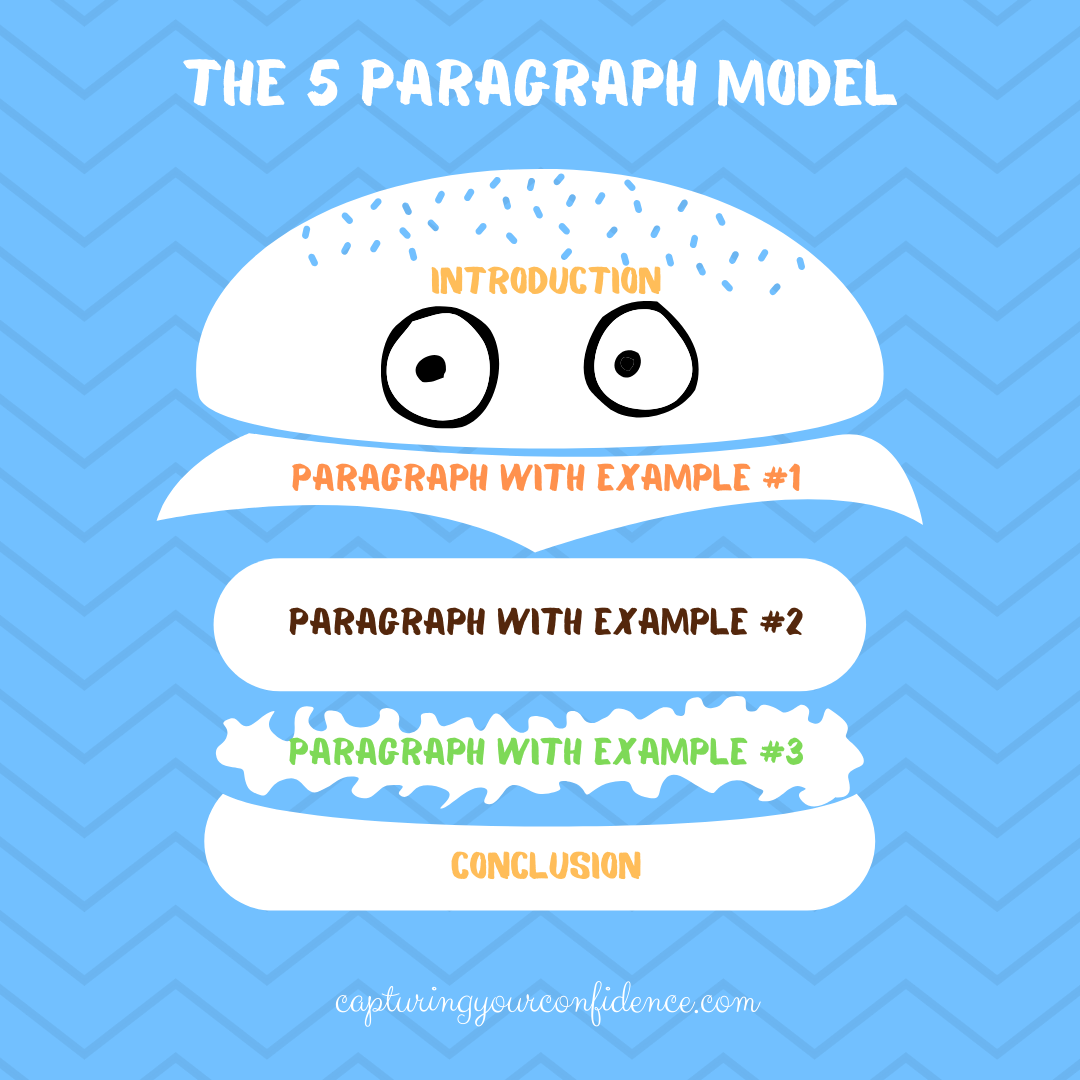
The introduction introduces the broad topic and develops a thesis statement, or main point, that the writer will make using evidence and/or examples.
The body paragraphs each make one point or show one example illustrating their point. These paragraphs go in descending order of importance, with the first paragraph being the strongest point of support. The weakest support goes in the third (last) body paragraph.
Finally, the conclusion reminds the reader of the discussion throughout the rest of the essay. This includes a reminder of the introduction, a summary of the three supporting points, and a sentence denoting the end of the paper. Sometimes this can be a call to action for readers.
That doesn’t sound too bad, right?
What harm does it cause to have some structure in student writing?
Researcher and renowned scholar Les Perelman has spent years studying the effects of short timed writing, including the infamous 5 paragraph essay. He is even credited for being a driving force in making the writing portion of the SAT optional instead of mandatory.
It’s not about the structure, it’s about the content.
During his research, Dr. Perelman wrote 5 paragraph essay (read it here). You will notice, the paragraphs in the essay start as any essay might, but are full of commentary about the testing process.
Can you guess how the essay scored?
It got a perfect score.
In short, it’s not about the structure, it’s about the content.
Lacks Complexity 5 paragraph essay structure perpetuates the idea that everything we need to say for an argument can be contained in 5 paragraphs rather than the more complex writing college students do.
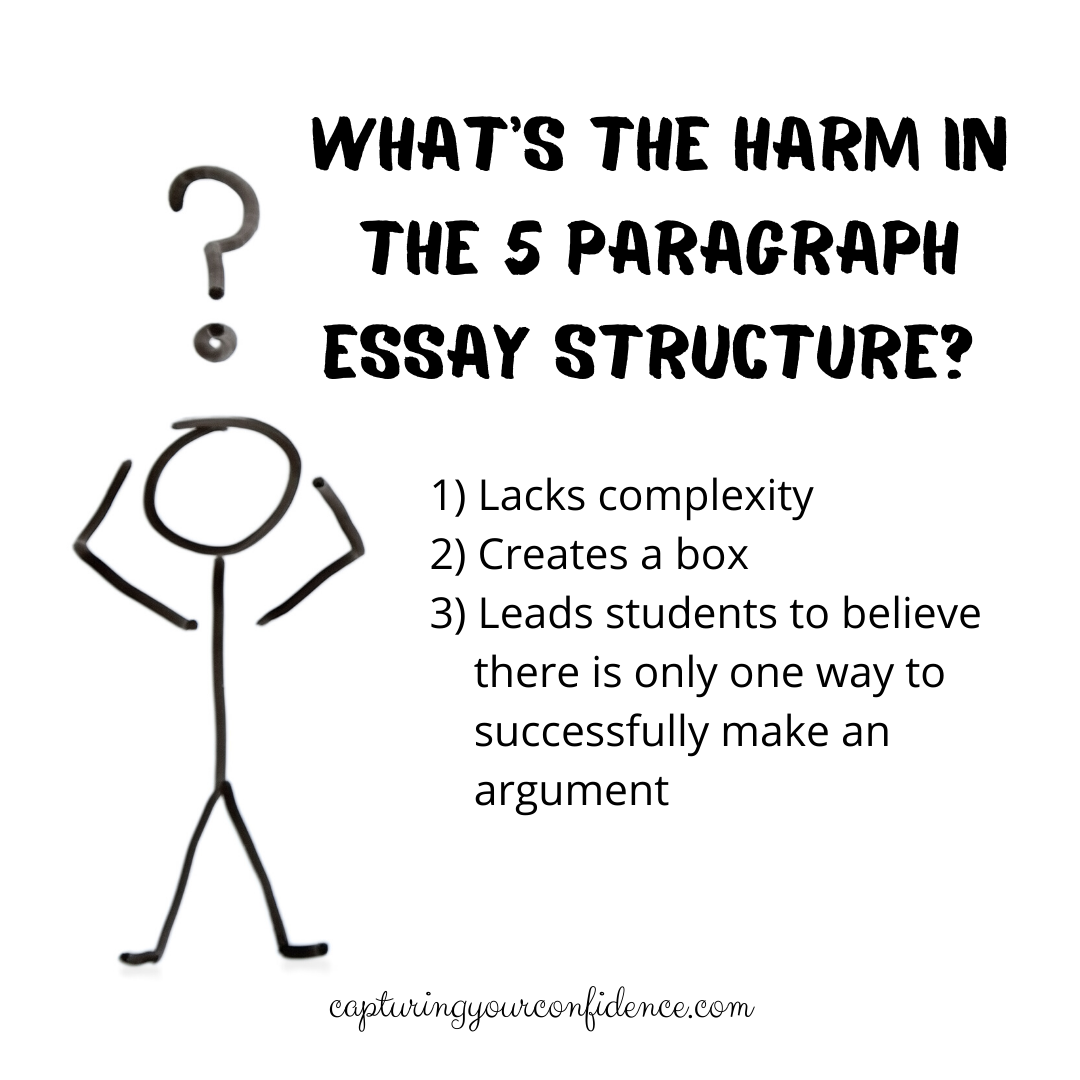
It also leads students to think that there are always three supporting points to any argument, and that they should always start with their strongest idea first.
This can be difficult to overcome in an entry level college English class where we write 6-10 page papers with required source material.
Creates a Box As you can imagine, students learn this style of writing early and for many years because of all the required standardized testing. I remember having to crank out those essays, too.
When students spend 12 years (or more) learning how to write a five paragraph essay, it can almost become a comfort zone. It’s as if when they get to the fifth paragraph, they can sigh in relief because they’ve made it. They have their argument, their three supporting points, and a conclusion.
When students write their paragraphs, it’s as if they’ve filled up their box, and finishing the conclusion closes the lid.
When students write their paragraphs, it’s as if they’ve filled up their box, and finishing the conclusion closes the lid. The problem being that, in college, we have much bigger boxes to fill (and we like to leave our lids open for further discussion).
Leads Students to Believe There Is Only One Way to Successfully Make an Argument Of course, all of these factors are intertwined. You can’t have a super complexly filled, or overflowing, box with a five paragraph essay.
Probably the most pernicious effect of the 5 paragraph essay format is that it leads students to believe that it is the only, or best, way to make a successful argument.
The bare bones idea can be helpful, especially for beginners who are easily overwhelmed by the enormity of writing and just learning the basics; however, this one way of argument isn’t always the best or most effective way, and it’s definitely not the only way.
How do we get students past the 5 paragraph essay?
The most common struggle I hear in entry level English is the length of our writing. “I can’t write 6 pages!” they exclaim. I’ve also heard statements like, “Well, I’ve made my point and there’s nothing else to say” after 2 pages out of a required 3 page writing assignment.
Upon discussion, this almost always stems from this five paragraph essay formatting. They’ve filled their box, or their paragraph quota, and they feel done.
Slowly At the community college I teach at, we have a pretty diverse student body, which includes both traditional age students and returning adult learners. Whether students were in high school last year, or 15 years ago, we always have to take it slowly to get out of the five paragraph mindset. Even in a four year university setting - maybe even more so - the five paragraph essay is prominent.

Each semester, we begin by thinking critically about other people’s ideas by reading and analyzing texts. Then we do some of our own research. Toward the end of the semester is where we start breaking out of that box and writing our research essays. They write a rough draft and get instructor feedback before turning in the biggest project of the semester: a 6-10 page essay (length requirement depends on the school).
Show them a Variety of Examples Personally, I always try to show a wide variety of voices in my class. My students are diverse, so the voices I show them should be too! But, as I’m thinking about the examples, I also purposefully show them work that’s different from the “standard” types of essays they’ve seen.
I show them almost exclusively student examples. All of them have done well, but none are perfect, which gives us good discussion in class. When we look at these examples, we talk about the areas that could have been better alongside the features that were successful. I tell them that any example I show them has room for improvement, but all of them would be acceptable models if they need help crafting their own papers.
Encourage them to Take Risks Outside their Comfort Zone There isn’t a lot of room to take risks on standardized testing essays, or really any graded essays where you turn it in for a huge part of your grade with no chance to revise. This makes writing VERY stressful for most students.
How can we expect students to learn how to write outside of their usual box if we don’t give them room to take risks and fail without tanking the grade they’ve worked toward all semester? I don’t think we can.
My college mandates revisions, but even when I was teaching at a four year university I gave students room to learn outside of their comfort zone by allowing & expecting revision. How can we expect students to learn how to write outside of their usual box if we don’t give them room to take risks and fail without tanking the grade they’ve worked toward all semester? I don’t think we can.
Give them Lots of Feedback Probably the hardest thing I do as an instructor to help students unlearn the five paragraph essay is to give them copious amounts of feedback. I say hard because it’s time consuming, and sometimes soul-sucking when you get a final draft back that’s the exact same as the first draft that didn’t do so hot.
This is probably one of the most critical things I do, though, because the students who are invested use that feedback to do real learning. They ask questions and truly try to make their writing better. Even students who aren’t interested or just don’t fix their mistakes have still see the possibilities of how they could improve for next time. At the end of the day, that’s the best I can give them.
But, in the long run, we college English instructors spend a lot of time unlearning this model because it’s simple, limiting, and just overall not what they need for college level writing.
I understand the value of teaching students the five paragraph essay format when they are young and just starting out. After all, they have to get past all that testing to even get to my classroom.
But, in the long run, we college English instructors spend a lot of time unlearning this model because it’s simple, limiting, and just overall not what they need for college level writing.
If you are a teacher, what have your experiences been with the five paragraph essay?
If you are a student, how has the five paragraph essay played a role in your education?
I’d love to hear from you! Drop a comment below or send me an email at rachel@capturingyourconfidence.com.

3 Easy Steps for Listening to Your Writer’s Voice

Think for a moment about the last time you wrote something creative.
What was going on in your mind?
For some of us, there is a whirlwind of sound - characters, dialogue, perhaps sounds from the setting (we hear you, barking dogs and ringing phones!).
But sometimes we don’t hear anything. Utter silence punctuated by the occasional self-doubt or questioning of what the heck to write next.
Do you fall into one of these categories?
Unless we have a set routine, it can be hard to focus in either of these scenarios. When we can really focus, though, these sounds become more intelligible and useful.
I don’t know about you, but when I get writing (and I mean really in the groove, not just a stray paragraph here or there) the characters actually do all the talking. It ceases to become my language and becomes theirs.
I write fiction (mostly), and I can say without hesitation that my writing is better when I let the characters write their own stories. It’s not only better, but also easier. It’s kind of like getting out of my own way, really.
The question is how to get to the place where your characters have a life of their own.

I follow a pretty simple 3 step system when it comes to getting the madness of my mind into words on the page:
Step 1: Listen intently to all the sounds in your writer’s mind.
What we’re thinking when it comes to our writing is not always organized. In fact, it can be downright wild. It is for this reason that I’m not writing my book linearly - it’s in sections that have a rough timeline.
Sometimes our minds are so dang loud and busy that we feel we can’t get anything done. Here’s the problem: all of those competing ideas and sounds probably play a role in what we (or our characters) want to say. When this happens to me (on the regular), I actually have to stop myself from multi-tasking and listen.
Rather than getting frustrated when your thoughts are jumbled, go to a quiet place and let them be jumbled.
I’m listening for character voices, setting details, pieces of a scene - anything related to my book. Sometimes this is triggered by something I read. Most often, I hear an old song on the radio that triggers a memory that then makes me think “What would Callie say about this?” or “How would she react to the memory from my life?” (Callie is my main character.)
Rather than getting frustrated when your thoughts are jumbled, go to a quiet place and let them be jumbled. Sit and have a cup of tea and think about them. Why do they feel so confusing? Why are they so mixed up?
Step 2: Take notes & doodles about the noise.
Once I decipher what the noise is, I write it all down. Because I don’t think logically about writing in the idea generation phase, my notes can get pretty messy.

This is what my notes look like... what about yours?
I’m talking lists with arrows every which way and sketches of characters. Bits and pieces of the scenes I imagine. Thoughts and ideas that make my characters angry or sad. Literally everything I can get onto the paper comes out in these notes.
The important part for me is that they are on a physical piece of paper. While I love technology and use it for many things, nothing will ever replace a trusty pen and paper. Not only does the act of writing help me sort out the noise, but it helps me contextualize where things will potentially go in my book. Not to mention the sense of satisfaction I get when I realize that I’ve piled 3 pages of messy notes onto the page.
If you really want to use technology, I would recommend Microsoft OneNote - it does pretty much all the things a regular old notebook would do, but digitally.
Step 3: Start writing.
The final step once I have quieted my mind and gotten all that idea noise into notes is to take action and start writing. This is the hard part, right?
Sometimes.
Usually by the time I have sorted out my notes into something semi-logical or usable I have had a thought or two about what scene I should work on. I find that most times I am drawn to complete parts of my writing, even when it’s not in the next logical scenario. Somewhere in my notes is usually a phrase or a thought one of my characters have had. This is where my characters come out to play. I start with that and let them say what they want/need.
My writer’s voice is the one that tells me to get out of the way so my characters can do the hard work.
This is my writer’s voice in action. My writer’s voice is the one that tells me to get out of the way so my characters can do the hard work.
If this all sounds a little hokey and out there… it might be. I know a lot of writers and everyone is different. I’ve read a lot lately about how “The point of the first draft is to get it on the page” or “First drafts are always awful.” That’s kind of a bummer, though, right?
If I’m thinking those kinds of things, there’s no way I’m staying motivated to finish my book.
So, I ditch those ideas and listen to the writer’s voice in my head. Sometimes she’s unsure. Sometimes she hates what I just wrote. And sometimes she doesn’t grace me with her presence at all, which is highly inconvenient when I’m trying to listen!
What is a “writer’s voice”?
You might be wondering what I mean when I say writer’s voice. It’s not a real person or an alternate personality, but a guiding force in my writing. A part of my mind detached from reality and from my work that can keep a clear head when I’m writing instead of getting caught up in the character’s voices and lives. My instincts. Most, if not all, writers have some kind of a writer’s voice.
While feedback is definitely valuable, and I would always recommend it for writing, the reality is that we are the creators of what we write. The thoughts and characters came from our mind, and no one else has the exact vision we have for our work. It is important to listen to other ideas, but it’s critical to listen to ourselves so we can create our vision.

When we listen to the writer’s voice in our minds there are benefits!
Express Initial Thoughts So your ideas don’t quite make sense the way your writer’s voice thought? That’s fine! Guess what? You have initial words on the page. At least you know what you were trying to do and/or what you were thinking about. When you take some critical distance from your writing and come back, you might be able to clean it up and refine it to be a really strong scene.
Write Genuinely You are wonderfully and perfectly you, and when you listen to your instinctual writer’s voice, that comes out! We aren’t made to be human shaped cookies that look and function exactly alike. Our differences make the world a beautiful and diverse place, so to have your unique voice on the page sets you apart in the best way. No matter how much you like someone else’s writing, you probably don’t want to just copy that person’s writing, right? You want to write with your own voice.
Our differences make the world a beautiful and diverse place, so to have your unique voice on the page sets you apart in the best way.
See Our Good Ideas I can’t tell you how many times I hear people say “I just don’t have any ideas” or “None of my ideas are good enough.” Um, what? Look, when you brainstorm the heck out of something and work it out in writing, you have a good idea in there somewhere. It may not be what you thought it was, or what you would even necessarily want to read yourself. That doesn’t mean it couldn’t be something awesome. It means that it’s an idea open to whatever you want/need/care to do with it.
While I write fiction, I can imagine a similar process for nonfiction writers, too. I deeply admire nonfiction writers who can make their subjects engaging and relatable.
The next time you try to write and get overwhelmed by the noise in your head, remember to stop and listen, write it down, and start somewhere - listen to what your characters are saying.
This is the process that I use, but I’d love to hear about yours!
What experiences have you had with your writer’s voice? Or what do you do when you have too many ideas at once? Drop a comment below or email me at rachel@capturingyourconfidence.com!
