

Blog

7 Strengths of an English Major

Imagine you’re about to finish high school or a gap year and you’ve been accepted at a college or university of your choice - yay! What an accomplishment! The question on your mind, and that everyone will be asking you, is: what are you going to study?
You freeze.
What do you want to study? What will lead you to a “good” job? What kinds of jobs are out there? Oh no! You don’t know. How are you supposed to figure it out when you haven’t even gotten there yet?
You freeze again.
Does this sound familiar? Even if that wasn’t your own experience, you probably know someone who had this moment.
There are a ton of choices when you go to college, and as a college student, you’re expected to figure out what you like and what you are good at fairly quickly to “get your stuff together” and graduate in 4-5 years.
Many people will say that the best and most logical course of action is to get a degree with immediate and easy-to-see job paths such as engineering, nursing, accounting, or pre-law/pre-med. For some students this makes sense! If you already know what you are good at and what you like, it makes a whole lot of sense to go right to a more direct career-driven degree.
But for those of us who just love a couple of things and want room to explore, that’s not always the best answer. Sometimes we need a little more flexibility than a nursing degree offers. English is an incredibly viable option for those who want to explore their interests while still making themselves employable.
Liberal Arts degrees are a hot topic right now because they are less structured toward a direct career path. English has often been picked on as an “easy” degree, but, as someone with two of them, I can tell you that’s not true.
Below are the top valuable skills that English majors acquire and hone during their degrees. Do those skills look familiar? That’s because they’re in almost every job ad you’ve ever seen.

English majors write. And they write some more. And then more after that. Chances are, if you are taking a full course load of English classes, you might end the semester submitting 30-40 pages of polished writing for a large portion of your grade in most or all classes. This means that by the time you have done this for 6+ semesters you are pretty darn good at sounding professional and appropriate in your writing. (You may or may not encounter the longer more intensive writing during your first year.)
You learn to speak the speak and walk the walk of an academic, and sometimes creative, writer. This is valuable in the professional world where the primary contact is via email. Figuring out how to complete all of these papers and projects without sounding exactly the same each time also means that you have developed a knack for getting creative and organizing your writing appropriately. You will be right in your element when you get into a workplace that’s project-based and you have to send 50 emails a day.

If you are shy of public speaking now, you probably won’t be after you get done with an English degree. At least not to the extent you were when you started. English majors have many presentations throughout their degree - some creative and some research-based. Sometimes they are brief (around 2 minutes) or sometimes they are longer (around 15-20 minutes). If you are a go-getter and the opportunity is there, you might even present at conferences! You might also have to put together group presentation at some point.
Any way you go, you will speak in front of people. This translates well outside of college for several reasons: you have to interview to get a job, many jobs require talking to people you don’t know, and even if you are not in a client/customer-facing position you will still work with other people. Being able to talk to people means that you are more likely to be able to work well on a team and collaborate with others, which is a desirable trait (often a requirement) in many companies and careers.

English majors think. Hard. For long periods of time. In writing. How do you think we get all those papers done? You will learn new things on a daily basis about researching, writing, and things you never thought you would know. English majors can look at a problem and dig in to see what’s at the root. I did my undergraduate degree in English, with a concentration in Literature, and for almost every single paper I wrote, I had to find an aspect of a piece of literature, explain it, describe why it’s important, and how it relates to everything else we learned in class.
Other concentrations are similar in that they all find a problem, explain it, and relate it to the larger discussion. You have to be able to think critically about what the problems are and what the larger conversation is in order to place yourself in that realm. This is beneficial outside of college because you can think about problems in the workplace and see the global picture as well as the situation at hand.
Creative problem solving goes hand-in-hand with critical thinking, because English majors learn how to identify and become a part of larger conversations. When you’re thinking critically about the conversation, you really have to be able to carve out a small niche for yourself to join that discussion. And, if you were thinking that you were the only one who fell madly in love with that classic novel written in the early 1900s, you are DEAD WRONG. People spend their whole lives writing about “classics,” so when you want to write about them for a class, you really have to get creative to figure out how to make your own ideas different from every other scholar who loves that book as much as you do.
The good (and bad?) news is that this happens all the time. So what is an English major to do? Pull up your researching pants and get to work thinking about how you can get creative with your writing. Employers need this skill, and often desire or require it in job ads, because if you can creatively solve problems, you can promote growth and help solve existing problems. It’s also important for upcoming fields not well established yet because you excel at making things work in new and creative ways.

What’s the weirdest thing you’ve ever looked up? (I don’t know if I actually want to know, by the way.) You will probably top it when you are an English major because most times you are able to write about something that interests you. Fashion in Victorian England? I know a researcher who is an expert. Dead bodies or trash and their portrayals in literature? I know researchers who study those things, too.
Not only is it incredibly gratifying to find a relevant article you can use in your end of semester papers, it’s also building an invaluable skill for post-graduation. We live in a world where information is literally at our fingertips almost anywhere at almost any time. About anything you can think of. It’s not enough to know some stuff when you go into a career anymore. You have to know how to quickly find information when you don’t know things. And when you spend the last semester of college trying to figure out how to write about a book no one has ever heard of, I’d say you’re probably pretty good at finding resources.

These are skills that many college majors offer, but are really critical to English majors. On average, if you’re taking a full load of 4-5 classes, you will have 4-5 end of term papers to write that are all due the last 3 weeks of class. Yes, you can do it. But, that doesn’t come easily if you don’t use some planning and multi-tasking skills. You have to manage your time at least reasonably because you will probably be writing 4- 5 papers on 4-5 topics that are all between 10-20 pages long. And that needs to be good, polished writing when you turn it in.
So, you have to prioritize and plan your time well to succeed. This is also imperative in life after college both personally and in the workplace. Things get complicated after college! It’s harder to hang out with your friends when they are on different work schedules than you and you all have significant others of some sort. These are also all skills you must have in any job, especially if you want to get into a career where you work pretty independently.

Last, but certainly not least, English majors are flexible! We get to choose much of our college curriculum for ourselves, and if two classes you want to take are at the same time, you have to pick one. We learn early on to make decisions and think ahead. Your favorite professor might be teaching your dream class at the same time as a class you are required to take - what do you do?
You might have to choose between two classes, but one of them sounds slightly less terrible than the other. You (hopefully with the help of an advisor) have to learn that flexibility and decision-making because sometimes specialty classes only run once every 2-3 years.
This skill is an absolute essential in most jobs outside of college, too. Employers need someone who can flex outside of their job descriptions sometimes (within reason) to lend a hand or for someone to take ownership of a project. English majors excel here because we’ve been taking that ownership for years.
While these are highly valuable skills, English is not the perfect major for everyone.
It does require intense writing and researching. Some of the careers English majors develop into also take a little longer to grow.
You need to work on doing something with your skills while you’re still in college. This might mean an internship, a part-time job, or an immersive learning class. With as competitive as the job market is these days, you do need to think about how to make yourself marketable in these types of ways. You can also consider pairing your English degree with another major or minor to really set your skills apart.
Word to the wise: you probably won’t land your dream job immediately following your degree. That’s okay! No one really has a “dream job” as their first job out of college! (If you did/do, please let me know how you got there! I would love to hear about it.) But, the skills you will develop during an English degree will be invaluable in growing into a successful long-term career.
I’d love to hear about your experiences! How has your English degree helped you? How has it challenged you? What would you tell incoming students who are considering it?

On Dreaming Big
When we’re kids, we dream big. We see the world and all it has to offer and we run towards it without thinking about obstacles. We don’t worry about “life” getting in the way, or money, or the odds of achieving what we set out to do. We just want it, so we work on what we think will make our dreams come true.

UPDATED AUGUST 2020
As a kid, what did you want to be when you grew up? Did you want to be an actor/actress? An elite athlete? A firefighter? A veterinarian?
When we’re kids, we dream big.
When we’re kids, we dream big. We see the world and all it has to offer and we run towards it without thinking about obstacles. We don’t worry about “life” getting in the way, or money, or the odds of achieving what we set out to do. We just want it, so we work on what we think will make our dreams come true.
I have been a dreamer for as long as I can remember. I went through phases, like anyone else. I wanted to be a veterinarian for a long time before I realized they have the unfortunate (and necessary) job of sometimes putting animals out of their misery.
I also wanted to be a paleontologist for a bit because I thought it would be awesome to go digging in remote places and discover really old things that no one in the modern world had seen.
But books and writing have always captivated me in a way that nothing else has. To be honest, I can’t imagine loving something (people aside) more than writing and reading. I remember reading my first “chapter book” when I was in kindergarten: In a Dark Dark Room by Alvin Shwartz. To this day I don’t know why, but my favorite of the short stories was “The Green Ribbon.”
I even set up a bookmark business when I was a kid! Everyone else in elementary school was selling bubble gum and erasers for a dime apiece, at least that’s what the going rate was when I was young. Meanwhile, I was selling bookmarks.
I remember sitting and lovingly (painstakingly) drawing them by hand. My parents loved them, and were regular customers, of course. I would even specially make them for people who wanted them and give them as gifts.
“The biggest dream I ever had, though, was to become a writer.”
The biggest dream I ever had, though, was to become a writer. I wanted to see my name on a book. I wanted to do for others what books have always done for me: offer a wonderful reprieve from life for a little while. The best books transport you into their world, and I wanted to create that.

Childhood writing from the year 2000. (And, yes, snow dogs are a thing and they are awesome.)
And I wrote! I wrote like it was my job. Short stories, poems, large pieces of a longer work, and even an entire manuscript for a novel (or what I thought was a novel). I even wrote Fruits Basket fan fiction when I was in high school, to the delight of my friends. We would all trade and tell each other how good our stories were.
And then I went to college. I got lost for awhile and forgot the biggest dream I had been running toward my whole life.
Has that ever happened to you? Where you lost touch of your dreams for awhile?
To say the least, it was disheartening. I would always think about writing but never feel like my ideas were interesting enough.
How could my ideas compete with these intricate fantasy worlds like Lord of the Rings? Or masters of words like Jane Austen?

Hand written manuscripts from (and predating) 2007-2008.
Even with degrees in writing and reading, I’m not sure if I will ever be at “that level.” And that’s okay! I’ve learned over the years that dreaming big doesn’t mean you want to be someone else. It means that you want to be the best version of yourself.
“Dreaming big doesn’t mean you want to be someone else. It means that you want to be the best version of yourself. ”
I don’t have to be Jane Austen or J.R.R. Tolkien to write a book and give people an escape. Being me and writing what I write is enough. If I can make others smile (and myself) with my writing, I am more than okay with that.
The world would be a far less interesting place if we were all talented in the same ways.
So now, after years of my childhood dream being lost to me, I have found that spark and dusted it off. I am once again working toward seeing my name on the cover of a book, and my heart is so very happy about it.

Rachel, Age 4, Writing Already
I’m writing a novel because I am a writer. I always have been, and I always will be. The only difference is that I know now that I can succeed. I have what it takes. And I’m sharing my story of dreaming big because I know I’m not the only writer who has a story like this.
I work with writers all the time who just need someone to believe in them. To show them their own incredible talents & how to use them. It’s an amazing feeling to talk to writers whose words are so powerful. (If this sounds interesting, click here to read more about working with me!)
We are born ourselves, and we discover little bits as we get older and wiser. But, no matter what we find in ourselves, dreams included, we can’t just sit there and assume it’s going to work out. We have to create the circumstances for our dreams to come true.
“We have to create the circumstances for our dreams to come true. ”
That’s what I’m trying to do. Keep dreaming big and making those dreams a reality.
My challenge to you is to think about your biggest dream and figure out one small step you can take today to start making that a reality.
What about you? What were your dreams as a kid? What are your dreams now? Have you dusted any dreams off lately, or thought about it? I’d love to hear about your experiences! Find me on social media, drop a comment below, or email me at rachel@captuingyourconfidence.com!
Let’s chat because you, my friend, are on your way to great writing.

Are You Afraid to Write? I Was, Too.
I’ve been making up stories and delighting in trying to figure out what characters would do since I was a little girl. I had stacks and stacks of short stories and pieces of novels written out in various stages of handwriting that has changed over the years.
But when I got to college as a creative writing major, I got my first real critics. You know, the ones who actually give you advice on how to make your writing better. Or the ones who say:
“This just isn’t working, and I don’t know why.”
Eighteen year old me had never had that kind of criticism before. Not only that, but eighteen year old me didn’t know what to think or how to make it better. And the people who were giving me criticism were more than a little vague.
The nail on the coffin of my writing dreams (for a long time) was the comment from my professor at the end of my first, and only college level creative writing class, who wrote on my story “Not impressed.” in red ink at the end.

Being the sensitive type, I cried. More than once. Due to other circumstances I changed schools, but I also changed majors. I switched and did my undergraduate degree in Literature because I could analyze the heck out of other people’s writing without fear of having my own creative thoughts critiqued.
I told myself that maybe I wasn’t really meant to write. At least not like that. I told myself that I just wasn’t as creative as other writers. I didn’t want it enough. I didn’t know anyone else who was writing what I was writing, so I didn’t have a sounding board.
I wish I could have reality checked myself sooner. All of that stuff that I told myself for so long? Complete bologna. Absolute bull. Part of writing is being critiqued, and we have to learn to grow from it rather than being destroyed by it. Super hard lesson to learn, at least for me.
So why in the world did I let that one experience define my writing life for so long? Good question. Until recently, I didn’t know. I thought it was because I was just too sensitive. (True, but not the reason.) Or maybe I was on a path to writing I just couldn’t see yet (also true, but still not the reason.)
I was scared. Utterly terrified...
I was scared. Utterly terrified that someone wouldn’t like my writing. That my writing wasn’t that good. That I just didn’t have any creative ideas to write about in the first place. That even if I did write something really good, no one would care (family and friends aside).
As a confident adult, though, I’ve realized that hardly any of those things are 1) valid and 2) reasons to stop doing what I love and what makes me feel fulfilled.
Here are a few specific fears you might have had and what you can do about them.
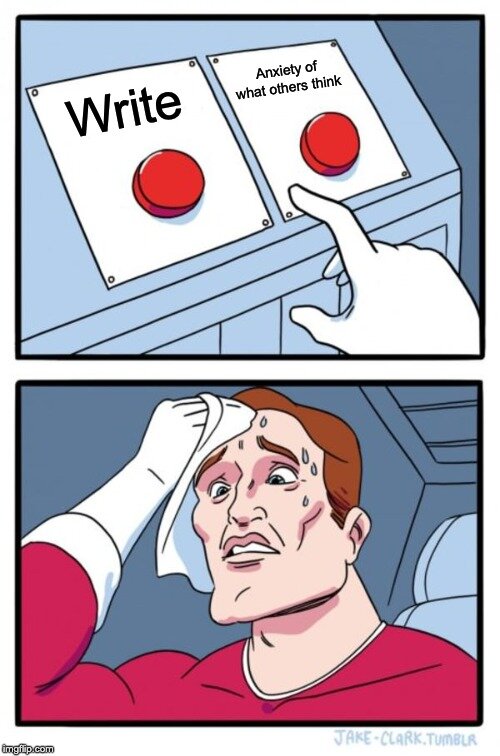
“No one will like my writing.”
Undertone: I need people to like me. I need people to validate my writing.
To ask yourself:
Why do you think this?
How do you know?
Have you experienced this before? If so, what feedback did you get?
Who are you writing for/to?
Actions to take:
Continue to write anyway.
Consider writing a different genre. So you didn’t do so well on a book? Why not try a short story or poem.
Look for a different audience. Maybe your writing is engaging, but the wrong people were reading it. If your friend doesn’t like romance books and you ask her to read yours, she might not like it as much as someone who reads them regularly.
Thoughts from others: Tucker Max does a great piece on book writing fears in his blog Scribe.
“My writing isn’t good.”
Undertone: I’m not talented. I don’t have it in me to create something good.
To ask yourself:
What do you already know about?
What areas do you feel confident about?
Why do you think your writing isn’t good?
How do you define “good”?
Action(s) to take:
Continue to write anyway.
Practice. Practice makes perfect! No one is born the perfect writer. All the greats had to practice to get where they are/were, too.
Read about how to write, and read good writing. There are plenty of great “how-to” books or books on crafting your writing. If your definition of “good” writing is really specific, you should also read that type of writing and dissect it. What is the writer doing? For what reasons?
Thoughts from others: Writer Dan Shewan has some tips to improve your writing, if you’re still feeling like you need some help.
https://www.youtube.com/watch?v=0JMCgBjTUg4
"Writing should be feelingful." - Richard Walter
“I am not inspired. I don’t have any great ideas.”
Undertone: I don’t have ideas that are worthy of other people’s time.
To ask yourself:
What are your ideas?
What makes an idea worthy of someone’s time?
If you have ideas and they aren’t worthy right now, what could you do to get them there?
Who are the “people” and why are you worried about wasting their time?
Action(s) to take:
Continue to write anyway.
Go somewhere new. Take a walk around the block. Take a short day trip. Go see your parents or a friend. Walk the dog. Do something besides stare at the paper. Think about other things, and when you come back, you will have a little different perspective.
Brainstorm your ideas and then pick one to write about. Look, not all of our ideas can be winners, right? That doesn’t mean that you don’t have any good ideas! Once you put them on the page together, you will be able to see which ones might work and which ones sounded cool in your head, but not on paper. Once you have a list, pick one and do some freewriting on it - whatever comes to mind.
Thoughts from others: The Write to Done Blog offers 31 ways to find inspiration when you’re just not feeling it. SmartBlogger offers a whopping 99 ways!
“No one will care about my writing, even if it turns out well.”
Undertone: I need someone to validate me. I need people to care about what I’m saying for it to be worth it.
To ask yourself:
Who do I need to care about my writing?
Why do I want them to care?
What would happen if I wrote something just for me?
How will I know if it is good?
Action(s) to take:
Continue to write anyway.
Write something personal. Write about something that hurts. Something that’s happy. Something that makes you laugh! You don’t have to share it, but write it. Even if you don’t share it, you still know that you did it. And, you can always come back to it later.
Write something that you want to write about and share it with someone you know will be honest with you. This is probably a hard step. But, when you write something that makes you happy, or sad, or whatever it is, someone around you will be interested. Even if it’s just because they want to support you, are curious, or just plain care about you as a person. Be brave and send that writing to someone who will tell you what they actually think instead of just the fluff and stuff comments.
Thoughts from others: Writer Jenna Moreci offers some sage advice about doubting your writing. (Just a heads up, there is some swearing!)
https://www.youtube.com/watch?v=HMwAXZ0v76c
“I’m creative, but I’m not a writer.”
Undertone: I can’t do it. I don’t have the skills. I don’t know where to start.
To ask yourself:
What can I do?
Where do other people start?
What would happen if I started something in the middle or wrote about exactly what I’m thinking at this moment?
What makes someone a writer? What if you were a writer?
Action(s) to take:
Continue to write anyway.
Do something creative & then write about it. If you’re creative (but not a writer) then it should be fairly easy to create something, right? Create that something you are inspired to create, or you have been thinking about for a long time. Once it’s created, write it’s story. Why did you create it? What does it mean to you?
Ask yourself why you don’t feel like a writer. You don’t have to actually ask out loud, if you don’t want to, but you should have a serious conversation/contemplation with yourself about why you don’t think you’re a writer. A lot of times this can come from imposter syndrome, but sometimes it’s a simple matter of how we define what a writer is.
Thoughts from others: Published writer Christian Fink-Jensen talks about six qualities that make up a successful author. Fink-Jensen focuses mostly on authorship of a book, but the six qualities absolutely apply to any type of writer you want to be.
So, are you scared? That’s okay! I didn’t share my novel with anyone until very recently! I’m talking within the last month. You can do it, though. Really. I believe in you, and you should, too.
I’d love to hear about your writing and your journey!

Books I Don't Love, But Feel Like I Should

I love reading, there’s no doubt about it. It’s always been one of my favorite things. I do have some particular tastes, which you can read about in my blog on what makes a “good” book. I also have a list of my favorite books and recommendations if you are interested.
Unfortunately, not everything we read will be our favorite book. The novels below are some that I have, in fact, read, but do not care for.
Many of them, though, are books that have historically been well-loved favorites by many people! It is for this reason that I always feel a tinge of regret that I don’t like them. They are not in any particular order.
Things Fall Apart by Chinua Achebe
Brief Synopsis: To be honest, the plot of this novel is very complicated. I don’t even feel comfortable trying to sum it up in a few sentences! So I will let SparkNotes do the talking on this one.

Overall Impression:This is actually one of the first books I remember disliking. I read it when I was taking introductory composition my senior year of high school, and struggled every bit of the way to finish. I was not really interested in the plot, and I think there are a lot of intricacies and larger discussions I probably missed as an inexperienced reader who hadn’t really learned to read critically. The plot is also very complicated, as you can see in the link above, and I don’t think I had the tools or interest to really get involved in figuring it out.
Romeo & Juliet by William Shakespeare

Brief Synopsis: This play has been a small part of most of our lives since high school when we all got assigned to read it. A classic play written by the famous playwright William Shakespeare about two feuding families: the Capulets & the Montagues. Juliet Capulet & Romeo Montague “fall in love” despite the feud. In order to be together, Juliet fakes her own death (because this is a logical conclusion). When Romeo finds her, he actually commits suicide. Juliet wakes up and she commits suicide because she can’t be with Romeo. By the way, did I mention this is all over a matter of 3 days? At least after these tragedies occur, the families agree to stop feuding.
Overall Impression: Look, Shakespeare was a master of words and brought a lot of great new words and ideas into the world; BUT, this story is about two teenagers who commit suicide because they can’t be together after 3 days. Definitely not my idea of a great love story.
Lord of the Flies by William Golding

Brief Synopsis: It’s war time, and a group of boys survives a plane crash and live alone on an island. They form a society, with all that entails, and it highlights the issues present in all societies, as well as how savage people can ultimately be. They are eventually rescued before one of the main leaders, Ralph, is killed.
Overall Impression: I wasn’t mature when I read this book. I was in high school. But my lasting impression was utter boredom and dislike. I didn’t connect to it on any level, which is part of what draws me into a book. Even though I feel as though I should read this novel again to see if it was immaturity driving my dislike, I really just don’t see the draw here.
The Hobbit by J.R.R. Tolkien

Brief Synopsis: Like many other epic fantasies, this tale follows the adventures the main protagonist, a hobbit named Bilbo Baggins, as he becomes a “burglar” helping a bunch of dwarves take back their home. Mind you, hobbits are not creatures that like adventures, so it is very abnormal for Bilbo that he ends up battling a dragon, visiting kingdoms of elves, and more.
Overall Impression: I love these movies! I have watched them about a thousand times! But the description in the book is just too thick for me. I’ve tried several times to read this and I’m always overwhelmed by the minutiae.
Game of Thrones by George R.R. Martin

Brief Synopsis: This fantasy epic is hard to sum up in just a few lines! All of the typical fantasy arcs take place: heroes, villains, overthrow, war… and most people you come to love and root for as a reader die.
Overall Impression:Martin’s prose is great. I actually really like his writing style. There are just way too many characters and subplots for me to follow. I liked the show! So I expected to like the book; however, it’s just not my cup of tea.
Wuthering Heights by Charlotte Bronte

Brief Synopsis:This novel is purported to be love story of Heathcliff (an orphan) and Catherine Earnshaw. They flirt with the idea of love, but Catherine chooses to marry another man despite her feelings for Heathcliff. The story is told from the memory of a housekeeper who lived through the tempestuous times and is now relating the events to the current tenet.
Overall Impression: It took me 3 tries to read this all the way through, and I had to buy a fancy edition to bribe myself. The prose is beautifully written, but the people in the book are terrible! For something that’s been hailed as one of the greatest love stories ever told, I was expecting a lot more. If you’re expecting a fairy tale ending (I see you, Jane Eyre), you will be disappointed.
Ulysses by James Joyce

Brief Synopsis: Who the heck knows? But really, it’s supposedly follows (loosely) the plot of Homer’s Odyssey. Encyclopedia Britanica describes the novel as, “Stylistically dense and exhilarating.” People far smarter and more dedicated than I were able to figure this one out.
Overall Impression: I tried to read this in grad school - we were reading it for a class - and I didn’t understand one bit of it. Now, to be fair, I was extremely overextended that semester, so I might not have paid as close attention to the smaller details as I could have. That being said, nothing about this book drew me it. Period.
To Kill a Mockingbird by Harper Lee

Brief Synopsis: This novel is told from the point of view of a young girl, Scout, whose father is a lawyer in a small Southern town during the 1930s. The father is a lawyer who is defending an African American man who is being accused of raping a Caucasian woman even though he couldn’t have possibly done it.
Overall Impression: This is another book I read as a young adult. My biggest memory of this book isn’t necessarily bad, but definitely bored. I do feel like this is one I have a chance of liking as an adult, because when I was younger, I don’t think I picked up on all of the intricacies and bigger conversations surrounding it. The last time I picked it up (maybe a year ago?), however, I just didn’t get into it.
Dracula by Bram Stoker

Brief Synopsis: The novel is set in the 1800s, largely in Transylvania. Lawyer Jonathan Harker travels to a castle for a real estate transaction with Count Dracula and immediately becomes aware of the creepy vibe in the surrounding town. As it turns out, Count Dracula is a vampire! So, when Harker escapes and goes back to England, naturally he rallies a team, led by Professor Van Helsing, to go kill Dracula...Spoiler alert, after a lot of other deaths and cross-country travel, Van Helsing’s team does end up killing Dracula.
Overall Impression: This book is actually very creepy! The prose is well-written, but I do not tend to enjoy books that give me the heebie-jeebies. Because let me tell you, Dracula has been majorly Hollywood-ized! He is way creepier in his original prose form. Not to mention, there’s a lot of death & vampires in the novel (to be expected), which is not really what I like to read about in general.
The Adventures of Huckleberry Finn by Mark Twain

Adventures of Huckleberry Finn
Brief Synopsis: The title pretty much gives this one away, on the surface at least. The book follows a young boy named Huckleberry Finn as he goes on many adventures down the Mississippi River. But who can forget Jim, a runaway slave who accompanies Huckleberry, or the other cast of memorable characters they meet along the way.
Overall Impression: I read this book when I was a young adult, and I did not connect with the characters very well. I remember laboring to finish the book, and being glad when it was done. The characters are very memorable! So it has that going for it, but Twain’s prose is not my cup of tea. I am sure that I also missed the bigger racial and controversial undertones of the novel when I was reading it, so perhaps it could mean more now that I have critical reading skills (like Things Fall Apart & To Kill a Mockingbird...is there a pattern here?)
BONUS!
World War Z: An Oral History of the Zombie War by Max Brooks

Brief Synopsis: In this zombie apocalypse book, the living have finally won the war over the living dead (zombies) after 10 long years. The man who wrote the final war effects report gathered many first hand stories of those who fought the war.
Overall Impression: I am not a fan of zombies or apocalypse type stories to begin with, but I was assigned this novel for a class. In general, I like the oral history aspect, but zombies kind of freak me out! I couldn’t finish the book because I was in college and mainly reading at night before I went to sleep...with the effect of having nightmares about zombies under my bed. I do know people who like the post-apocalyptic world in books, and it seems to be of decent quality in that respect? The movie was decent, as well. But, I don’t much enjoy having zombie nightmares.
Do you love these one or more of these books? Make the case and convince me to retry or reread! I would love to read a book with a new perspective in mind.

10 Excellent Books to Read This Year
UPDATED AUGUST 2020
There are so many books in the world today, especially with the innovation of e-books! I try to vary what I read both by genre, author, and length in an effort to see what the world has to offer. I admit, though, that overall, I tend to prefer fiction. If you're interested in knowing more about the specifics, check out my blog on what makes a book "good."
My academic background is in literature, so, as you can imagine, we spent a lot of time reading the “classics,” which often includes books by a slim canon of authors. There's not much diversity in the classical canon, at least not in my experience. It was refreshing in grad school to hear from so many of my peers who have been reading other things for years! And from my professors who study more diverse writing and writers for a living.
One of my favorite feelings is finding a new book or author I adore. If an author can interest me in one book, I will read the rest. It’s even better if someone has recommended something to me, because then I have someone to share my excitement with when I absolutely love the book and am sad I finished it.
The novels below are some of the absolutely adore sort and ones that I would wholeheartedly recommend. They are not in any particular order.
East of Eden by John Steinbeck

East of Eden
Brief Synopsis
This epic and complicated novel focuses on the brothers Charles and Adam Trask and their tumultuous relationship, which is supposed to resemble that of the biblical figures of Cain & Abel. Adam Trask’s sons, Aron & Cal, end up having a similar relationship, too. Essentially, all of the men are jealous in thinking that their father loved the other brother more. This cycle is broken - tragically - at the end of the novel.
Overall Impression
This is the first Steinbeck novel I read, and I loved it from page one. I love the description and the way Steinbeck writes. It’s a long haul, and it took awhile to read, but something about the whole realistic but fictional world Steinbeck creates is enchanting.
Gone with the Wind by Margaret Mitchell

Gone With the Wind, 1st Ed.
Brief Synopsis
This expansive novel follows the story of southern belle Scarlet O’Hara through and after the Civil War. The war tests her wits & strength, and she learns many lessons in life and love along the way.
Overall Impression
From the first time I picked this novel up in high school, I loved it. I love the description and characters, which is important since the book is over 1,000 pages long! A note, though: there are some problematic descriptions and a romanticized view of slavery that I did not pick up on when I first read it. I do love the story, but I don’t at all think it’s a realistic view of many pieces of the Reconstruction era.
The Physick Book of Deliverance Dane by Katherine Howe

The Physick Book of Deliverance Dane
Brief Synopsis
This novel flips back and forth between the present day story of Connie Goodwin - a PhD candidate who is working on her History dissertation research - and the 1690s when the Salem witch trials were taking place. When tasked with cleaning out her grandmother’s house during the summer, Connie finds a mysterious piece of the past that leads her to find surprising, and dark, history. She might be related more closely related to the trials than she initially thought.
Overall Impression
The was Katherine Howe’s first book, and I’ve read every other book she’s written since. Connie’s character resonates with me, since I am familiar with the graduate school process, and I enjoyed watching the story unfold through Connie’s usually careful eyes. The whole novel is very much a growing experience for her, and I liked watching that occur. I also like that the story flips back and forth between present day and historical. That almost always intrigues me.
Anne of Green Gables by Lucy Maud Montgomery (Books 2 & 3 are also good)

Anne of Green Gables
Brief Synopsis
Anne Shirley, an orphaned girl in Canada, finally finds her forever family. The books tell the tale of her adventures and mishaps during childhood, as well as on through her adulthood in the later part of the series.
Overall Impression
This is my immediate go-to when I need a feel good happy book. There are very few characters that I can think of who are as pure and just plain enjoyable as Anne Shirley. The 1985 film series with Megan Follows as Anne is also great!
Harry Potter by J.K. Rowling (The Entire Series)

Harry Potter series
Brief Synopsis
Harry Potter learns, at 11 years old, that he is a wizard! He’s not just any wizard, either, but a very famous one who survived a murder attempt from one of the most powerful dark wizards of all time when he was just a baby. He’s raised by his “muggle” (non-magic) aunt & uncle, and the 7-book series follows his mishaps and heroism as he goes through magic school.
Overall Impression
I love the entire book series (and the films!). I’ve read them all the way through probably at least 5 times. J.K. Rowling created one of the most magical worlds I’ve ever found. The first book, The Sorcerer’s Stone, was published in 1997, and the seventh and final book, Harry Potter and the Deathly Hallows finished the series in 2007. I remember the night it came out because my dad took me to the midnight release!
The Great Gatsby by F. Scott Fitzgerald

The Great Gatsby
Brief Synopsis
Nick Carraway recalls the events of the summer he lived next to Jay Gatsby, a self-made millionaire. Carraway recounts the wild and mysterious things he learns about Gatsby, and what he learns from his friend before Gatsby’s untimely demise.
Overall Impression
Full disclosure: I read this in college, for a class, and loved it; BUT, if I had read it in high school like a lot of people I know, I don’t think I would’ve liked it because I wouldn’t have been able to look at it critically enough. I like the prose, but I also like Carraway’s voice - can we trust him? We don’t really know, but we want to. I also like that Fitzgerald starkly questions the idea of the “American dream.” To clarify, he doesn’t promote the idea that it doesn’t exist, but he does point out the intricacies of social class and the things people do to live/achieve this “dream” that no one talks about.
The Brief Wondrous Life of Oscar Wao by Junot Diaz

The Brief Wondrous Life of Oscar Wao
Brief Synopsis
Oscar de Leon, also known as Oscar Wao in the book, is a huge sci-fi/fantasy nerd who dreams of falling in love. His family is from the Dominican Republic, and he really finds himself when he visits there one summer. His family always encourages him to get out of his shy shell, meet some girls, and do normal “boy”/”man” things. When he does, though, it’s not what they expect, and ends very badly for him.
Overall Impression
I really liked this book because Diaz’s writing is very engaging. He does a great job crafting Oscar’s voice. But also, how many times is being a nerd portrayed as a good thing? It definitely is in this book! Oscar’s true nerd self is much better than the stereotypical “man” self he tries to be at the end of the novel. His attempt to be someone he’s not is his ultimate downfall in the end, and I like that Diaz really dives deep and gets at the intricacies of Oscar’s view of his own masculinity. Nerds rule the world!
12 Collections & The Teashop by Zoran Zivkovic

12 Collections & "The Teashop"
Brief Synopsis
This book is called a mosaic novel, which means that it is comprised of 12 brief pieces of writing that all relate to each other. The patterns and links between each of these odd characters is what helps the reader put together some semblance of a meaning from the novel. “The Teashop” is a short story included at the end of the work. It is a story about a simple trip to a tea shop with magnificent storytellers...or is it?
Overall Impression
I bought this book because “The Teashop” is, hands down, one of my absolute favorite short stories ever, and the novel was just a bonus. The short story is just a really fun read. It’s just real enough to make you think it could happen, but just fantastical enough to question whether it could. The mosaic novel interesting because the work is short, less than 100 pages, but you really have to read it more than once to understand the connections and figure out what’s going on. I’ll say this, the characters are fascinating, and the whole book is very purple. You’ll never read anything quite like this book, that’s for sure.
The Night Circus by Erin Morgenstern

The Night Circus
Brief Synopsis
A black and white circus travels around, mysteriously appearing in towns and staying briefly before disappearing into the night to the next town. The circus is only open at night, and features real magic! It’s also the scene of the ultimate battle of two magicians who each have a “player” who doesn’t know s/he is being groomed from the time s/he is young to play the ultimate magical game. The two players face-off and beat the odds. No one wins the game.
Overall Impression
I love a lot of books that have magic because they are mysterious and go outside of the “normal” world we live in. The Night Circus is excellent and I have read it several times. Morgenstern has quite a knack for weaving little pieces into a full narrative without giving anything away.
Emma by Jane Austen

Emma
Brief Synopsis
Emma is from a well-to-do family and loves meddling in other people’s love lives. Little does she know that she is in love, too! With whom might surprise you, and it definitely surprises her.
Overall Impression
Emma is my favorite Jane Austen novel. Yes, I said it. It comes in just above Pride & Prejudice for me, although I love that one as well. The novel discusses love in a very different way, but still with memorable characters. Emma is one smart cookie, and very observant, but when it comes to figuring out her own love life she is clueless. And for the record, I think Emma and Mr. Knightley are a great match despite the age difference.
BONUS!
Half Broke Horses by Jeanette Walls

Half Broke Horses
Brief Synopsis
Walls tells the story of her grandmother, Lily Casey Smith, who lived during the early 1900s. Lily's life is full of unexpected adventures, survival through extremely tough times, and a never failing can-do attitude.
Overall Impression
This book was amazing! I love the voice that Walls creates for her grandmother and mother. It's almost magnetic. You don't know what's going to happen next, but you have to turn the page and find out. It's also look into the lives of ranchers and survivors of hard times that many people in our generation don’t know about or understand. Quite refreshing.
Don’t see your favorite book? Send me an email & convince me why I will love it! I love recommendations & talking books with others who enjoy them.

6 Organic Ways to Grow Student Confidence
As a college instructor, one of the most important things I do is work to ensure that my students come out of my class confident in their ability to write and conquer their other classes. Confidence and self-efficacy work hand in hand on this.
I began my teaching career at Ball State University, and was blessed beyond belief to have incredible mentoring that really helped me figure out what my priorities are for my students. I almost immediately made fostering confidence a purposeful goal in my teaching partially because of my own experiences and partially because of what I saw in my students. Being confident in writing is a major pain point for so many people.
Every semester, without fail, at least 85% of my students answer their first day survey (one of the activities I use to begin creating open dialogue) that they are “not good” at writing or writing “isn’t their strong suit.” This was true at Ball State, and it continues to be true at Ivy Tech Community College where I teach now.
Instructors at four-year universities and community colleges alike genuinely care about student confidence, but no one seems to be sure how to discuss it or change what we all see. My colleague and I did a study on this in graduate school wherein a majority (57%) of our survey respondents did discuss confidence in some way in the classroom, but the other 45% did not. We didn’t know whether this came from it not being a major concern or not knowing how to begin that discussion.
Growing and discussing confidence in the classroom can be tricky for a number of reasons. In the beginning of the semester, I never know what experiences students have had with writing (good or bad), or anything about them academically. I don’t know what’s going on in their personal lives that could be affecting them in the classroom, or what changes throughout the semester unless they tell me.
Writing is also much more subjective than math or science where there often is only one truly correct answer. As English teachers, we tend to get a more personal look at our students because many submit writing based on experiences, which can be raw and emotional.
So how are you supposed to be able to grow student confidence in your classroom when you don’t know anything about them and there is more than one right way to write? Good question!
Below are 7 practices I actively utilize in my classes every semester that WORK.
Learn their names, and quickly
This is critical. I try to learn all of their names by the second week of classes; however, if you’re teaching a 4-5 class load, this might take you additional time. That’s a lot of names!

This helps for a couple of reasons.
You might be the only teacher that student has who knows their name & it shows you care.
Often in writing and composition classes, we hear some very personal information due to the nature of the beast. We ask students to write about things that matter to them, and sharing those things with a teacher is scary!
When you know their name quickly, it grows the relationship beyond “student and teacher” to “student and person who is my teacher.”
The major difference here is the person aspect. You were a person before you were a teacher, and that’s important because they are a person too. A person is more approachable than the title of teacher, so students are more likely to come to you for help when they need it.
Have a discussion about confidence
This seems to be the crux for a lot of instructors I’ve talked to about it. How does one talk about confidence without asking students to share out loud in class? That could be both unnerving and uncomfortable for students who are already worried about it.

I begin the “discussion” at the beginning of the semester in two ways.
I tell my students up front on the first day that I know that writing is hard and it’s not everyone’s cup of tea. We are there to learn, first and foremost!
Nothing is perfect, and we need to start where we are at and build on it. Sometimes students have just come out of high school or sometimes they’re coming back after 10 years. You just never know where they are at, and that’s okay.
I have them fill out a survey asking them questions about their writing experiences and confidence level with writing.
I don’t grade these, but it gives me a way to tell where they are without them having to tell me out loud. They also get to look back at these surveys on the last day and reflect on how far they’ve come.
Be transparent about your goals
This might seem obvious, but sometimes students really don’t see past the syllabus. If I don’t tell them what I value for our class time, they won’t know! Everyone values things a little bit differently, and every class has a different set of official objectives, so this piece will be unique to you and your institution.

Your teaching methods and goals drive the class and atmosphere no matter what objectives you’re trying to achieve.
Students value this openness and tend to feel more comfortable asking a question or reaching out for help when they feel like they know what you want and expect of them.
It also makes your life easier when you don’t have to try to remember what you told your students. I believe, and have seen, that honesty and transparency are the best policy.
Be vulnerable & empathetic
This is probably the most important thing, for me, in building student confidence. I tell them some personal things when I introduce myself on the first day: I’m married and have an adorable, crazy little dog. I also tell them that I have another job and what it is.

Above all, I tell them that I was a student not long ago, and I know how hard it is. I really do get it.
My goal here is always to humanize myself and make myself approachable.
I don’t want there to be a time when any of my students can’t ask me a question because they are worried about how I will react! It’s literally my job to answer their questions, so I want to make that as comfortable as possible.
In terms of empathy, it is important (and sometimes very difficult) to try to step back and think like a student in order to gauge the situation.
If a student comes to me in a panic about not being able to get to his/her/their three page minimum, my first response is always to have them explain why they are worried and what their thoughts are.
Sometimes they just need to talk it out, or sometimes they just misunderstood the instructions. Either way, being empathetic to their panic is much more effective than brushing it off.
Always find something positive to say about their writing.
Have you ever gotten a paper where it’s obvious the student just phoned in the assignment? Or that they just completely missed the point of the entire project? I know I have! And sometimes it’s just not a very good paper.
But, here’s the thing.
You and the student both know it’s not the best paper, and the student probably expects a lot of “red ink” and criticism because that’s what has happened in the past.
I always lead any written comments I’m giving with a compliment. Always. Even if that’s about the fact that they remembered page numbers or have a creative title.
If you really want to build their confidence, you don’t want to be just like all the other English teachers who didn’t take a moment to find a compliment.
This isn’t to say that you should make up something or dig with a magnifying glass to find something fantastic; however, students do gain confidence when you recognize that they have done something right, even when you both know the paper wasn’t awesome.
Meet with your students one-on-one multiple times during the semester.
This is a hard goal, mainly because we only have a limited number of days in any given semester. We have 16 weeks to teach them what they need to learn, and we usually need every minute of that!

However hard it is for me, I make sure - every semester - to meet with my students one-on-one at least twice. One time I cancel the class(es) for the week & we do conferences for their research topics.
This is early enough in the semester that we are still new to each other, but after the first project so they know how I operate.
I check in about how their semester is going and just life in general.
The second time, we meet outside of class and I explain my comments on the first draft of their research paper. This way we are there, in person, and they can ask questions where something doesn’t make sense.
I practice all of these in my own classroom, and they have worked. I’ve seen students grow throughout the semester and become more confident in their writing (and as students). There are definitely differences from university to community college, but these practices have worked in both settings.
I will be the first to admit that I am not perfect and I still learn important lessons every semester, without fail. These are simply things I’ve implemented because of what I’ve seen in the classroom.
What do you see in your classroom? What have you noticed or tried? If you teach younger students, would these practices (modified, of course) benefit your classroom?
I’d love to hear your thoughts!

I Love Writing, But...5 Excuses That Hold Us Back From Our Writing

As writers, we love to create. We love the feeling of putting our words on paper, of inspiring others or drawing out emotion, and that feeling of accomplishment when something feels “complete.” But sometimes what we love doesn’t quite translate into what we do.
There are days, weeks, or even longer periods where we simply don’t make time for what we love. I waited years to begin writing again. It was such a long time that I almost forgot I had a writing voice in the first place. I made these choices despite the fact that writing has always been my favorite hobby and biggest talent.
Sometimes we use “busy” as an excuse because we are scared or discouraged.
Sometimes we might be genuinely busy with work, family, or community commitments. There have been several periods when I’ve been in college or grad school working a job or two on the side. There have also been times when I’m working a full time job and adjuncting in the evenings.
Sometimes, though, we use “busy” as an excuse because we are scared or discouraged. I know I am guilty of this. I mean, I made excuses not to write for 7 years! That’s almost a decade. But here’s the thing: I thought about writing. All. The. Time. Perhaps not every day, but certainly every week.
Every time, I told myself at least one of the statements below. Here are some ways that I’ve figured out to fight these excuses (they were always excuses for me) and make time for my writing.

Not enough time
I’m too busy. I don’t have enough time.
This is probably the most “comfortable” fallback of any I’ve ever used to convince myself I don’t need to write. It’s definitely one of the excuses I’ve used the most. I have come to realize, though, that no matter how busy I am, if I can make time for just 10-15 minutes of concentration on my writing, it actually relieves stress. It doesn’t matter if it’s the worst thing I’ve ever written - if I get something down onto the page and it gets me out of my head for a few minutes in an otherwise stressful day, it’s worth it to me.
No matter how busy I am, if I can make time for just 10-15 minutes of concentration on my writing, it actually relieves stress.
I have taken to writing at lunch on especially busy days. If I am in meetings all day or have an abundance of tasks to complete, setting aside 20 minutes (and putting it on the calendar!) to eat my lunch and jot down some thoughts is soothing. When I am done, I feel much more relaxed and ready to take on the rest of the day.
Setting a timer is also helpful when I am extremely busy. This works during lunch when I’m writing, but even more so when I’m at home. Having a time dedicated to something I love, even if it’s just 15-30 minutes when the whole weekend is packed with engagements and responsibilities is invaluable and refreshing.

Family first
Family first. I don't have time.
First, your family is absolutely important! Especially if you have kiddos at home! We don’t have any yet, but from my limited experience, it’s a pretty crazy adventure to undertake, and you might not always be able to just set a 20 minute timer and ignore everything else. Pets and significant others are also a big factor. After a long day of being at work, your spouse might need some TLC. And, I don’t know about your pets, but my dog definitely needs some me time for belly rubs and such when I get home.
You might not always be able to just set a 20 minute timer and ignore everything else.
What has worked for me with a husband and dog is to write when they are asleep. This could be early morning or late at night. Or, sometimes if they are napping on a weekend, right during the middle of the day. This is a way to get some “me” time in with my writing without taking time away from other family-oriented activities.
The other thing that I’ve done is to make my little family part of my process whenever I can! My dog, Charlie, is the best little cuddle bug on gray days when I’m trying to make excuses not to write. He will curl up next to me and take a snooze while I get some writing done. I will often ask my husband a question (usually very random with a “Wait, what?” response) about whether something is plausible or believable. I think this could also work with older kids, if they enjoy being creative and like to try doing what mom/dad do. Help them get started on their own story, or have them draw a picture story.

Inspiration
I don't have inspiration.
Whoa is this familiar! "I don't have inspiration" combined with “I’m too busy. I don’t have time.” is such a powerful deterrent - especially when you tell yourself that over and over again. I get it. Some people just seem to be overflowing with inspiration and always seem to be working on something different. And here you are with half an idea that’s barely even a whole thought.
Hard truth? You know all about yourself and have unique experiences that no one else has had.
But, hard truth? You know all about yourself and have unique experiences that no one else has had. Even if others have gone through something similar, in the end, no one is you! So, start by writing what you know. Write about your experiences, the people in your life, the things you love (or hate), or even things that inspire you. Maybe you have something in your life that doesn’t “look” like an inspiration for expressing yourself, but it might be if you give it a chance.
If you’re thinking that you’re still not inspired by your own life or circumstances, why not think about what you would like to learn? What big questions do you have and how would you answer those right now, at this very moment? How would you go about finding a better answer, if there is one?

My life is boring
I don’t have anything to write about. My life is boring.
How many times have you told yourself that your life is boring and no one cares what small problems you have going on? How many times have you looked at someone else and thought about how exciting their life must be? Even if no one will ever read it, consider writing about your own life. You could do creative nonfiction essays, like my good friend Courtney, or you could fictionalize it like I have. You could even start a journal for complete privacy.
Writing down bits and pieces of your life will become valuable to you at a later time.
Any way you choose, writing down bits and pieces of your life will become valuable to you at a later time. I have journals from when I was a teenager and first time college student and it is a hoot (and most times quite dramatic) to read about my life and feelings at those points in time.
What’s going on in your life right now? What hurts? What makes you happy? When my grandma died 5 years ago, one of the ways I learned to cope with it is to write about her. It was tremendously sad, as we were very close, but it was also cathartic. On the other hand, has anything great happened? Have you had a big milestone, made a life-decision, or perhaps even just made a new friend? Write about it! It will continue to give you joy even as the excitement fades.
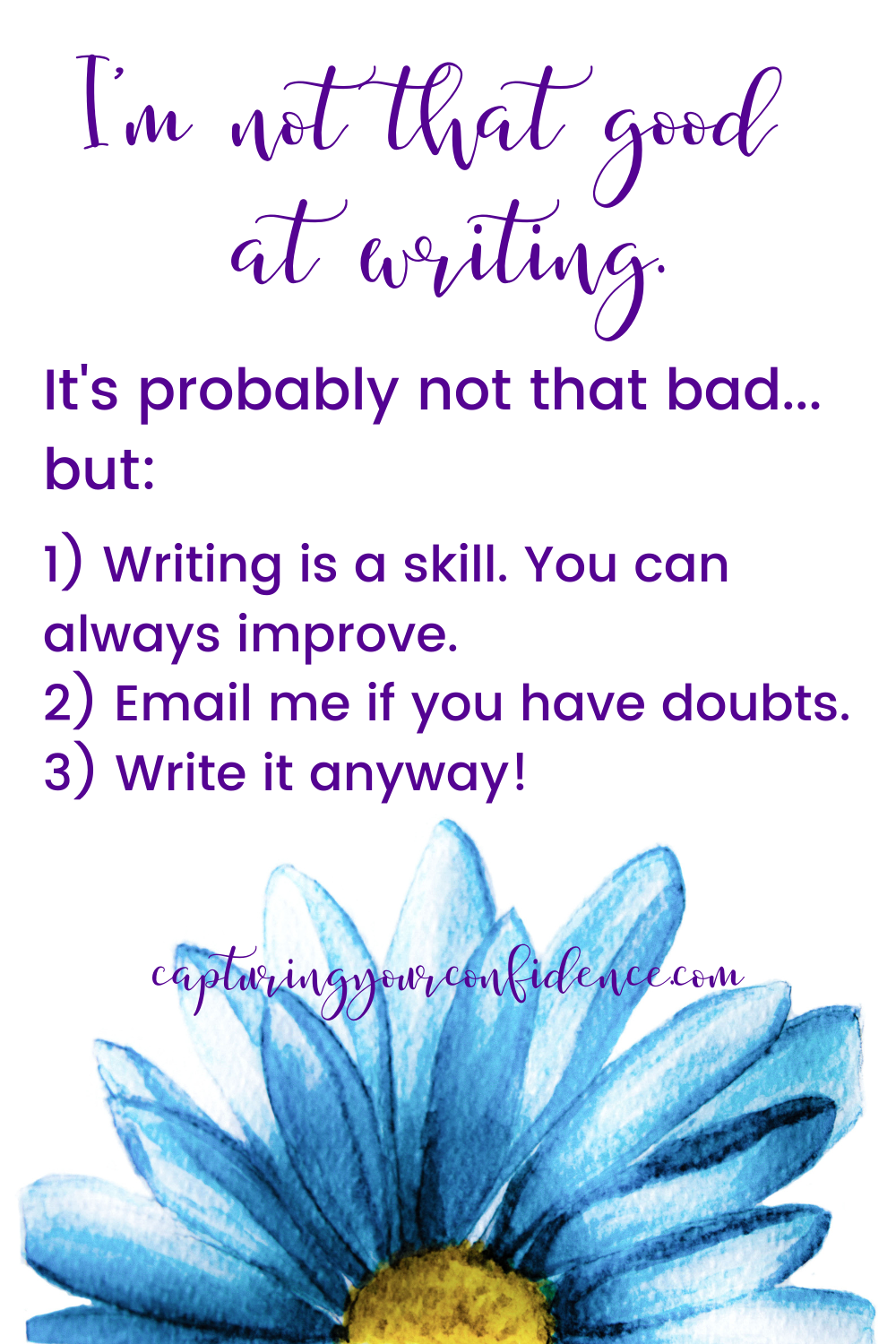
Not that good
I’m not that good at writing.
I hear this a lot from my students. For many, there is this constant nagging fear that someone will read their writing, which they are not confident about, and think poorly of them because of it. A note on this from a college English instructor: it’s probably not that bad. I haven’t read your writing (yet), but almost 100% of the time, it’s not as bad as you think. And, if it is, you can always add to it and change it! Good writing is not a one and done activity, it’s a process.
I haven’t read your writing (yet), but almost 100% of the time, it’s not as bad as you think. And, if it is, you can always add to it and change it!
If you are inspired and passionate about something and you want to write about it, no one has to read it! You could keep a journal or write a story and keep it to yourself. If you want to write, you should do it. If you are that worried about it being “bad,” email me and we will talk about it!
No one should feel afraid to express themselves in writing because of something that someone else thinks. Believe me, in the long run, you will regret not writing down your ideas more than you will regret someone telling you it was “bad,” especially when it probably just needed some extra love and attention.
Obviously these are not the only excuses we use. These are simply some I have found most common in my own life, have heard from other writers, and that students have told me when I am teaching.
What are some excuses you have made or reasoning you have used that has stopped you from writing? Did you encounter actual problems or did you use them because you were scared? How did you overcome them? What did you do during times when you couldn’t overcome?
If you’re in one of those periods now, I’d love to chat and help you figure it out! Drop a comment below or email me at rachel@capturingyourconfidence!

The Adventures of Writing a Novel
Have you ever woken up from a dream, and for just a moment you thought it could have been real? That’s how my adventure of writing a novel began.
UPDATED JUNE 2020
Have you ever woken up from a dream, and for just a moment you thought it could have been real? That’s how my adventure of writing a novel began.
In April 2019, I was blessed to celebrate a friend’s upcoming wedding at her bachelorette party. Now these events usually get a “dirty” connotation with all kinds of phallic-shaped objects and sloppy drunken shenanigans, but this (thankfully) was not that kind of party. I met some great women, connected with a few I hadn’t talked to in far too long, and overall had a very pleasant night.
The scenery was idyllic: a remote, hilly area with trees and narrow back roads for miles.
We were all sharing a large cabin in the woods, and there was plenty of space for everyone. The scenery was idyllic: a remote, hilly area with trees and narrow back roads for miles. The cell phone service was poor, and the WiFi was nonexistent, which, despite how it might sound, was a great reprieve from the urge to get online rather than spending time with the ladies around me.

Friends
April 2019
I was overtired when I went to bed, and didn’t sleep well. I never really sleep well under conditions where I’m not familiar with my surroundings, and/or away from my husband and dog.
Typically, with this combination of circumstances, I dream vividly. Not the kind of dream that leads you into a peaceful sleep where you wake up feeling refreshed, but the kind of dream where you feel actively involved and wake up feeling like you lived a different day overnight.
It was all very dramatic.
During this particular dream, there were two people, one young man who seemed familiar in a vague sort of way, and the other a young lady who seemed a lot like me in my younger years. They were both on the younger side of college age. The girl was taking refuge in her university’s library to get away from her problems, and the young man was her friend who found her and came to comfort her. It was all very dramatic.
When I woke up, I shook off the fuzzy feeling from not sleeping well, but that particular moment lingered in my mind. Who was that guy and why did he feel familiar? And that particular moment had definitely not occurred in my life, so why did it feel like a memory?
Amidst the hubbub of having breakfast and packing up my things to leave, I lost track of the scene. I absentmindedly wondered if it would come back to me.
I began the two hour drive home, and it was back.
I began the two hour drive home, and it was back. Crystal clear. A name for the guy, and why he felt familiar. He looked like someone I had recently met, but with the personality of someone I had known for years. It was almost like something out of a movie, that scene from my dream. Or, a really good dramatic book.
I thought about that guy, and that girl, whom I surmise had very similar experiences to me, the entire way home. By the time I hit the highway (we were pretty remote!), both people had a name. By the time I had been driving an hour, they had a story arc together. By the time I arrived home, I had two scenes in a creative work I couldn’t define or say where it was going.

Country Roads
Country roads make for good contemplation!
As soon as I got home, I wrote down the scene I dreamed. It was much more brief on paper than it seemed in my mind: just 425 words. But then, another scene came pouring out. This scene was a little longer, just over 800 words, and is still my favorite scene in the entire piece.
So, there I sat, with about 1,200 words written of this thing I dreamed about. It was the first substantial creative thing I had written in 7 years. SEVEN YEARS. And I wrote 1,200 words in an hour.
The next day I wrote another scene. And so I’ve continued. The longest scene is about 7 ½ pages, and the shortest is just a page. I typically do one scene per sitting, and it’s rarely linear. Now I have 24 scenes with more than 25,000 words. Over this past year I went from nothing to 100+ pages of creative writing.

Words and stories
Before those two scenes, there was just a dream. A movie-esque or dramatic book that took all of 15-20 minutes to write down. The characters have grown organically, and plot twists have come up. Because the girl in my dream felt so familiar, that I am using many of my own experiences, and those of people I know to build her character and those with whom she interacts.
When I first started writing again, I was scared to call it a novel.
When I first started writing again, I was scared to call it a novel. I mean, that’s a pretty lofty goal, right? An average novel is about 100,000 words, give or take depending on the genre, author, etc. But, by the second week of May, when I had 20 pages and in depth character profiles for each main character, I was less timid. By the beginning of June, I was calling it a novel or a book, but only to my close friends. Now, here I am, telling you all about my novel. It’s pretty crazy how fast these things can change.
As it stands, my best friend and confidant who conveniently has a graduate degree in Creative Writing, reads it every few new sections, and has thoroughly enjoyed it. I can’t write it fast enough. Does this boost my confidence? Absolutely! Will there be others who dislike it? Yes! And that’s okay.
So, here I am, a writer, a blogger, a dreamer, on the verge of a novel that I’ve dreamed of writing since I was a child. Words and stories have always been dear to me, and I feel like I have brought back a part of me that was hiding for a long time. Even after a year, it’s been a joyful process, although I know there will likely be frustration along the road.
My process might be unique, but I know I am not the only person who has experienced something like this. I know many amazing writers! What is your story? What pieces of my story would you like to hear as I write my novel?
Find me on social media, drop a comment below, or email me at rachel@capturingyourconfidence.com!
Let’s chat because you, my friend, are on your way to great writing.

What's In a “Good” Book?
When you think about your favorite books, what stands out? Action? Adventure? Romance? Whole new worlds? Do the characters have to memorable? Does the plot have to thrill or mystify you? I love a book that can catch me off guard with a twist.
You probably have a few things you really love in a book. Sometimes you like them so much you might even be willing to put up with a subpar plot to keep learning about the characters or the world they live in. I’ve often felt like the readers I know who love the Lord of the Rings series must be super-readers because they can get through the 2-page long descriptions and still somehow be able to focus on the plot.
Maybe you like these kinds of because you enjoy an escape experience, or because what you’re reading is so unlike your life that you are learning through someone else’s eyes. Maybe you want to have a feel good experience, or maybe you want to be so scared that you and your pet are hiding under your blanket in bed.
Whatever those “good” factors are, they’re important for your experience. You won’t like a book without at least some of these factors. Although I try to keep my mind open, I definitely gravitate towards specific patterns and types of books that I’m generally interested in learning about outside the book.
My Good Factors
Below are the top factors I look for when I’m interested in a book. This list is obviously not exhaustive, but most of the books I read have at least one of the following elements.
Fiction
As a learner, this is actually surprising to me. I’ve often thought that my love of learning would lead to liking nonfiction, but that has never been the case. I’ve always liked being able to read as a bit of an escape from reality.
The escape aspect is why I love magical books like Harry Potter - it’s so different than reality that I enjoy thinking about the differences and the possibilities. I recently read The Rules of Magic and Practical Magic by Alice Hoffman, mostly because I love the movie with Sandra Bullock and Nicole Kidman. The idea that someone could have powers like that in another, but similar world is fascinating.
When I know something is based in reality, I also often feel the need to research other information about the people and setting. So when I know the book is fictional, I don’t feel that pressure to know more - I can just read and enjoy.
Strong Female Character(s)
As a woman, I tend to relate more to female characters than male characters. I understand their experiences more because I’ve lived some of those things. Relating to the characters or having some sort of empathetic understanding is important to me because even if they’re in a different world, they’re still people (I will talk more about this in a little bit).
It’s always a pet peeve for me when a book has a whole cast of characters and not one of them is a woman who shows some sort of actual personality or spunk. Or, there is only one woman character that plays a larger role but is demonized or thought of in a purely negative light. We all see you, Heart of Darkness.
This isn’t to say that all of the books I like need a heroine at the helm, but I mean, jeez. Not all women are passive and gentle creatures. This is sometimes a struggle when I read a work classified as part of the western literature canon or a “classic” because the roles really were different back in the day. And not in a liberating sort of a way.
Spunky females pop up in many of my recommended books blog reads. If you want to read a book with really scandalous women (at the time), you should check out Peyton Place by Grace Metalious.
Historical Aspect
History has always been one of my favorite subjects to learn about, so it’s no surprise that I love books that include an aspect of it. The time periods I am most interested in include: Medieval times, the Civil War, and World War II & the Holocaust.

These time periods are so drastically different from the world I’ve always lived in, so I find it fascinating. These were also times of great tumult and tragedy and I always am just astounded by the atrocities that happened. I continue to be amazed by the fact that there are many things in history that are so awful that it seems like someone should have made them up instead of it being fact.
I particularly like when an author can effectively weave a present day narrative together with a historical narrative. That’s one of my favorite factors in a book, actually. I just finished The Key by Kathryn Hughes that did this really well. One narrative was set in the 1950s and one was set in the early 2000s.
An Actual Conclusion/Ending (Or Known Continuation)
For me to really enjoy a book, it has to have some sort of actual ending - good or bad - or another book to bridge the cliffhanger at the end. I hate it when you’re reading along and all of the sudden the book is done with no sort of resolution and no other books to read.
I don’t find this to be a problem too often because I’ve seen it mostly in books that are sci-fi or fantasy based, but it is really irritating. It almost seems like, in these circumstances, the author just ran out of things to say or something.
“Classic” or “Canonical” reputation
As a student of literature, I do have a personal interest in what most people call the “classics.” These are generally books that have been acclaimed as good and presented as capital “L” literature that’s better than popular fiction.
I enjoy seeing the prose of “the greats,” although I’m a firm believer that we shouldn’t be afraid to be critical of them. As you can see in my blog about Books I Feel Like I Should Love But Don’t, there are many of these books that made the list.
On the whole, though, I like being able to read the book and then contextualize it so that I can see how it would have been taken and understood at the time.
My Avoid Factors
On the other hand, there are some things that just turn you off of a book almost immediately. I’m sure you can probably recall a time when you picked up a book and read the cover summary or the first few pages and put that book right back on the shelf. I have moments like that every time I go to the library!
Maybe it’s missing some or all of your “good” factors. Or maybe it has them but assembled in a way that makes you think “What the heck was that writer thinking?” Maybe you just don’t like certain things.
Below are the top factors I avoid in a book. This list is, again, not exhaustive, but chances are, if a book has one or more of these factors, I won’t like it very well.
Sci-fi & Fantasy Genres
This is kind of disappointing to me, actually! I like movies that are fantasy based, with some sci-fi thrown in, but I really do not like these books too much.
I recently tried an audio book, The Colour of Magic by Terry Pratchett, because I read about it in an article. I sometimes struggle with audiobooks because of boring narration, but this guy is the full package doing different voices and everything. I just can’t get into the book, though! Which is sad because it’s the first of a super long and apparently really cool series.
I just can’t grasp the idea of this world that’s sitting on the backs of four huge turtles floating slowly through space, even in my wildest dreams.
Contemporary Romance Plot
I’m not a racy paperback romance kind of gal. If romance is an offshoot of the main plot, I am fine with it, but you won’t catch me reading any of the (what seems like) thousands of Harlequin romance novels.
The main problem, I think, is that all of it is way over the top. It’s too much. Cute romance is one thing - boy meets girl, you know the kind - but I don’t need anything graphic. Plus, 9/10 times I feel like the situations don’t and wouldn’t happen, so I’m just not into it. It also feels like there are about three types of romance plots that run through every book like this. Not my type of escape!
Bad Writing/Prose
10/10 a problem for me in any book, even if the subject matter is really interesting. I need my sentence structure and vocabulary to be varied!
This is the prime reason I don’t care for any Nicholas Sparks books because his writing is just flat for me. And, although I enjoyed the story of the Twilight series, the writing is just...not good. I’ll say that.
Apocalyptic/Post-Apocalyptic Setting
Like the other genre-type factors, I can’t relate to anything, and I can’t imagine the world ending in any of the ways I’ve seen it in fiction. Zombies? Literal nothing-ness where somehow one or two people have managed to survive? At least there are a variety of different ways people see these events happen, which keeps things interesting.
In particular, Cormac McCarthy’s The Road was troublesome for me, as was World War Z by Max Brooks. I understand, or at least I think I understand, that the point of these books is really about humanity, but survival during end times is not really the kind of humanity I enjoy reading about.
Flat or Irritating Characters
So, I don’t find this to be a problem most of the time, honestly. Or if it is, the other factors outweigh it and I keep reading. But, isn’t it the worst when the character kind of just lives on the page and doesn’t change at all? Or has zero real personality? As a reader, I need to be able to see some kind of growth or changes throughout their arc.
I’m not trying to pick on Twilight again, but Bella Swan? Absolutely a big part of the overall story, and she was written to be that way, but still irritating as heck. Kristen Stewart was criticized like crazy for how she played that role in the films, but guess what? That girl was dead on how Bella was in the books!
Everyone’s reading experiences are different and everyone loves different types of books! That’s why we have such an amazing selection available to us.
What do you think, though? What makes or breaks a book for you? What are your go-to factors or factors you avoid?
I’d love to hear from you!

Introductions: Who Am I?
First, and foremost, I am a human who loves reading, writing, and all things literary! I emphasize human here because just like everyone else, I am prone to making mistakes, irritating the daylights out of my husband, and sometimes letting my emotions run right over logic. This also means, though, that I learn every day, I work extra hard to be compassionate and loving to those around me, and I genuinely care about other people.

First, and foremost, I am a human who loves reading, writing, and all things literary! I emphasize human here because just like everyone else, I am prone to making mistakes, irritating the daylights out of my husband, and sometimes letting my emotions run right over logic. This also means, though, that I learn every day, I work extra hard to be compassionate and loving to those around me, and I genuinely care about other people.
I grew up in Indiana, and have spent most of my life here. I have always loved reading and writing, and had an amazing support network growing up. I entered college as a Creative Writing major, and had lofty dreams of moving to New York City and working in a big publishing house someday – surely to be a successful author.
My first semester I took a Creative Writing class with upperclassmen (I was the only freshman), and was very confident about it – too confident it seems. The comment I got back from my professor on our biggest project was “Not Impressed.” I was crushed. This was my first interaction with a “real” and successful writer, and he didn’t like my work!
The next year I changed universities (due to other circumstances) and the first thing I did was change my major from Creative Writing to Literature. I remember the exact moment I decided I loved literature enough to study it throughout my degree, and in that same moment, I let go of my dream to be a successful creative writer. After all, that successful professor didn’t think my writing was that good, why should I?
I went on to get a Bachelor of Arts in English, with a Literature concentration, and Master of Arts in English, during which time I also focused largely on Literature. I met many amazing people who were doing Master’s degrees in Creative Writing, and they were very encouraging as I thought about dipping my toes back into the creative world. I did not get up the courage to take a creative writing class in graduate school, though I did begin work on a short story that I never let anyone read.
During graduate school, I also began teaching my own composition classes. Every instructor has their unique core values for what’s most important to them in their classroom. Mine are creating and maintaining student writing confidence, and honing student decision-making. These are two basic things any student needs to succeed at college and in the workplace.
I am constantly promoting self-awareness and working to maximize the strengths my students bring to their writing. There are no “silly” questions, and no one is born the perfect writer.
Writing is hard work and takes practice!
My teaching values stem largely from the fact that I let someone discourage me from doing something I love and something that allows me to express myself. I don’t blame the professor for making that comment - although I did for years - because ultimately it was my choice to let those words control what I thought about my own writing.
On the other hand, as a writing instructor, I am not as shocked by the comment. I realize now that it was probably just a flippant off the cuff remark that wasn’t really meant to be personal. I would never dream of saying something like that to a student, but not all teaching values are the same. There are many of my colleagues who more highly value the brutally honest truth and lay it out there without sugarcoating.
18 year old me didn’t realize that writers spend a lot of time getting rejected and changing things they spent a lot of time and heart creating. 18 year old me also didn’t know that multiple drafts are beneficial, and most times necessary. But, as I’ve learned and grown, I’ve gained my writing confidence back. It’s been a slow journey, and one that I’m still working on.
I recently began writing my first novel, although it’s definitely not my first manuscript. I have just over 50 pages, and so far, my reader who I’ve trusted to give me the brutally honest truth (and trust to do so) has loved it. I am excited to reignite my creative writing dreams. Even though I no longer dream of going to New York and working in a big publishing house, I still dream of seeing my name on a published book someday.
Seven years later, I am confident that I can make this dream come true. I let someone else’s words hold me back, but enough is enough! I am excited to share my progress, stumbles, and successes with you, and hope you enjoy diving in with me.
I would love to hear and read about your ongoing projects, and give you some positive affirmation that you can do it!
Sometimes all it takes is one person to believe in you for your fire to be reignited, and I would love to be that person.
