

Blog

Do the Thing that Scares You

We’re all scared of something. Personally, one of my biggest fears is bees. There’s nothing really wrong with the buzzy little creatures, but I was attacked by a swarm when I was younger and ever since anything that remotely looks like a bee freaks me out.

Besides these small fears, though, I do have some bigger fears looming that can sometimes seem insurmountable. Will we ever pay off our student loans? What will happen when we have kids?
Thinking on this bigger scale, what are your fears? The future? Your career (or lack thereof, perhaps)? Serious relationships? Take a moment and just think about it - just the big ones (you don’t have to tell anyone you’re afraid of sleeping with your feet out of the blanket even though you’re an adult). What scares the daylights out of you? Go ahead and make a list while you’re thinking about it.
Now, what excites you?
Now, what excites you? That sweet date night coming up? Working your way into a job you enjoy? Spending time with your family? Take another moment here and consider what makes you excited to get up in the morning. Again, think of the big things. The fact you’re having pancakes for breakfast is exciting, but maybe not quite the stuff of big dreams. (Unless you dream of creating a lifestyle where you have time to have a luxurious pancake breakfast every morning at home in your PJs.) Make another list. They can be on the same piece of paper, or separate. Thinker’s choice.
Looking at your two lists, what overlaps?
Looking at your two lists, what overlaps? Does anything you listed as a fear make you a little excited, even though it might make your stomach drop, too? What about the things that excite you? Do those big dreams make you a little afraid, too, even though they would be awesome?
They probably do! Fear and excitement are both excellent motivators, although they work in different ways.
When you’re afraid of something, you might hedge around it or try to avoid it altogether. But, when you’re excited, you take a breath and lean in to the excitement. Even if it’s difficult or inconvenient, you try extra hard for things that excite you because you want them. Somewhere along the line you decided the excitement was more important than the hard stuff.
Of course, it’s one thing to be excited and run toward our dreams, but it’s quite another to face our fears and overcome them.
Hard truth, though. If you’re dreams don’t scare you at least a little bit, they’re not big enough.
I’m definitely not the first person to think of or believe this, and I won’t be the last. It might even be a cliche. But, it’s true. I was taking a webinar the other day with the fabulous Marie Forleo, and she reminded me how important this statement is. How much of a difference it can make in our lives.
Hear me out.
If you can turn fear into motivation to get to the things that excite you most, you will be a force to be reckoned with. You will turn yourself into an unstoppable dream-getter.
If you can turn fear into motivation to get to the things that excite you most, you will be a force to be reckoned with. You will turn yourself into an unstoppable dream-getter.
So why aren’t we all unstoppable dream-getters?
We haven’t figured out what we are afraid of.
We know what we are afraid of and we avoid it.
We think we can figure out workarounds for our fears instead of dealing with them head on.
We let the fear run our lives and convince ourselves we’re okay with it.
We want to be dream-getters but we don’t know how.
Which of these categories resonates with you? Which have you done or do you actively do that you hate admitting to yourself, even though it’s true?
It’s okay.
If you need to read that again, please take the time.

It’s okay to be afraid and it’s okay that it’s not easy for you to admit, even to yourself, that you’re scared of one of your biggest dreams - let alone to tell someone else.
It’s okay that you’re a work in progress, because the reality is we are all works in progress.
Let me share something with you. If you’ve read some of my other blogs about the beginning of my novel writing journey, this will probably sound familiar, but if you’re brand new and you’re wondering who the heck I am, let me tell you.
I am a writer. I am a novelist. I am a teacher. I am a learner. And I have always loved helping others.
I am a writer. I am a novelist. I am a teacher. I am a learner. And I have always loved helping others.
But it took me almost a decade to be able to call myself a writer and really believe it. Seriously. When I was young I wrote prolifically! So much. ALL THE TIME. I went away to college as a Creative Writing major, I was so committed.
During my very first creative writing class, where I was the only freshman among juniors and seniors, the professor gave me some “blunt” comments, shall we say. There were other comments, I’m sure, but “Not Impressed” was the only piece that stuck. It crushed my little 18 year old heart.
Because of that experience, I stopped writing creatively for SEVEN YEARS. I was afraid to disagree with someone who is an “authority” on writing. I was afraid of other people disliking my writing. I was afraid of not being good enough.
I was afraid to try again because I was sure I was going to get knocked down again, and I didn’t know how to deal with that.
So I changed my major to Literature and kept writing: essays and research. I loved writing about other people’s writing, and that became the new normal. Over the years I convinced myself I wasn’t creative enough for creative writing. It wasn’t really for me, and I had just grown out of it. I let myself think this way, and did so on purpose.
BULL.
That’s right. I was purposely telling myself this bull crap because I was afraid of my writing dream. Even though it had been my dream for my entire life. Crazy, right? But what’s a girl to do? Give up because of one bad experience?
HECK NO!
If you’re feeling this way, and you’re tired of letting that fear stop you from doing things you love, here’s what you need to do.

Step 1: Admit You Are Afraid and Define What You’re Afraid Of
You can’t solve anything if you can’t admit there’s a problem. The very first thing you need to do is acknowledge to yourself that you are afraid of something. You don’t have to tell anyone else if you’re not comfortable. And you don’t even have to write it down. But you have to know, in your own mind, that there is a fear and what it is. Out of all the ways you face your fear, admitting it will most likely be the hardest part.
Step 2: Figure out Why You Are Afraid
Once you have admitted to yourself that you’re afraid of something and determined what it is, you need to figure out why.
What is it that scares you about this particular dream/experience/goal?
What is it that scares you about this particular dream/experience/goal? Was there some sort of event in your life that caused you to put the breaks on something that previously made you happy? Did you go through a phase where your interests changed and you didn’t really know what was happening? Take time and really dig deep for the “why” - it’s important.
Step 3: Figure Out the Edges of Your Comfort Zone
You’re getting there! You know what you’re afraid of and you’ve determined why you’re afraid of it. Now you’re looking directly at your fear, and it might be uncomfortable. Good work. Keep going! Don’t turn back now. I know it’s scary, but now that you have a little better picture of what you’re afraid of, you need to figure out where the edge of your comfort zone lives.

How have you been talking about or working around this fear? What’s comfortable? Sneak out to the edge and push that a little further. What is slightly uncomfortable? What makes you a little uneasy? Not panicked or tense, but just a little...out of your comfort zone?
Press this a little bit in all directions. See how far you can go without going into panic or shutdown mode. If you will remember where these boundaries are, you don’t need to write them down; but, if you’re like me and think you might forget, go ahead and define them on a piece of paper.
Step 4: Determine One Small First Step to Face Your Fear
You’ve figured out the very edges of your comfort zone, and that’s great. If you need to take a break, feel free! We can’t always face our fear in one day, sometimes they are just too big. But, when you’re ready, you need to step back out to the edge of your comfort zone. That place where you feel okay, but a little uneasy. If you wrote down your boundaries from Step 3, this is a good time to pull that out and take a look.
Look at those boundaries and determine one small thing you can do to face your fear.
You’re going to look at those boundaries and determine one small thing you can do to face your fear. Notice I said small. This doesn’t mean go running out into the wild beyond your comfort zone with reckless abandon. On the contrary, look at your fear and your comfort zone and decide on one action you can take in the immediate future to start facing this fear.
For me, this step came in the form of actually putting my writing onto a document and not erasing it. It wasn’t a big step, but it was a step. What can you do that might make you a little uneasy at first, but will be one small step toward your big scary dream?
Step 5: Set Goals for Your Dream
Whew, take a breath! Whether you’ve taken your first small step or not, you’ve set yourself on a completely different path than when we started here. You’ve made a concrete decision about your fear and you’ve decided to tackle it. Perhaps you’ve even done taken that first step, which is amazing!

After you’ve taken the first small step, take a moment and look at your mindset. Look at your concrete step and where you’ve come so far. Has your fear started to look a little less scary and a little more like a dream? If it hasn’t happened yet, that will come (probably sooner than you think). Once you’ve taken your first action, you need to sit down and set up regular, achievable goals for yourself to kick that fear out of your mind and achieve your dream.
You can add some bigger goals into the mix, but really think about everyday tasks you know you can complete. For me, the bigger goal will be to get my novel published. But that translates into smaller goals such as writing a new section every week, getting regular feedback on new sections, and taking time to map out where my novel is going.
Notice that none of these things are terribly long and cumbersome. I don’t set a page limit or a word count to reach because I know this will be a deterrent and I will constantly feel bad about my progress if I miss them (which is silly because everything I do that didn’t exist before is progress!)
Step 6: Name Your Dream and Own It
So you’ve got goals in place? Some reachable, tangible steps you can take toward facing your fear and getting to that big dream? Good job! This stuff is hard work. You’re almost there! This next step might seem easy, but it’s definitely powerful.
You need to name your dream. Call it what it is. When I started my novel in April after my long hiatus, I was literally calling it a “thing” - a little “writing thing” I was working on. Not a project, and certainly not a book. It took weeks and progress of taking those small steps before I was able to say out loud to myself that I was writing a book. I gave it a name. This was very scary!
When you own your dream, it becomes tangible. It’s not just a nebulous idea, but a goal.
Once you’ve named your dream, you need to own it. Owning it might come with the naming or a little while later. But, when you own your dream, it becomes tangible. It’s not just a nebulous idea, but a goal.
About a week or two after I first called my writing a book, I got up the courage to tell a friend I was working on a novel. It didn’t happen overnight, but once I was able to name it, my dream became a solidified reality. Not just a book, but a novel: my novel.
Step 7: Work Toward Your Dream
Congratulations! You’ve gotten to the point where you’ve named your dream and started owning it. Is your fear still looming? Or has it receded to the background?
You have your dream and your plan (and maybe a little bit of nervous energy leftover from that big scary fear). Your job now is to go and work on those goals. Use the remnants of your fear to fuel your motivation. You can do it! After all, you’ve gotten this far, right?
Keep chipping away at your goals, even when you don’t feel like it or it feels impossible. It’s okay to feel that way sometimes, but don’t let it take you back to where you started. Everything you do toward your goals and dreams is progress. No one is perfect, and you don’t need to be! You just need to keep working hard and making an effort.
Step 8: Reflect
When you achieve your goals, small or large, make sure to leave time to reflect not only on how you feel about your accomplishment, but also how far you’ve come. You can write your thoughts down, jot notes, or just contemplate. Personally, I like keeping my thoughts in writing, but if that’s not you, don’t feel pressured to do so!
You are powerful. You are an unstoppable dream-getter who doesn’t let fear hold you back.
This final step is about recognizing to yourself, and others if you want, that you are powerful. You are an unstoppable dream-getter who doesn’t let fear hold you back.
Whenever you feel like your fear is too much or you find yourself avoiding things because you’re scared of them, take a breath and do it anyway. It may take longer than a day or two - heck, it might even take a really long time! But do the thing that scares you. You and your dreams are worth facing the fear.

What fears are holding you back? What small steps do you think you can take to face them? Email me at rachel@capturingyourconfidence.com or leave a comment below and let me know! If you’re struggling with this, shoot me an email and let’s talk about it.

What's the Deal with Writing Prompts?
We’re constantly inundated with new ideas. We see them on TV and other visual media, read them in books, and perhaps research or create them on our own, if we’re feeling inspired.
This can be a good and bad thing, right? An abundance of ideas would seem to lend itself well to a lot of great creative work. But, sometimes it’s just too much. We have so many ideas at the same time that we don’t know where to start and we just kind of shut down.
We writers hate this. Both the feeling that we have no “good” ideas and the feeling of being overwhelmed by too many ideas and not knowing where to start. This is where writing prompts come in handy!
What is a writing prompt?
A writing prompt is usually a short phrase or sentence that has a multitude of directions it could lead, should someone use it for their writing. You might remember using prompts at school when you were young. Things like “Describe your dream vacation” or “Tell me about your summer vacation.”
A more “adult” or intricate example might be: “A stranger shuffles up to your front door and paces around the front porch for several minutes before ringing the doorbell. What does s/he say?”

Who uses writing prompts?
Anyone can use a writing prompt!
Young writers
Old writers
New writers
Experienced writers
People with anxiety who aren’t “writers” at all
People who want to learn to appreciate their lives a little more who also aren’t “writers”
Anyone who wants to create something but isn’t sure where to start
All writers get “stuck” sometimes, and writing prompts can help. Even if they can get you out of your own head for a little bit. But writing prompts aren’t just for writers - they can help anyone who wants to be more mindful, or just wants a place to express themselves in a way that doesn’t make them worry about where to start.

When do I use a writing prompt?
Many people use prompts for lots of different reasons. Certainly we use them in school to get students writing (much to their dismay sometimes), and creatives often use them to spring into new genres or ideas. These are the most common reasons I’ve seen and heard for using writing prompts:
You’re stuck. You had a great character in mind but you have no idea what he’s supposed to be doing. You had a great setting but nobody to inhabit it. You had a dream or an event that sparked a great idea, but when you wrote it down, nothing else came to mind. The list could go on and on. Everyone gets “stuck” every now and again, so using a writing prompt to get you out of that rut can be super helpful.
You feel like your current idea is boring. You have a great character and a storyline, but you’re just not feeling it. And maybe your readers aren’t either. You just wrote 50 pages and when you reread it, it’s just blah. So, the issue wasn’t that you didn’t have an idea, or that you were stuck, but maybe your idea just isn’t the one for you right now. There are certainly many creative writing prompts - maybe you even find one that spices up the work you’ve already done!
You want to try something new. Just like we tend to read specific types of books because we like them, a lot of times, we tend to write pieces we like or we are within our comfort zone. Using a writing prompt can be really great to get you out of your box!

Where can I find writing prompts?
Because we are a largely digital society now, writing prompts are EVERYWHERE. If you Google it, there are 145,000,000 results for a simple “writing prompts” search. When you search Pinterest for “writing,” the very first suggestion is writing prompts, which will lead you to all sorts of images and visuals containing writing prompts for your use. There are also books upon books of published ideas for helping you get started writing.
The amount of writing prompts available can be almost as overwhelming as having too many ideas and nowhere to start! The good news is, whatever it is you need help starting, somewhere out there is a prompt that can help you. You just have to search for it.

What kinds of writing prompts are there?
This is an interesting question because a lot of people assume writing prompts are purely creative or only for creative writers. Or that they are just for kids or younger people.
This is not the case, though! There are tons of writing prompt types.
There are writing prompts for pretty much anything your heart could desire!

If I use a writing prompt, isn’t that someone else’s idea?
If you were to copy and paste someone else’s words and use them as your own, that would be a problem; however, prompts are there to help you! Most of the writing prompts you look at are barely more than a phrase.
This is because they’re just meant to get you thinking, not to write anything for you. If the prompt you want to use is about a large bird named Thompson, you are the one who will create Thompson as a character - NOT the prompt. S/he will be your large bird who can do whatever you want her/him to do!
The other thing to note here is that if you found a prompt on the internet (maybe it’s inspiration at first sight?), you are definitely not the only one who’s seen it. In fact, there are probably lots of people who have! And they may be full of great ideas about it, too. This doesn’t change how the writing prompt resonated with you, or that you had a brilliant idea. You are the only you, so even if your idea is a little similar to someone else or something you’ve read, your voice will be different than everyone else. Take that idea and run with it!

Rachel, have you ever used a writing prompt? What do you think about them?
I will be completely honest with you: I have not used a writing prompt to start any of my own creative writing. When I was younger I was brimming with ideas I thought were brilliantly original (even though they were not). I wrote all the time about lots of things!

A poem from around 2010 (ish?) about being 30. It's surreal now that I'm closer than ever!
My current work features a lot of situations and inspiration from my own life, and I honestly started it because of a dream. You can read more about it here. Because my novel is drawing on experiences I’ve already had, I have plenty of material without a prompt.
I also keep a gratitude journal every day, which some people like to use writing prompts to begin. Because my gratitude journal is not rigidly structured, I know I would have a hard time keeping up with prompts. Moment of truth? I would not do it if I had a list or prompt I had to read every day beforehand. The challenge of remembering what I’m grateful for on the bad days is enough of a challenge for me without adding in other ideas.
I have used prompts to try my hand at poetry, which I am admittedly not good at. I am definitely not a poet at heart. The poetry that I have kept, however, is alright because it was loved and worked on throughout an entire semester. I would never have thought to write about any of the subjects unless I had been prompted first.

In the end, the choice of whether or not to use a writing prompt is completely up to you.
You are the mastermind behind your own writing, after all! There’s absolutely nothing wrong with looking at things from a different perspective sometimes; in fact, I encourage you to do so.
Even if you’re not a writer and want to express yourself in a way that’s NOT crying on your spouse/best friend/dog/other pet’s shoulder, writing prompts can be a fantastic option. You don’t even have to worry about where to start!
What experiences have you had with writing prompts? Where & when did you use them? Did it go well? I’d love to hear about it! Drop me an email or leave a comment below.

The Hidden Benefits of Writing with Pen and Paper
When was the last time you wrote something by hand? What was it? A to do list? A grocery list? Maybe a note to your significant other/roommate/child?
I write to do lists every day, but rarely do I write longer words on paper anymore. I keep my creative work in a Google document and a Word document (for safe measure). I typically keep my blogs solely online in Google documents and my website.
But I used to write everything by hand. I have an entire novel manuscript from when I was in high school that was written out by hand with a trust pen and notebook.
I have been thinking a lot about this recently, as I begin to write more. I realized that I miss it. I miss the delicious feeling of a brand new pen sliding along a blank page. The visual of my thoughts becoming something on the page - a something that can’t accidentally be deleted with one wrong click of a button.
Now don’t get me wrong, digital technology can be incredibly useful! But it’s not always the best way to write. Here are 10 important reasons to pull out a notebook and write the old-fashioned way sometimes.
10. Allows for a global view of your writing.
When you’re typing, you can always scroll back through the document. If you make it tiny, you might be able to see all the pages at once, but you probably can’t read the writing at that point. When you have a pen and paper document, though, or, a typed and printed manuscript, you can lay those pages out on the floor or table and physically move them around to see how certain parts would sound in another area of the text. It’s pretty cool.

9. Allows you to see progress.
As you can see, most times we don’t always think in “final draft” form. We make mistakes, change working, and sometimes cut things out. In a pen and paper document, you have a record of what you’ve said and done. You can decide later whether your third draft wording is better than your first. With word processing, we don’t typically get that experience. Microsoft Word does have a track changes function, which is nifty. I’ve definitely used it before, but it’s not something you probably want on a first draft. Mine are way too messy for that - yikes!

Pen & paper first "page" of this blog
8. Acts as therapy.
I find handwriting more emotional than typing. It’s not that typing can’t have the same effect when put together (I see you, Eleanor & Park.) It’s more that my handwriting fluctuates with my mood. Angry writing is different than sad writing which is different than writing when in love. I like visually being able to see and remember the emotion in handwriting. Getting things out on paper and being able to see them visually is helpful for us to be able to process emotions and ideas and work through them.

7. Removes risk of accidentally deleting your writing.
This is a big one for me because I seem to be a master of losing documents by my own hand. Most of the time I can recover them, but that still causes a panicked irritation in the moment. I know I will keep paper all day long: obviously I still have handwritten writing from when I was much younger. So having a physical copy really help my peace of mind.
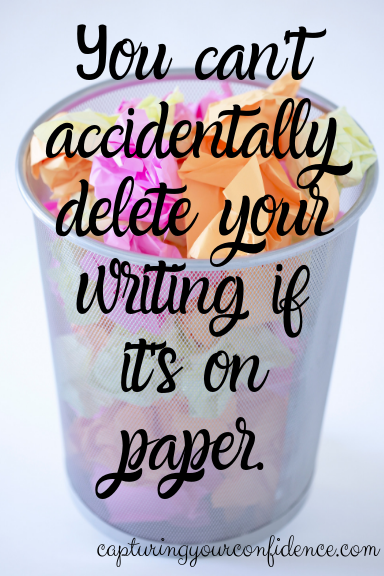
6. Removes risk of naming your document something “clever” and never finding it again.
How many times do we keep our original titles for writing? In my case, rarely. So finding a piece of writing with an old title you may or may not remember is like looking for a needle in a haystack. I could be searching for days without luck! Having too many documents is beside the point. When you write something with pen and paper, you can’t lose it to your own cleverness (or lack thereof).

5. Feels productive.
So, I wrote this blog out by hand first. I wanted to see how it felt, and it was great! A “normal” word processed blog with blog spacing (little paragraphs with lots of spacing) might be 3-5 pages typed out. My handwritten blog, with mock blog spacing, turned out to be 5 handwritten pages versus the 2.5 typed pages. The length was about the same, but I felt much more productive because I wrote 5 pages in a little over an hour!

This blog written out by hand!
4. Offers a much needed break from screen time.
I don’t know about you, but I spend a heck of a lot of time staring at a screen every day. I work at a job where I’m constantly on the computer, and then I will often come home and write/design/do administrative blog work on the computer. During the school year I also grade on the computer. It’s A LOT. Sometimes I just need to get away from that for awhile, you know? I think we all do.

3. Assists with memory.
Science has tied handwriting to improved memory. I find this very compelling. If you’ve met me for any length of time, you probably know that “if I don’t write it down, it’s not getting done (or remembered)” is pretty much a theme song of my life at this point. Long term memory? Great. Short term memory? Awful. So when I write with a pen and paper, it helps me imprint the idea onto my brain. It’s almost like physically writing allows the idea to skip the short term and go directly into the long term memory. Science for the win!

2. Forces you to slow down and think.
I don’t know about you, but I definitely can’t write nearly as fast as I can think. Typing alleviates this problem a bit, as I can type pretty quickly, but sometimes I don’t need to be going that fast. I like the idea that I have to slow down to write things down in a legible manner. So much of the time I’m hurrying or feel the need to rush. I don’t want my writing to feel like that, and I don’t want it to sound like that when you read it, so handwriting is a perfect solution.
https://www.youtube.com/watch?v=DS_j7mNru9w
Alister Stephens discusses his recent experiences with pen & paper writing.
1. Connects you to other writers.
I’ve always been a writer, a storyteller. And I’ve written A LOT over the years, with both pen and paper and word processing. There’s something about handwriting, though, that makes me feel like a writer. This definitely isn’t to say that people who only type are not. But writing is a craft people have been doing for hundreds of years! Many of my favorite books were written long before convenient word processing was available. Think about it for a moment: all of Jane Austen’s novels, for example, were carefully written out. Remembering this makes me feel like I’ve shared something with the authors of the books I hold dear. Where were your favorite books written? Can you imagine the author sitting at her writing desk scribbling away at a piece of paper or parchment?

Writing takes time in any form, and I’ll admit pen and paper does move a bit more slowly than typing. But in the extremely fast-paced world many of us live in, it’s actually a sweet reprieve. It’s not a negative experience because it’s “inefficient” but a reminder that sometimes the best thoughts occur when we slow down to let them.
What do you think? Have you written anything the old-fashioned way with pen and paper? What was your experience? Drop me an email or a comment below and let me tell me about it! I’d love to hear.

7 Surefire Ways to Beat the First Day of Class Jitters: Teacher Edition

As a student, you probably remember getting a little nervous on the first day of classes each semester. Or maybe a lot nervous! There were several times I distinctly remember, the Sunday before classes started, questioning what I was thinking to take the hardest combination of classes on the same semester.
As teachers, we can empathize with our students because we’ve been through similar experiences. We make a great deal of effort on the first day to make students feel welcome and to begin community building right away. We always hope they leave a little less uncomfortable that first day, and maybe even have a class “friend” by the end of the week.
What we talk about less, if at all, is that teachers get nervous, too! It’s not just students who have panicky thoughts about their class load and are worried about how the very first day of the semester will turn out. Sometimes I think I might actually worry more about it than my students.
Teacher Panic: What Could Go Wrong?
I’m not saying that everyone worries like I do. In fact, I hope they don’t! It’s a little silly, even to me. (Thanks, anxiety.) But, every semester, I always worry about what could go wrong. What I could accidentally do that would make things awkward that first day. What a student could say that catches me off guard just enough to unsettle me and make me lose credibility before class has even really picked up.
I know I’m not the only one who has these thoughts. I have a lot of teacher friends, and am casual friends with many of my former professors. Most people I know who teach - college and kids - get anxiety right before the semester starts. Sometimes it even sneaks in with our excitement as we’re preparing for the semester.
These are some of my worry points:
Building the course calendar. This has, admittedly caused less stress the longer I teach. I am going into my fourth year teaching college English, and this bad boy takes a long time, but is usually manageable if you have planned the class before. If you have not, the course calendar is very stressful!
Last fall I taught a brand new class with more projects and objectives than ever before. It wasn’t just a new class, either. It was the first time I taught an essentially 3 hour class, and there were also at least 2 assignments I had never designed or taught before (and that I hadn’t done as a student until graduate school). Triple whammy = major stress. Trying to figure out the course calendar was awful, to say the least.
Anxiety points: New class, new college/university, new/changed objectives or expectations, new length of class (50 min., 75 min., 2 hr. 50 min), required assignments & topics you haven’t taught before
Selecting the readings. This has always been the trickiest piece for me, even as I gain experience. When you create the course calendar, you select the readings, presumably for most of the semester. So, if you happen to change something (or derail), the entire course calendar becomes incorrect.

Since I’ve taught at community college, I’ve met several people who present the first half of the course at the beginning and put up the second half later. This is a great idea! And I have used it in the past year. BUT. (There’s always a “but” with most solutions, right?) When you only plan the first half of the semester, you have to then go through the process again when planning the second half of the semester.
I also like to be as inclusive of different voices as I can with readings, especially at the beginning of the semester. Not only does this increase engagement, but it also gives more students opportunities to relate to the readings.
Finally, there’s the issue of the textbook. There’s always the worry about assigning book reading too early. Some colleges/universities let instructors choose, but at my institution we have one book for all required entry level English classes, plus a common read, if you choose to use it. As a student, I always purchased my books before the semester, as we often had reading for the first day in English; but, many of my students depend on financial aid, which sometimes isn’t available until a week or two after class starts. So some students will have the book that first week, but some won’t.
Anxiety points: Too much vs. not enough, being inclusive, assigning textbook reading too early, students not having materials, readings won’t include enough talking points
Planning the first day. After you’ve done some longer term planning, it’s finally time to think about the first day! At least this is how I go about my beginning of semester planning. Hard stuff first, then fun stuff. Or what I think will be fun. But will students think it’s fun? As a teacher, you’ve probably encountered each end of the spectrum: the chatty-right-away group and the stone-cold-silent group. If you haven’t yet, you will.
For me, the chatty group is much less unnerving and easier to work with. Last semester, though, first day of a 3 hour class, the first hour and a half was painfully quiet. PAINFULLY. I hadn’t really considered this, because previously my community building activities, where students have to talk to each other, have gone quite well. Needless to say, it’s definitely on my radar as a concern, now! I now think about ways to spice things up (without getting too spicy, it is only the first day, after all).
Anxiety points: You’re nervous, students are nervous, new classroom, new technology, student engagement, “fun” or engaging activities planned
Teacher Triumph: How to Tackle Those Jitters!
Even if we’re a bit nervous about the semester, we wouldn’t be teachers if we couldn’t stand up in front of our students and teach them, right? Whether you’re teaching adults or kids, you worked hard and learned your butt off to be there!
No matter how long it might seem or how quiet it gets, you will get through that first day. It’s a guarantee. But, in case you don’t like waiting around being nervous and uncomfortable, here are 7 ways you can help yourself get past those worries about the first day.

Turn your jitters into excitement. Sure, the first day might be a little nerve-wracking, but it’s also very exciting! You get to meet a whole new group of students and then watch them learn things you love for the next 16 weeks. That is SO COOL. Channel that nervous energy into making sure you are prepared, have a good lesson plan, and maybe an anecdote or two to loosen the tension. In the end, we’re all people, so the more “people-y” you can be the first day, the more approachable you will be. Showing (and telling) your students how excited you are to be there is definitely one of the most people-y teacher actions you can take.
Relax the night before & get a good night’s sleep. I can’t express how incredibly helpful it will be to get enough sleep before the first day. If you are already prepared (and not scrambling at the last minute, admit it, this adds to your stress) you can watch a movie or read a book, go to bed at a reasonable hour, and wake up ready to go. Your energy & stress levels will be much higher if you skip this step.
Review your class roster. Look and see who’s in your class, and try to pronounce their names out loud at least once. The idea of a group of people seems less scary once you know their names, right? At least a little. Because then they seem a little bit less like strangers, and you will need to be able to address them!
If you’re working with adults, I would highly recommend sending an email the week before class asking if anyone has a preferred name or nickname they use. If the student has an unusual name they might very well have a nickname they prefer rather than you accidentally butchering their full name. Some students might also just prefer to go by a different name entirely. Either way, when you go to take attendance or do first day activities, you will be able to pair those names with the name on the roster and stumble and/or get corrected less.
Prepare a fun first day lesson plan. How many times did you go to class the first day only for the teacher to read the syllabus to you? And how many syllabi do you remember? Probably none. Because it’s BORING. Certainly the syllabus is important, but there are other ways to go about reviewing expectations.
It’s the very first time students are meeting each other and you. Make the most of that! Have them interact, even if it’s in little ways like getting someone else’s contact information for times they have to miss class. Do something you would have liked as a student. What would make you comfortable or interested in the class? Even if you’re the greatest most interesting person ever, you won’t convey that energy at all if you only plan a syllabus reading activity.
Arrive early & scope out your classroom. This seems like common sense, but sometimes you can’t get into your classroom because someone else is teaching there before you! I’m a firm believer in being early for most things, but it’s definitely helpful for teaching because then you can figure out the lay of the land. So, if you can, getting to your classroom early that day has many advantages.
You can set up all your stuff and walk around. You can figure out how to work the room without circling like a vulture. Those of you who have taught in awkward and small classrooms know what I’m talking about, right? You can also test the technology before anyone gets there - sometimes those projectors are finicky beasts! Best to wrangle them into submission before your students start arriving, if at all possible.
Be prepared to laugh at yourself! This was initially very difficult for me, but now I really enjoy it. I make terrible jokes and use puns. I use hilarious (and awful) memes. I love laughing the rest of the time, so why not in class, too? My goal is to keep things light and open that first day.
I want to be as approachable as I can, and one way to do this is to freely laugh. To make jokes that are purposefully bad (what they don’t know is that those jokes will be sticking around all semester). I’m perfectly fine standing in the silence, which they also think is a joke (it’s not), but that’s really not doing anyone any favors, you know? It’s much more helpful for everyone to get the conversation going and to get them laughing or relating to each other. Even if that happens at my expense.
Remind yourself why you love teaching. I saved this for last because I think this is the best and most important action you can take to help yourself with the first day jitters. You didn’t become a teacher because you were afraid to talk to students, did you? That’s just a minor short-term inconvenience. It will pass. But your love for what and who you teach will not.
We come back to teaching because we love working with students. We love that moment when a student finally gets something they have struggled all semester to understand. We love that we can share ideas and subjects we are passionate about with other people, who sometimes like it, too. The best thing you can do for yourself before the semester is remind yourself why YOU became a teacher. What keeps you coming back year after year?

We teachers get nervous that first day, too! But there are things we can do to work around that. And if this is your first time teaching, know that it does get easier.
How do you prepare for the first day? What jitters do you overcome? I’d love to hear about it!

Timed Writing: 3 Reasons You Should Try It (Outside of School)

You’ve probably done “timed writing” at some point. If you’re shuddering and remembering a time during high school or college where you studied all night and still flopped, I’m right there with you.
I will be the first to admit that even as an English major, and someone who has done A LOT of writing, this version of timed writing still makes me cringe. I teach timed writing as a requirement of my class, and I am very up front about the fact that it’s a requirement and probably one of my least favorite things about college.
So why do we feel this way?
There are so many steps. Not only do you have to formulate a “correct” idea, but you then have to plan, organize, execute, and proofread it within the allotted amount of time.

There’s a lot of pressure to get it right. You’re doing all of this for one person, usually the teacher/instructor, to read it and judge it with a grade. This grade will then be part of how you succeed (or not) in a class. When you’re paying hard earned money for a class, you want to do well!
We have prior experience looming over us. Even if you’re a good test taker - congratulations! - there will almost always be at least one time when you fail miserably. Something unexpected comes along, you don’t understand the prompt, you have the flu on finals, anything. For most of us, that experience will be enough to convince us somewhere in the back of our mind that timed writing sucks. So many times this determines our outlook on future situations like this before they even arrive.
After high school and college, or even grad school, timed writing can take a different form. It doesn’t have to be the long sigh as you get out a pen and notebook. We don’t talk about it much, but setting limits for yourself in your writing habits can be incredibly helpful!
Here’s why.
We run out of time. Being an adult with a job and adult commitments is hard, despite the fact that most of us try to rush to get here. Working at a job you may or may not like for most of your waking hours takes a lot out of you. You might not always want to come home and write about your day or work on a creative project. Sometimes your mind is just done.

We run out of inspiration. I don’t know about you, but on occasion we get into a rut. My husband and I have our weekly grocery store run, walk the dog in the evenings, go to bed and wake up at certain times… you have those routines, too, don’t you? Or some version of them. This doesn’t leave much room to be “inspired” to write.
We don’t know what to write. Then there are other times when I am ready to go: maybe I just took a nap or someone left a really nice comment on my blog. Maybe I am just happy and want to express that. But how does that translate into something productive? I am an advocate for writing for its own sake, but a lot of people might see that as a waste of time if they don’t have plans for the writing.
So, if I tried this timed writing thing (when no one was watching so they can’t “grade” it), how would that help me?
Makes writing more manageable. Writing is hard. It takes a lot of work. It requires filtering through your own mind, which can be a challenge sometimes if you want the writing to make sense to other people. If you set a timer for yourself knowing that you will stop when the timer goes off, there’s not as much pressure to “finish” something.
Gets ideas onto the page. Sometimes the hardest part of writing is starting. At least that’s how my writing works. For whatever reason, I’m always nervous to start a new project or write down an idea that feels really out of my normal box. I assume it’s because I’ve always been a people pleaser.
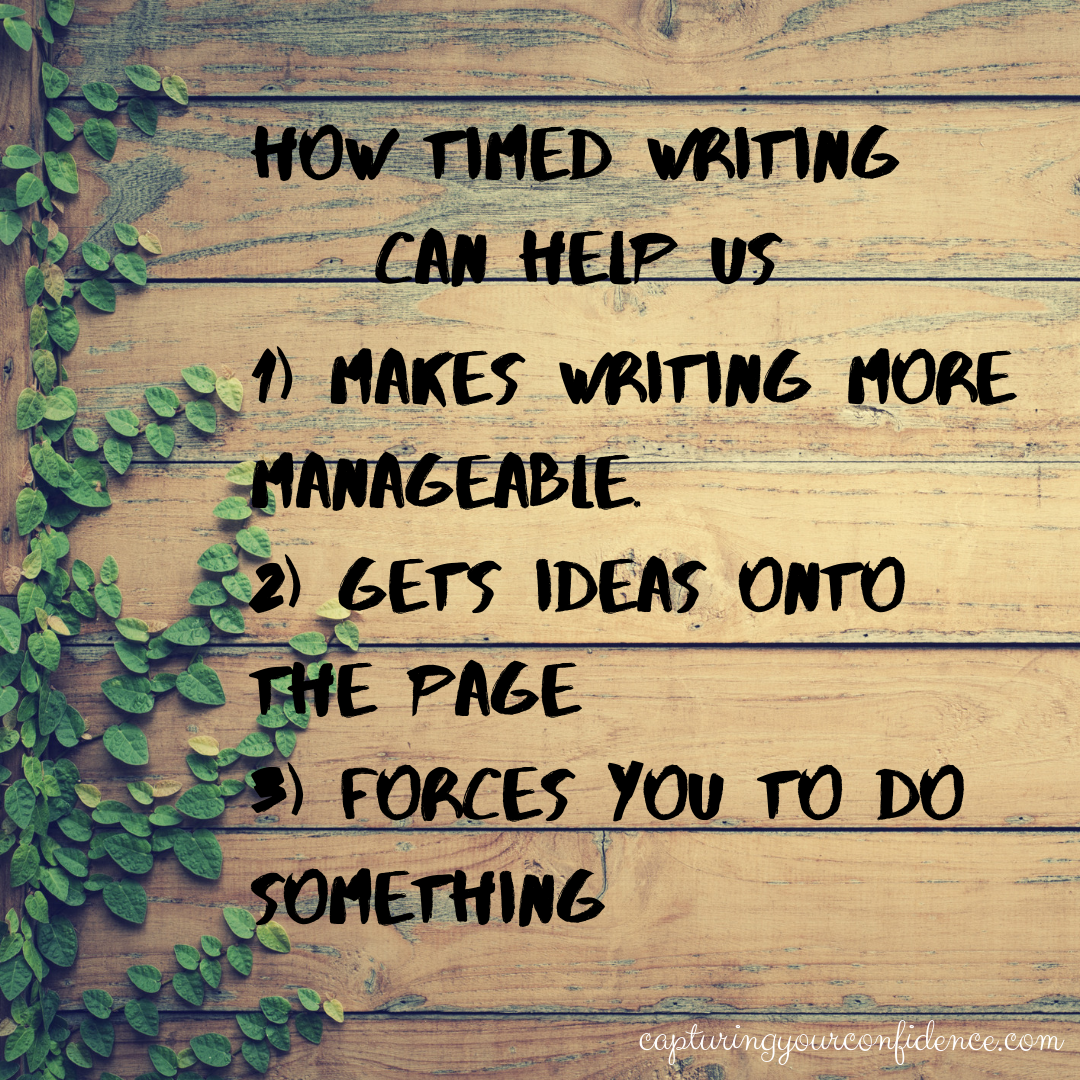
But, if you have a timer there knowing that you are only going to spend 15 or 30 minutes with this idea, maybe that makes it less scary. It’s only a 15 minute idea, so even if it’s utter garbage (sometimes you’ll have that), you won’t have invested a lot into it before you realize how bad it really is.
Forces you to do something. If you’re a writer, aspiring or established, it’s important to work on your writing. You aren’t going to get better at it doing nothing, and you’ll probably feel guilty for loving something and never making time for it. I am 100% guilty of this, and have used any number of excuses to dictate why I don’t need to write. But, I do need to write. And if you love it, you need to write, too.
When you set that timer for 15 minutes, you are prioritizing yourself and something you’re passionate about for those few minutes. You will thank yourself later. (Don’t worry, your Netflix/Hulu/Other Streaming Service will still be there when you get done.)
Note on Timer Length
I’ve mentioned 15 minutes a lot, but you can set your timer however you feel best! The reasons I find 15 minutes works well are because 1) I can usually spare that amount of time, 2) it’s short enough to feel like just a few minutes, but long enough to get a whole thought onto the page, and 3) if I forget to set a timer, it’s pretty easy to see on the clock.
I also think that 30 minutes would be a comfortable amount of “timed” time, if you know you will commit. The longer you set for yourself, the easier it will be to find a distraction during that time and lose focus, which won’t help you!
When I started writing this blog, I set myself a timer for 20 minutes.
I wanted to see how much I could get done by that time, as I haven’t really timed myself too many times when writing blog posts. I also wanted to use it as an example that this really works. I try very hard not to give advice I wouldn’t take, because I feel like that’s silly. It’s the “do as I say but not as I do,” ideal, which is not how I like to function.
Anyway, I got from the beginning of the blog all the way down to right after the “It gets ideas onto the page” section - about 770 words. Very productive! I did start writing with a pen and notebook, but quickly realized (yet again) that I type much faster than I write. Unfortunately, my handwriting just can't keep up with my ideas in the same way as typing.
Even if your first timed writing, or any try at timed writing, isn’t very productive, you still did it! You created something with that sliver of time, even if that’s just a not-so-awesome paragraph.
Here’s the thing: even if no one ever reads what you wrote, that doesn’t mean you shouldn’t write it.
For many of us, writing is the way we best and most emotionally express ourselves. It helps us cope with things that are hard, delight in things that are joyful, and just connect with other humans in a way that a lot of other mediums don’t allow for.
If you’re thinking this won’t work for you: do me a favor. Try it once or twice. Set your phone timer, the oven or microwave timer (the one that will drive you crazy if you don't get up and turn it off), whatever floats your boat. Try it and see what happens.
I’d love to hear about it! Even if it was 15 minutes of wasted time (I don’t think it will be). If it was, email me at rachel@capturingyourconfidence.com and let's talk about it.

Research & Creativity: Friends or Foes?

You’ve probably heard of the left-brain vs. right brain binary, right? People who are more “left-brain” oriented tend to be more logical and grounded in facts while “right-brain” people are dreamers and creatives.

There is often a similar thought about research and creative work. If you’re a scientist in a hard science, say, Biology, people probably think of you as a researcher, aka someone who is not very creative. You like fact-finding and getting to the black and white “truth.”
On the other hand, if you’re a creative writer, for instance, people probably don’t think of you as a researcher. You like creating new worlds or exploring the world we live in from another angle, not figuring out whether those things would actually be possible in “real” life.
Here’s the thing about generalizations, though. They always miss important details!
If you’re that scientist, you have to be creative to solve problems in the lab. If you’re researching how to solve a disease and you run have run out of ideas, you’re not just going to stop trying, right? You’d have to look outside the normal realm of possibilities or look at your current possibilities in a different light.
On the other hand, if you’re going to be a successful creative writer, that requires research, too. It’s not necessarily the same kind of research as a scientist, but you do have to know about the setting you’re writing to make it believable and factual. This is especially true if you write nonfiction about places or people. Your audience will call you out faster than you can say, “Wait, let me fix that” if you don’t research well enough.
So, are research and creativity foes?
Nope! How do we know?
Science doesn’t support this. Upcoming scientists are encouraged to do creative research, and why not? The old adage “necessity is the mother of all invention” is a proverb you’ve probably heard - and it’s true. All solutions start with a problem that has to be solved, and most times the answer doesn’t just appear out of nowhere (even though we wish it would).
Creative research is actually a whole field of study. We’re finding more and more that creativity is essential to research. If you are researching extensively and can’t find a specific guide or resource, you’ll probably have to put that information together and write about it if you want to reference that information again easily.
Personal experience. If you’ve been to college, or (especially) grad school, you know that you have to be creative to do good research. In English we write about super obscure topics that might have less than 10 experts in the field...in the WORLD. You have to be able to think creatively to find an academic niche and join that conversation.
If they’re not foes, are they friends?
Absolutely! How do we know?
They need each other. Most good research has at least some creative aspects, and most good writing has at least some research.
Many times, the best solutions and creations use both. We have a lot of conveniences now, but it wasn’t always like that! It’s hard to remember a time without GPS and the internet, let alone without wheels. But all of these things were new once, which means some smart people had to do creative research and problem-solving.
Personal experience. Have you seen any academic titles recently? Most times, they are long, include a colon, and try to be intriguing and/or actionable. At least that’s how we do it in the humanities. One of my last grad school papers was called “Confidence in the Classroom: Identifying Instructional Strategies in First Year Composition.” Even books have these kinds of titles - we read one of these types during my last semester called Cities of Affluence and Anger: A Literary Geography of Modern Englishness by Peter Kalliney. If these don’t highlight the creativity and research combo I don’t know what would.
So why do we think of these processes as mutually exclusive?
We learn one definition of research and one definition of creative in school and don’t revisit those ideas as we get older.
We tend to work largely in one field, and don’t often know how (or look closely) at other fields to know differently.
We learn about the left-brain/right-brain idea and don’t stop and question it. Science doesn’t support this one either!
We might tend to excel in one aspect and not pursue the other because we find what we’re good at and passionate about.
What do you think? How have research and creativity interacted in your life?
I’d love to hear about it!

3 Powerful Post-It Tricks for Your Writing
When is the last time you saw a Post-It note? Or used one yourself? Were you leaving a reminder for someone? Or perhaps a note of encouragement?
Post-Its, and other “sticky notes” as they have come to be known, are incredibly helpful! People have been using them for decades in numerous ways.
Like other creative thinkers, blogger Kami lists 26 unique ways to use Post-Its in her blog NoBiggie. Some of the ideas are simple - such as the DIY travel coloring cases (we don’t have kids yet, but when we do, this idea is perfect for the car!). But some are quite elaborate, like the Color Your Dashboard Lights. Who knew this was even a possibility?!
Reader’s Digest offers a few other creative, and practical, ideas for using Post-Its at home. I would never have thought to use a Post-It to catch sawdust!
As expected, 3M, the company who produces the name brand Post-Its has a trove of really neat ideas for Post-Its. Even academics are studying the effects of these sticky miracles!
So, we know these little guys are super helpful, but what does that have to do with writing?
Much like the Bullet Journal organization method, which you can read more about here, Post-Its are a creative way to help you organize specific pieces of your writing. The most creative among us might even devise a way to write a complete piece of writing ON Post-It notes!
Below are the top 3 ways I love using Post-Its to plan my writing. They are not the be all and end all, but they have been incredibly helpful as I began to work through my novel.
To Do List
This might seem obvious, but in order to make sure all tasks get completed, it’s useful to have an actual to-do list. I like having a physical list because then I can put it somewhere it constantly pops up and I have no choice but to recognize that I haven’t crossed everything off yet. I also can “accidentally” close out of it without saving changes.
The reason Post-Its are a powerful tool here is that they stick to things! I have one on my computer screen. I purposefully put it on the top right hand side for a few reasons.

Green = To Do List
Orange = Encouragment
I have a Mac, so the basic computer information is up in the right corner.
It blocks the time. Nothing is worse than trying to write on a blank page, or even a half-filled page, and looking at the clock every 30 seconds because you’re distracted.
It blocks the charge/power bar that indicates how much battery life I have left in my computer. I leave the note just far enough to the corner to be able to see the numbered percent left. If I’m not all the way on my writing game yet, as you can read about in my blog about excuses, I will literally find any reason to get up and walk around, including a battery life of less than 50%.
It’s front and center, so I can’t pretend it’s not there. It is a reminder that I do have things I need to accomplish for my writing so it doesn’t become “out of sight, out of mind.”
Interactive Timeline
Perhaps a little more writing specific, I create a Post-It note timeline when planning out my novel. I am a visual learner, so this allows me to see when during the plot specific events happen or when specific people come into (and leave) the main character’s life. The interactive parts are the events and people! The set up is really easy.
I started with my base “years,” which are pink, although I rarely determine actual calendar years. For my current novel, I am thinking about from the beginning of high school to the end of college, so I put up my year Post-Its first.
I then added the major romantic relationships - those are in blue when they happen in my main character, Callie’s, life.
Last, I added friend relationships in orange and school/personal events in yellow where they occur.
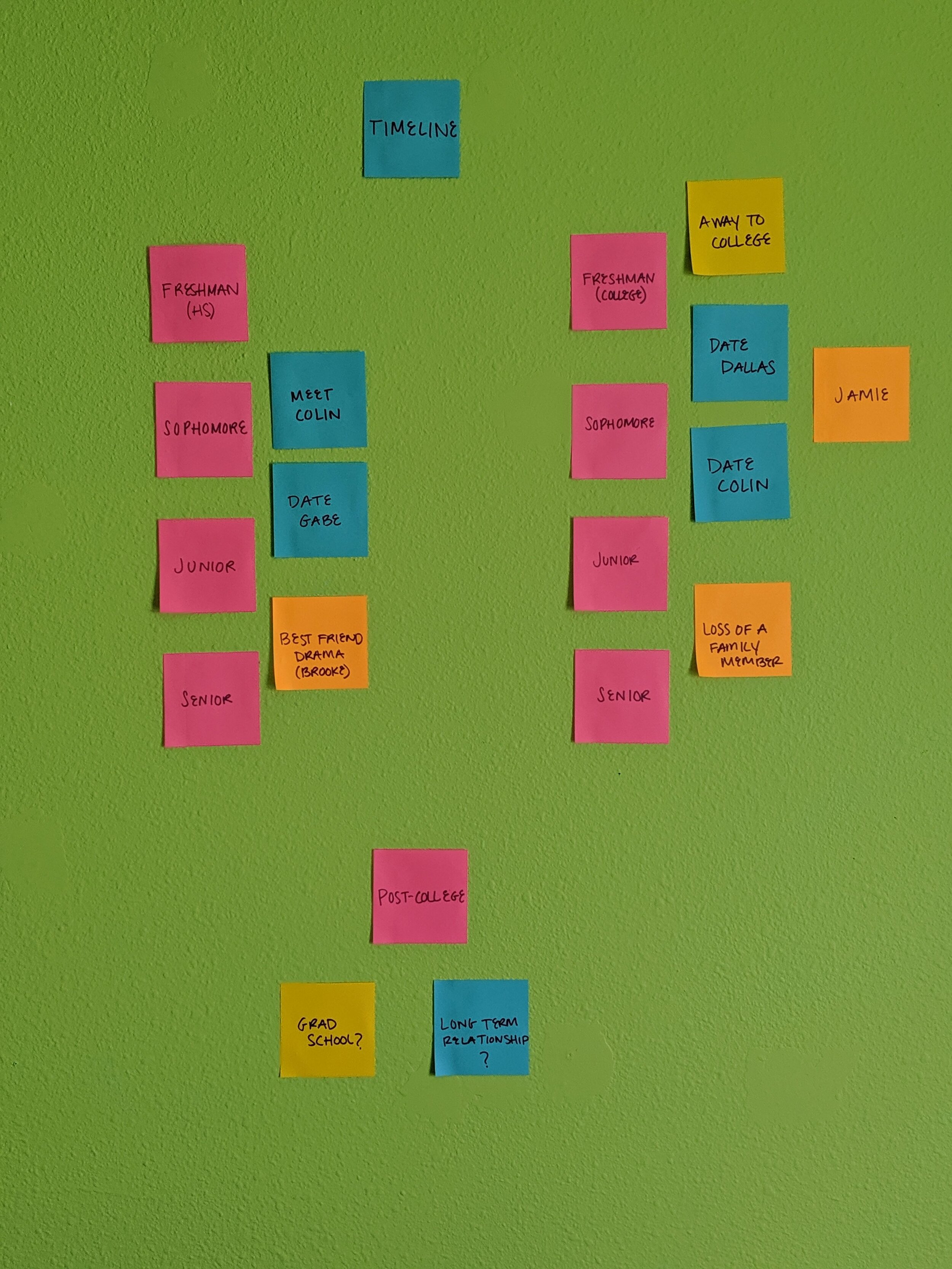
The best part about all of this is that I can move one of those events to any other time on the timeline or add an event to see how it would vibe with the rest of the story. All I have to do is take the note off the wall and move it to the year I’m thinking about changing it to. I can also see how a romantic relationship overlaps with a specific friendship or life event.
If you don’t have a lot of wall space, or, like me, you have textured walls that reject anything you try to stick to them, a nice big cork board or dry erase board would work well.
Character Web
Another handy visual tool that Post-Its rock at creating is a character web. This tells me who all of the characters are and how they relate to each other. The extent of the web will depend on how many characters are involved in your writing and how complicated things are.
I’m not sure that this would be the best option for someone trying to create the next Game of Thrones, for instance, because there are just so many people who are so complexly interrelated. You can create one like mine with 3 easy steps:

Write each character’s name on a separate Post-It. The main character is in the center with the other characters around. I like a more circular web, but a square would work, too.
Add how each person is connected to the main character. I use hearts for romantic relationships and smiley faces for friendships. I place a smaller Post-It (or cut them in ¼ pieces) with the heart or smiley face in between the main character and the outer character. If there is more than one type of relationship, I put two separate connector notes in between.
Add how other characters are related to each other, if they are. For instance, two of my characters are cousins, so I have a small note with the word cousins pointing out to both characters between their individual notes.
Because I’m so visual, it really helps me to see how all of the character relationships interact with the others. If I had the same characters but more “drama” or intersection between them, I would use string or ribbon to connect them together.
I currently have my character web on a poster board (because of my textured walls) but again, you could effectively use a dry erase or cork board. If you want your web to be mobile, like mine, you can always use a poster board.
BONUS!
Encouragement Notes

I love to write myself notes of encouragement and stick them in places I know I will see them. I usually find them just when I need that extra boost of confidence. I have done uplifting quotes, the whole “You’ve Got This” mantra (currently on my computer), or a funny meme. I am big into puns and word play, so if I find a really good one I love to hang it somewhere I will see it often.
Have you used Post-Its in planning your writing? Do you have other creative ideas about how to use them to best serve your goals? I’d love to hear about it!

8 Simple Habits to Develop Writing Inspiration

UPDATED: May 2020
Do have something you simply have to do before you can really get into your writing? Most writers do! Many have specific habits or even “requirements” for the environment where they are most productive or rituals they must do.
Many factors go into the decision such as:
Type of writing
Expectations of what to accomplish
How much distraction will detract from what a writer is working on.
Some famous writers had/have crazy writing habits!
Some famous writers had/have crazy writing habits! For instance, writing in the middle of the night, or only two hours a day!
Personally, I don’t feel like I have many required habits for me to feel inspired to get writing.

Writing Inspiration
My Productive Writing Starter Pack: Computer, charging cord, pen & notepad, encouraging Post-It, socks, drink, Charlie (and his rope), and a blanket for when I get cold.
Below are 8 simple writing habits that ensure my writing inspiration & productivity.

Music
1. Turn on Music or a Movie Soundtrack
Music or a film soundtrack can be an inspirational catalyst. The type of writing we're trying to accomplish can dictate what background sound we play.
Music
Choosing music is important because it helps create a specific mood and mindset. Music is an emotional experience for many of us, so by choosing something specific, we have a good chance of channeling the kinds of thoughts and emotions we need to be inspired.
Choosing music is important because it helps create a specific mood and mindset.
If I am working on my novel, which is Young Adult (YA) fiction, I tend to choose something that reminds me of when I was in high school and first starting college.
Sometimes that’s Taylor Swift or Aly & AJ. I also like the 70’s light rock Pandora station because most of the songs don’t require a lot of energy or thinking. I grew up listening to most of the songs, so it’s an easy-listening music experience.

Taylor Swift concert
Taylor Swift Concert, Red Tour, 2013
Movie Soundtrack
I also love film soundtracks. Movies that we love and have seen a thousand times often bring up memories and emotions that we don't even recognize, but that can be supremely helpful to help us find the words for what we're trying to write.
Movies that we love and have seen a thousand times often bring up memories and emotions that we don’t even recognize.
Braveheart is by far my favorite film soundtrack because of how emotional the music is. Incidentally, you can listen to the whole thing for free on Spotify (you will just need to sign up for a free account)!
When I am writing emotional scenes or blogs, I listen to a movie soundtrack because I subconsciously recall what emotion is happening during the scene and use that to inspire my words. I also really enjoy Sullivan Entertainment’s Anne of Green Gables (1985) because it’s such a positive story, and the soundtrack reflects that mood.
Why it Works:
Having some kind of music and/or white noise playing in the background helps reduce the amount of distraction many of us face while writing. Things like kids screaming, dogs barking, or a spouse asking a favor. You know the kind. Music can help block this out and allow us time to really focus on being productive with our writing.
It can also help spark inspiration when we know we need to write but feel utterly uninspired. If you don't know where to start writing, turn on some of your favorite tunes and see what kinds of memories and ideas start popping up!

Close Email
2. Close Email & Put Phone Away
Before you outright reject this strategy, let me give you some background info! For those of us in administrative jobs, especially customer or client-facing roles, we don't really have the opportunity to just disconnect during the day. We never know when something might catch fire that we have to put out!
There are also many of us who work second jobs, which doubles the email expectations. Having email on our phone almost becomes a necessity.
We also can’t predict when anyone will call or text throughout the day. Sometimes it’s a spouse, but sometimes multiple family members, friends, and the pharmacy service all text and call. It really depends on the day.
The constant word stimulation is definitely a distraction from any type of writing we might be doing.
The constant word stimulation is definitely a distraction from any type of writing we might be doing. Have you ever started writing something, even just a sentence, and all the sudden an email pinged into your inbox on your computer or phone? Suddenly, your brain starts wondering what's in the email and if someone will need an immediate response. There goes any inspiration or productivity you might have!
If I get the chance to write at work, I set a timer for having all of this turned off so I don’t miss anything important, but can still focus. If I’m at home, it’s definitely easier to disconnect, and will often (to the annoyance of my husband) turn my phone on silent altogether.
Why it Works:
How much can you get done when your inbox is pinging constantly? Or when messages are pouring in? (We see you, group texts.) No one can function efficiently like that, especially writers! Your writing inspiration and productivity will get a quick boost when you close email and put away your phone.
I don't even keep my sound on most of the time like everyone else, so I can't imagine what it's like for writers who keep their sound on. The same goes for phone use. If you're going in and out of a text convo, or people keep calling you, both your writing and the conversations are going to be worse for the wear.

Close Tabs
3. Close Tabs (Especially Social Media)
How many tabs do you have open in your browser right now? I have 12. Would I try to write with this many tabs open? HECK NO.
Like email, having a bunch of web pages open is a total distraction from our writing - the exception being if you are using one or two of them for research or something directly related to your writing.
Be honest, though, how many of your tabs are actually productive?
Be honest, though, how many of your tabs are actually productive? How many are social media?
Social media sends out an insane number of notifications by the hour - sometimes more! Just like an email dinging into your peaceful workspace, it throws us completely out of our focused writing mindset.
So although it's hard, we need to close tabs and make sure to shut down all of our social media when we are trying to connect with our writing inspiration and be productive.
When I say social media, I mean:
Pinterest (although it's not a true social media)
AND anything else you're checking regularly for social updates.
Note: I know we can turn off the notifications for all of these; however, being able to click on the notification when I have time has proven to be helpful, especially as I interact with a lot of people directly for business.
Why it Works:
You just posted the cutest picture on Insta and you can't wait to see who likes it. You just found the funniest joke to tweet. You need to get to promoting that new blog on Facebook! Or find beta readers for your novel!
It’s a great feeling to to see people interacting with your content.
I get that.
It's a great feeling to to see people interacting with your content. But you have to have time away from social media to create that amazing content that keeps people coming back for more! You can't fully focus on your writing if you're watching your phone or browser like a hawk for new notifications.

Pen and Paper
4. Have Pen & Paper Ready to Go
Do you ever have a stray thought that has nothing to do with what you are working on? I know I do! Sometimes our brain has more of these moments when we're trying to write because it's looking for a way out, a way to distract itself from being productive. Or realizing that we're not inspired.
If we really want writing inspiration, we need to cut out the excuses and distractions and get productive.
It’s important to have a place to jot these thoughts down that’s not on the computer and/or document you're working on. If we really want writing inspiration, we need to cut out the excuses and distractions and get productive.
When I suddenly remember I need to answer an email by the end of the day, my blog post or novel is not the place to write that down. For one, I definitely won't find it again in time. Not to mention that I will keep seeing that reminder for the remainder of my writing time, which tanks my momentum.
Why it Works:
Writing things down by hand helps you remember things. Scientists study this all the time! In my experience, though, when you write things down in the wrong place, you STILL forget, only then it's worse because you know you wrote it down but you can't remember where!
Don't do this to yourself. Keep a pen and paper nearby when you're writing so you can easily come back to your ideas later.

Laptop Charged
5. Have Laptop Charged & Charging Cord Nearby
If you are writing on a desktop, you obviously don't need a cord because you're connected to the wall, which is great!
But, if you're like many writers and writing on a laptop, it's so important that you make sure to keep your laptop charged when you want to write. If your computer is a little older or otherwise prone to losing charge quickly, it's also important to keep the charging cord nearby.
Excuses seem to multiply like rabbits when we're low key trying to avoid our project(s) from a lack of writing inspiration or motivation.
This is imperative because when we sit down to write, and we're not “in the zone” yet or having trouble focusing, we tend to get up and do any number of things instead of actually getting writing done. Excuses seem to multiply like rabbits when we're low key trying to avoid our project(s) from a lack of writing inspiration or motivation.
Such an easy step to make sure we stay on target!
Why it Works:
You can't type out writing if your computer is dead can you? I mean you could, on a phone or tablet, but will you? You can't make this excuse to get up and away from focusing on your writing if you have already prepared!
Even worse than not being able to work, if you're writing and your computer dies, you may or may not be able to get all that hard work back when you charge up again. This is a major bummer, believe me from experience!

Location
6. Location Matters
Some people have to be at a certain place to get a lot done. I know many writers who need to be at their desk or have certain lighting to get into their ideal writing zone.
This habit is all about figuring out where you do your best work.
Where we are has a lot of impact on what and how we think. This habit is all about figuring out where you do your best work.
When I was in graduate school, I loved to hole up in a library study room or in our home office. I find I don’t really need a particular place, now, though. I will usually either write at my desk, in my journal in bed, or on the couch snuggled up with my dog, Charlie. He is the best (and cuddliest) supporter during the times when I’m writing like a maniac.
Why it Works:
Location is very personal, unlike some of the other habits we've talked about. You might be open, like I am, but you might need a little more quiet or more structure.
I know plenty of people who prefer a table to using their laptop on the couch. It's all about figuring out how you can be comfortable and leveraging your environmental preferences to get your writing done.

Writing Medium
7. Decide on Writing Medium
There are all sorts of ways to write in the digital age! Of course you can always trust in a good old pen and paper routine. But there's also Google Docs, Microsoft Word, notepad (search your computer for the app), Microsoft OneNote, Evernote, Wattpad, and the list keeps gong on and on. How you write is really personal because you are the one working in it on all your projects.
I used to prefer writing in a Word document and emailing myself back and forth. The problem being that if I forget to send that email...well, I would have to wait until I was back at that computer to work more on the piece of writing because I was saving locally to my computer.
How you write is really personal because you are the one working in it on all your projects.
Nowadays, Microsoft 365 is a game changer with Sharepoint and cloud-hosting, so you can access your documents similarly as you do with Google Drive.
My preferred medium now is Google Docs, where everything is instantly saved online, so I can access it wherever I can get internet. I can work at home, at work, and even on my phone! We have the Google Pixel phones, so all of my documents and things sync together nicely.
Why it Works:
When you pick a medium and stick to it, you know, reliably, that your documents will be safely waiting for you each time you go to write. Make sure you have a way to back up your work, whichever medium you choose.
I have to say, Google Docs is pretty dang great! I love the fact that I can write something on one computer when I'm out, it saves to the cloud, and I can pull it right back up when I get home. I don't have to worry about forgetting to save and send or taking my flash drive with me, and neither do you!

Comfortable
8. Make Sure You're Comfortable
This is probably the most important habit because being uncomfortable is the ultimate distraction. Who can pay attention when they're sweating or freezing? When their feet are cold or they've been sitting on a hard chair so long that they don't know if they can get back up normally again. No one! We've got to be comfortable when we write.
Personally, this habit is tricky for me because I’m fidgety. I don’t do well sitting down without moving for long periods of time, and I get cold very easily.
We've got to be comfortable when we write.
I typically sit cross-legged or with one leg tucked underneath me whether I’m in a computer chair or on the couch. I always wear layers, and have a pair of socks on hand for when my toes inevitably turn into ice cubes. Sometimes I even have to go get my slippers in the middle of summer! Interestingly, I find it more distracting to have cold toes than walk away and get my slippers.
I tend to move around and sit in different positions throughout the time I spend writing, that way I can remain as comfortable as possible. There’s nothing worse than having an aching tailbone right when you’re about to write about someone’s first kiss!
Why it Works:
Your body is super important to your writing. When you're not on your game physically, you probably can't be at your best or most productive in your creativity. You know yourself best, so you know if your toes get cold when you sit down for a long time. Or, if your eyes hurt from looking at your computer screen for a long time you probably need blue light glasses or the free Flux app to help you out.
Your body is super important to your writing. When you’re not on your game physically, you probably can’t be at your best or most productive in your creativity.
There will always be more habits that could be helpful, but these are critical. Making sure to build these habits over time will really help writing inspiration and productivity!
If you're like me, though, and inspiration strikes, we are on it. We get the words onto the page as soon as we can, lest we forget anything (short term memory is definitely not my strong point!).
Sometimes I can get to my computer, but sometimes I can’t. I have written in almost every medium! There’s a section of my novel that was typed on my phone in the Google doc when I was laying in bed trying to go to sleep. As it turns out, it was a full three pages. There were also several sections handwritten late at night when I got inspired right before bed.
Once you start writing you'll figure out how to best tame and create your habits.
What are your writing habits? What do you need to write productively? If you don’t have any, you’ll get there! Don’t feel pressured into doing anything crazy. Set your own goals and work towards achieving them.
I would love to hear more about your writing habits and rituals! Drop a comment below, find me on social media, or shoot me an email at rachel@capturingyourconfidence.com! Let's chat.

Inspiration in Odd Places - Where Do You Go to Get Inspired?

Do you ever have that stray thought that’s absolutely brilliant...and don’t have anywhere to write it down OR your phone? So you can’t even text it to yourself?
This happens to me all the time. In fact, most of my best thinking happens when I have no opportunity to write any of it down.
Cue the voice memo (if I have my phone). Or, once I realize it’s a great thought, I try to repeat it over and over again so I don’t forget the most important part. At least if I get the main idea down, the other stuff will come back, right? Sometimes.
But sometimes once I jot down the main idea, other, even better thoughts come out of it. I can expand that thought into several. I can create characters or scenes from it. I am inspired!
This is awesome because, as writers, we aren’t always inspired. Most days we don’t just wake up and have a complete vision for what we want to write that day. Or even where we see our work going at all. In my experience, your original “vision” usually changes by the end anyway.
So when we can inspire ourselves or have a moment of clarity here and there, no matter where it is, it can fuel our writing and make it better.
Here are the top places and situations I tend to get the best thoughts, some more inconvenient than others, and what I do to incorporate those into my writing. The last action always being to write it down with as much detail as possible, as soon as possible.
The Car
If you read my blog on how I started my novel, you’ll know that the initial thought started as a brief dream, but grew into a full creative piece in the car on my way home from an event.

My old car got totaled in February, and we had to buy a new one. Sassy Sally is awesome!
This is how powerful car thinking can be! I don’t necessarily mind long drives anymore, as I went away to college and (gradually) learned to get over my fear of highway driving and cruise control. I blare my music, and it gives me time to think whatever I need or want to think.
In the instance of my novel, it turned a “What the heck was this dream about?” thought into an entire novel idea with pretty well visualized characters and somewhat of a plot. This isn’t the only time this has happened, either. Just the other day, I was thinking about ideas for my blog in the car, and like 3 separate ideas popped into my mind.
Of course, you can’t just whip out your phone and type those into a note or a text when you’re driving, so you can be left hanging. (If you do text while driving, please stop, for your safety, and those around you.)
What to do when inspiration strikes:
If you have a phone with voice command, command it! I have a Google phone, so I can just tell it “Hey Google, make a list, remind me…” Siri & Alexa work the same way. This allows you to still be hands free, but get your ideas somewhere to reference them later.
Think through the idea in as much detail as you can. The more detail you add, the better picture you create in your mind, which means you have a higher chance of remembering at least the main points.
The Shower
I typically shower in the evening, as I find it relaxing. I also have way too much hair to want to blow dry and style it every morning. The problem with this is that as I am winding down for the day, my mind does one of two things: 1) It calms down like a normal brain and begins to think about getting sleepy OR 2) It goes into hyper mode because it realizes that this is the last chance of the day to think productive thoughts.
Most nights, my mind takes option two and just goes haywire. Sometimes it’s about the blog or about my book. Sometimes it’s about my classes and how I can get my students engaged with the material. Sometimes I just think about random things that happened throughout the day.

But of all the places to have a great writing thought, the shower is probably the worst. At least for me. Think about it: you don’t have a pen and paper, or even just a pen to write on your hand (kicking it old school over here). You don’t have your phone or other electronic device to voice record or type. You’re literally just in there with your body and your soap.
What to do when inspiration strikes:
Roll your eyes dramatically and sigh. You don’t really have to do this. It’s pretty dramatic, really. I’ve come to realize that this is, in fact, part of my process every single time, though. For whatever reason, the shower seems to go much more quickly after that sigh.
Think through the idea in as much detail as you can. As in the car, if you can create more detail and think through the “why” of the idea, you have a better chance of remembering when you can write it down.
Walking the Dog
I love walking my little guy, and he loves it, too. It gives us both a chance to get out of the house and allows me a break from screen time and technology.
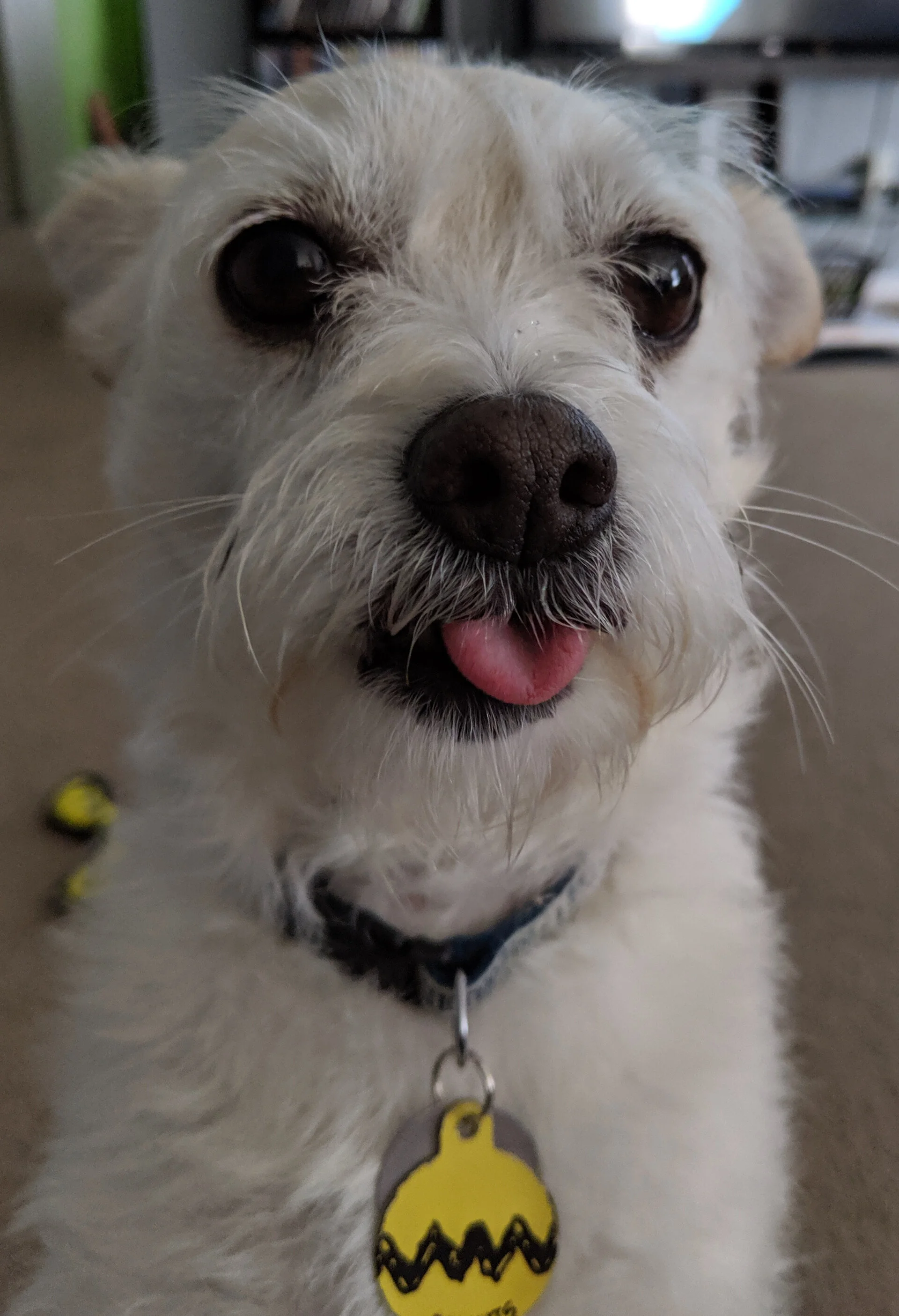
Charlie
Inevitably, we get around the block or away from home and I see something really cute (I see you sweet neighborhood dogs and toddlers learning to walk) or a really pretty plant and it inspires a half a thought. What if so-and-so saw this in my book?
By the end of the block I’ve got a whole little scene or conversation in my mind, and clearly, nothing to write it on. Honestly, this one is the best case scenario for me because I am close to home, and know that I will be able to write it down soon.
What to do when inspiration strikes:
Observe your surroundings closely. Is there a particular detail that struck your fancy? Try to remember that object or dog or toddler and what’s going on around it. Why did it inspire you? What was it about the moment that caught your eye?
Tell your idea to your dog. Let’s be honest: your dog is probably a good listener who won’t talk back, and s/he is a captive audience during the walk because s/he literally can’t go more than about 20 feet away from you. Now, I might suggest looking around and seeing if you will have an audience before you talk to your dog like s/he’s a human...but, I’ve been known to talk to Charlie even when there are people around. I swear he understands half of what I’m saying, or at least he makes a good show of pretending to figure it out. He likes when I talk to him (even if he doesn’t understand), and your dog probably does, too!
Trying to go to Sleep
If my mind hasn’t gotten over its thinking frenzy when I get done showering, it’s inevitable that I will keep thinking when I’m trying to go to sleep.

Usually this is because I’m just so excited about the idea that I want to keep thinking about it even though I need to stop. Or it could be because I am dreading something the next day and don’t want to go to sleep.
Either way, it’s super inconvenient because I will be doing all of my other bedtime routines and then actually laying down, and this thought will still persist and grow more details. It can be like it has a mind of its own.
What to do when inspiration strikes:
Write it down quickly with the details you have right now. As you can probably tell, I’m usually all about the details; however, sometimes enough is just enough. I always keep a notepad and pen next to the bed for exactly this reason. Write down what you have and put it away for the night. You can pick it up the next day. Sometimes you might even dream about it and get more from it!
Type it out in a note or text message on your phone. If you don’t like physically writing things down, or you have already turned off the light, you can always make a note on your phone or put your idea in a text message for later. Word to the wise: don’t type your idea out in a message to someone who immediately texts back, just in case you accidentally send it. They will be confused, and you might be too if you don’t remember what you were trying to remind yourself.
In a Meeting
Even if I am paying the most attention in a meeting, on occasion, someone will say something striking and turn my thoughts in a completely different direction. Because of my job, I am usually delegated to take notes, so when my mind wanders off, the notes are not very good.

Kind of like a keynote speaker at graduation. You have the best intentions of hearing all the takeaways, but you get 2 deep and your mind starts wandering a little bit. This could be a good or bad thing, depending on how far down that path you go.
This can be problematic for both the meeting and the idea! You can’t focus on either one, and reasonably, you should probably prioritize the meeting notes in this case.
What to do when inspiration strikes:
Jot it down on your notepad. I usually have a notepad I’m taking notes on, so I’ll write it on the side or top margin and draw a bubble around it so I can easily tell it’s separate from the notes. You can delineate however you like, but make sure it’s separate.
Type it out on a blank Microsoft Word document and send it to yourself. If you’re a typist and you take your notes on the computer, popping open a new email, typing the thought out quickly, and saving for later is a quick and easy way to keep the thought separate. You can then send it to yourself and voila!
Obviously these are some unusual, and sometimes inconvenient, places to be inspired. I know I’m not the only one, though, and there are definitely other places this happens!
Where do you find yourself getting inspired? And when you have that inspiration, how do you hold onto it?
I always love hearing about other people’s writing processes!

Bullet Journaling: A Bulletproof Organizational System
Do you find yourself using multiple calendars? Having lists stuck to a Post-It note on the outside of your calendar? Forgetting your calendar at home when you need to schedule appointments? Or lost the calendar you finally remembered to write your shopping list in?
I have done all of those things and more. I LOVE lists, and that is not an exaggeration! And, I’ve come to accept that I love calendars, too. But not just any calendars. They have to meet a pretty strict set of standards:
Must be bigger than pocket-sized but smaller than a full page
Thick enough to not get bent in half in my bag, but small enough to fit in a large purse
Pages need to be more durable than the newsprint a lot of calendars use
Must include the full month and weekly view, but the weekly view has to be big enough for me to write down upcoming bills and appointments
Ideally not plain: I like my calendars to look cute or inspiring
Needs to have ample space for notes/lists
So you can see where I might run into trouble finding my ideal calendar, right?
Well, last year I found a great system that solves all of my calendar troubles! If you have any of the problems I mentioned before, like I did, this could be perfect for you, too.
The system I started last year is called a Bullet Journal. If you have never heard of this before, you can read about the “official” product and goals here on their website. If you have heard about this before and are skeptical, keep reading and I’ll show you how this creative organizational tool is not only incredibly helpful with daily life and planning, but also really helps me boost my creativity.
My Journey to the Journal
Before I started bullet journaling - which, despite what it sounds like, is not like a diary or anything (although you could definitely include pieces like that, if you want!) - I had a calendar called The Happy Planner. I loved this thing because it had space everywhere and it was so customizable! But, once I finished grad school, I didn’t need a huge calendar anymore.
So I shuffled around to a calendar from Barnes & Noble, which was okay but didn’t have enough space. And then I tried one from the dollar store and the pages were outright falling out, even though the space was great. So I Googled it and found the bullet journal method.
The idea is that you can put everything you need in one place - calendar, lists, goals, dreams, etc. - and utilize a simple system to keep yourself organized. You don’t even necessarily have to buy a new notebook to start, although dotted grid notebooks are far easier to work with, in my experience, because when you get more creative and draw lines or pictures, you don’t have to eyeball things (or if you love stickers, you don’t have to see them stuck on the page crooked every day.) Essentially the small, personalized details that make your bullet journal fun and your own.
The official branded Bullet Journal system was designed by Ryder Carroll, who has written a ton of great information about how to begin and structure, as well as a book. There are some key pieces that make up the structure of a bullet journal, although you can design them however you like. Each page or related topic is called a collection or spread. The pieces include:
The Index These are the pages at the front that tell you which collections are on which pages
The Future Log This spread is used for any longer term planning outside of the current month. Some people like to do 6 month planning. Personally, I like my future log to be the whole year at a glance.
The Monthly Log These pages plan each month with both a numbered calendar view & a task list.
The Daily Log These pages record your day-to-day activities & tasks.
Custom Collections Custom collections are anything that helps you stay organized, on task, or inspired! These are open to however or whatever you need them to be.
The example Carroll sets up is simple and easy to maintain, which is where I started before I developed the system that works best for me. If you’re using a calendar already, chances are that you already use most of the pieces of a bullet journal, they might just look and feel a little different. That’s good news, right?
After I learned how to do the basic formatting and key parts of the journal, I began to customize how I put it together.
Some of the pages in my bullet journal include:
Index (I like to leave 2-3 pages)
Entire year calendar at a glance (Future Log)
Each month with the month at a glance and each week with room to write on the days (Monthly Log & Daily Log)
Books to read
Year long goals
Home to do list for our house
Dreams for the backyard
Interview preparation
Giraffes (What can I say, I love them.)
Blog planning
Creative writing planning

I love giraffes so much that they are page #1 in my bullet journal!
And this isn’t even the whole list! But, this list is obviously super varied and the pages are not all related. Some pages, like my giraffe page, are pretty simple. I include them simply because they make me happy.
I do a lot of print-outs since I’m not good at the lettering by hand. I also plan one month in advance. So, last week, I set up my basic bones structure for July. This allowed me to fill in what I need to do in advance rather than having to come up with a whole new page each time an event comes up.
Outside of the calendar aspect, every time I have a new project or anything I need to make notes about, I turn to a new page of my bullet journal and it’s literally a blank canvas. When I’m done listing or brainstorming, or just doodling if that’s what I need, I got to my index and write it down so I can find it later.
“Well it’s cool that it works for you, Rachel, but is there a point to this?”
Yes! Bullet journaling is an incredibly powerful tool for writers and creators! Take a moment to think about how you organize your writing. Or your to do list when you need to get creative tasks accomplished. Do you have a good system? If so, that’s great! If not, this could be a quick and easy (and cheap) way to get yourself organized and actually feel good about it.
No matter how fancy Pinterest or Google examples are, bullet journals don’t need all that to function effectively. If you looked at the Youtube tutorial or read about Carroll’s system here, his is definitely not full of frills. Take a look at Carroll’s example:
https://www.youtube.com/watch?v=fm15cmYU0IM
Ryder Carroll sets up his original Bullet Journal formatting.
Personally, the original bullet journal seems a little utilitarian for me. But what do you do when you don’t have time to spend 3 hours handlettering one week of a month-long calendar? I know I don’t! I have found shortcuts and adaptations like print-outs and colored pens that spice things up but don’t take a long time to put together. Planning expert and blogger Erin Condren also shares some time saving tips in her blog.
Although all of it does require a bit more preparation than a calendar or planner you might buy at the store, front-loading some of that planning onto the beginning of the month or week (however you would use it best) will not end up being a bad thing in the long run, trust me. I use mine for everything. I have calendar sections, of course, because we have bills to pay and other obligations like everyone else; but, I also have whole blogging and creative writing sections.
I enjoy physically writing down my ideas, and of course, because I’m a list junkie, I like crossing things out on paper when they are complete. Free writing? Check. Plot map? You bet. Huge brainstorming list of future blogs? Absolutely. I also enjoy that I can get creative and colorful with colored pencils, pens, and even sometimes markers.
So How Do I Get On Board with This?
If you are visual and like videos, Youtube is full of helpful people who have posted how to get this going for themselves. I really enjoyed this super helpful and encouraging video by Natalies Outlet:
https://www.youtube.com/watch?v=BdCYG-hfGA8
How to Bullet Journal for Beginners! by Natalies Outlet
All you really need to start a bullet journal is a pen or other writing utensil, a notebook, and your imagination. And possibly Pinterest. Pinterest continues to inspire me!
You can get the notebooks from the Bullet Journal store directly or search Amazon. If you go to the Bullet Journal store, the notebooks are a little more expensive, but definitely high quality. There is a little bit less selection in terms of outward appearances, but they have built in features such as pointers for beginners and index pages that are already laid out for you.
I love the selection from Amazon because they have all different designs, page counts, and sizes. You can get a smaller notebook, like 5” x 7”, or you can go a little bigger and do 8” x 10” like I do. There are even notebooks that are normal paper size of 8.5” x 11” if you are so inclined. For me, I have my specific standards (those picky ones I mentioned at the beginning), so I stick pretty closely to the 8” x 10” notebooks and try to get as many pages as I can. I’m eyeing this little beauty for the end of this year when I run out of pages.
When you have your notebook, you are ready to start! If your notebook is completely blank, leave the first page or two blank. Those will be your index where you can easily reference what pages your content is on. If you already have the index pages, you can skip this step and get into the fun part! You’ll want to go through and number a good section of pages, though, as most blank notebooks don’t come with page numbers.
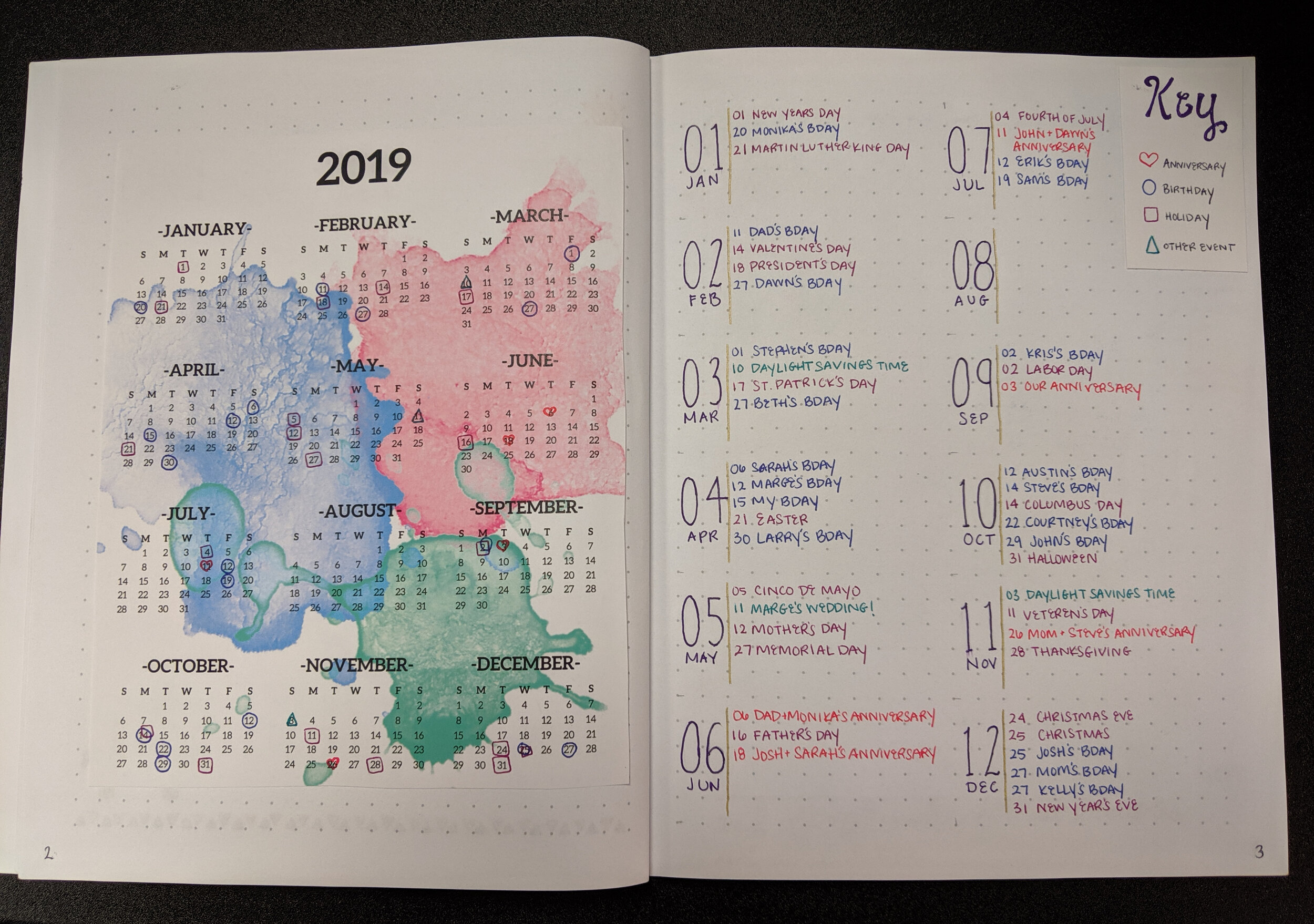
My 2019 Future Log/Full Year Spread
If you like some semblance of normalcy, you can start off with the future log first, which I do as a whole year at a glance calendar. Or not! Mine is on the second and third pages.
The rest is up to you and your needs. You can draw yourself a month calendar & weeks, print them out, brainstorm all over the page with your ideas, color code your characters for your writing...really, anything is possible! Kim Alvarez does a great job of going into depth with starting a bullet journal on her blog Tiny Ray of Sunshine, if you want a more detailed step-by-step guide and explanation.
What do you think? Is it worth trying out? If you are a fellow bullet journal enthusiast, what are your tips and tricks?
I’d love to hear your thoughts!
